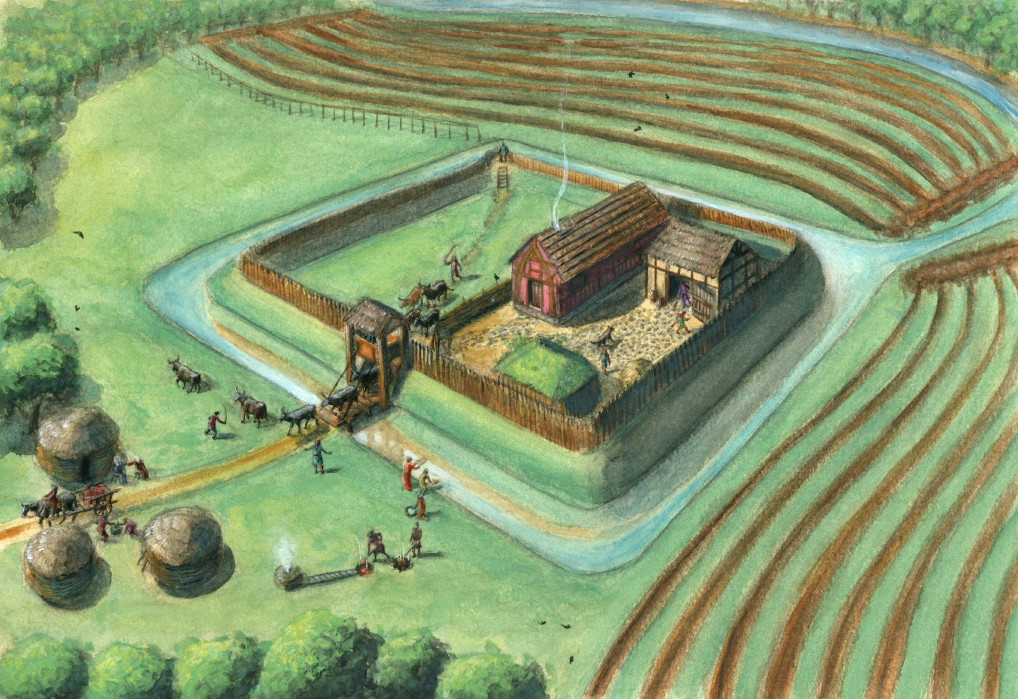
Right, so there's crop rotation so I think he's growing clover in some fields some of the time. But would the rest be all wheat? Wheat with some barley?
Are there specialized animal ranchers, or is this something all farmers take part in?
This question can be difficult to answer because medieval society was highly rural and localized and so sparsely populated. One manor could do some things a little differently than others and many decisions were up to the lord of the manor. But here's a brief overview of the manorial system that would have been found in Northern Europe in the high medieval era (roughly 1100-1300 AD).
The traditional village layout of the High Middle Ages in Northern Europe would have been the Manor. This website gives a good layout of it here
The three main crops that the time would have been wheat, oats, and legumes. With some fields growing barely or rye. And it would follow the ‘Three-field system’ of one part wheat, one part legumes, and one fallow. This method improved upon the Roman ‘two-field system’ as 2/3 of the land produces every year as opposed to only half. (The widespread crop failures in the early 14th century that came from the over planting of wheat and not properly rotating crops).
The land worked by most villagers was the lord's domain (or demesne). This is where the staple crops listed above would mainly have been grown. This is mainly because the cultivation of these crops requires tilling the land which was done by a work horse with a heavy moldboard plow. Because of the difficulty in setting up a till and turning the horse around, these tracts were very elongated as seen here. They were called furlongs as in "for long.”
Simple vegetables would have been grown in the yard of villagers' own cottages that looked something like this. Villagers would have also kept animals at their cottages. Often there would be a fence that divided the yard in half (half for animal raising, half for their own vegetables that would switch every year). This was also because farm animals, especially pigs and goats, are great at kind of tilling soil with their hoofprints. In the wintertime, villagers would often bring their animals into their cottage with them at night! (This era was before standardized lumber, what we think of as a traditional barn didn’t quite exist yet)
As for what to grow, they grew turnips, onions, radishes, carrots, garlic, leeks, beets, and various leafy greens and root vegetables. The local economy was very rural, probably something like a small town farmer's market: Everyone grew a little something and you just asked around to barter what you needed. "Hey, Thomas is cooking a stew and needs some onions, He gave us some leeks last week so let's give him some of ours." These manors are like small, closely-knit country towns where everyone “knows their neighbor.” Much of the food in this time would have been prepared and consumed communally
As for grazing grounds, most villagers would have had a common pasture where animals would be allowed to graze during the day. ... As for specialized animal ranchers, this one's harder to pin down. In England, the wool industry was beginning to really grow in the high medieval, so there would have been lords with their own flocks (not owned in common).
And with this society being so rural and decentralized, there was very little in the way of a "vocation." To answer your question, yeah, farming was something virtually every common person in most small manor would take part in. Medieval England is an agrarian sustenance economy. Even skilled free peasants (blacksmiths, bakers, millers, tanners, coopers, fletchers, etc.) who didn't work the fields had little operations of their own. Their wives and families would most likely had animals they tended and at least a small garden where vegetables were grown. An interesting take my old professor gave was that basically everyone was a farmer first, and some had a skill on the side to bring in extra income. These manorial societies were pretty much all devoted to the sustenance of the village. If you were a blacksmith, most of your work was related to producing farming equipment. If you made barrels (cooper), most of your work went into making food storage containers. If you were a brewer, most of your supply came from leftover crop yields, etc.
It's a very brief and general overview, but I hope it helps!