(This question goes for other ancient cultures as well, but I'm focusing on the Greeks and Romans because of their stated dedication to the perfection of human forms.)
[This] (https://mymodernmet.com/laocoon-and-his-sons-statue/#:~:text=Laoco%C3%B6n%20and%20His%20Sons%20is,Vatican%2C%20where%20it%20remains%20today) is a Greek sculpture called "Laocoön and His Sons" and dated sometime during the Hellenistic Period, c. 323 BCE - 31 CE.
Meanwhile, [this] (https://commons.wikimedia.org/wiki/File:Thueros_affresco.jpg) is a painting from the same time period (c. 2nd century BCE).
I understand that this is only one example amongst thousands, but why is there such a distinct difference in forms? Was there a challenge extant with two dimensions that wasn't present in three?
Edit: Thank you so much for the awards, kind strangers!
The Greeks and Romans themselves saw no distinction between the accomplishments of painting and those of sculpture. The greatest painters, like the most eminent sculptors, were famed for their ability to capture life in every ineffable detail.
Sometime around the beginning of the fourth century BC, the great Greek painters Zeuxis and Parrhasius had an artistic contest. As Pliny tells it:
"Zeuxis produced so lifelike a representation of grapes that birds flew up to the stage building where it was hung. Then Parrhasius produced such a successful image of a curtain that Zeuxis, puffed up with pride about his birds, asked the curtain to be drawn aside and the painting revealed. When he realized his mistake...he conceded the prize, saying that while he had deceived birds, Parrhasius had deceived an artist." (35.65)
There are many other anecdotes about the astonishing level of verisimilitude achieved by other great artists (Apelles and Protogenes, for example, had a similar contest). For our purposes, the important point is this: the Greeks and Romans never viewed painting as an inferior medium, and attributed almost photographic realism to the greatest painted masterpieces.
So: why do the ancient paintings we possess seem inferior to the greatest classical sculptures? To an extent, the problem is often an apparent failure to use scientific perspective, making the scenes and figures appear flat and cartoonish. Sometimes, as in vase painting, this is just a consequence of convention. In frescoes, it tends to be a failure of the artist, not his technique. When they wanted to, the Greeks and (especially) the Romans were perfectly capable of creating impressively three-dimensional scenes. Roman Second Style paintings, for example, often evoke whole monumental cityscapes.
The most basic reason for the perceived inadequacies of ancient painting, however, is the simple fact that all of the masterpieces have vanished. Thanks to the Roman practice of producing copies of Greek sculptures, we have at least a general idea of the appearance and accomplishment of the greatest accomplishments in that medium. But with the exception of the frescoes of Pompeii and Herculaneum (and, to a lesser extent, mosaic copies scattered across the Roman world), ancient painting is lost to us.
Most Pompeiian frescoes are not masterpieces. They were never meant to be. They were the functional equivalent of wallpaper, rendered rapidly by teams of painters working from pattern books. The same is true of most tomb paintings, such as the example given by the OP. But when the artists were exceptionally talented or exceptionally careful, we can still catch glimpses of the lost masterpieces of ancient painting. Take, for example, the famous frescoes of the Vergina tomb, or the Alexander mosaic from Pompeii (a reproduction of a lost painting by the great Apelles). At least some classical artists could work wonders in two dimensions.
Hi, there's plenty to be said on this but while you wait for a newer answer, you may be interested in this section of our FAQ on "realism" in visual arts. It makes a couple points to consider:
firstly, art in a given culture has meaning that goes beyond "realism" as a goal -- consider Egyptian tomb paintings as an example of art that's stylized, or paintings/illustrations in medieval manuscripts that depicts people in certain ways for religious or spiritual reasons;
second, the "quality" of artists is not universally distributed -- the sculptures from the ancient world which are extant and depicted widely comport to the ideal art forms of the Renaissance and beyond, when perspective and "realism" in visual arts are highly prized. The person who sculpted the statue of Laocoön is very much not likely to be the same person who painted the fresco you linked, and picking examples that are widely separated don't tell us a lot about realism -- the Fayyum mummy portraits are realistic by our standards, while other attempts to paint or repair paintings by a well-meaning gran can go pretty badly wrong.
Repost of an earlier answer...
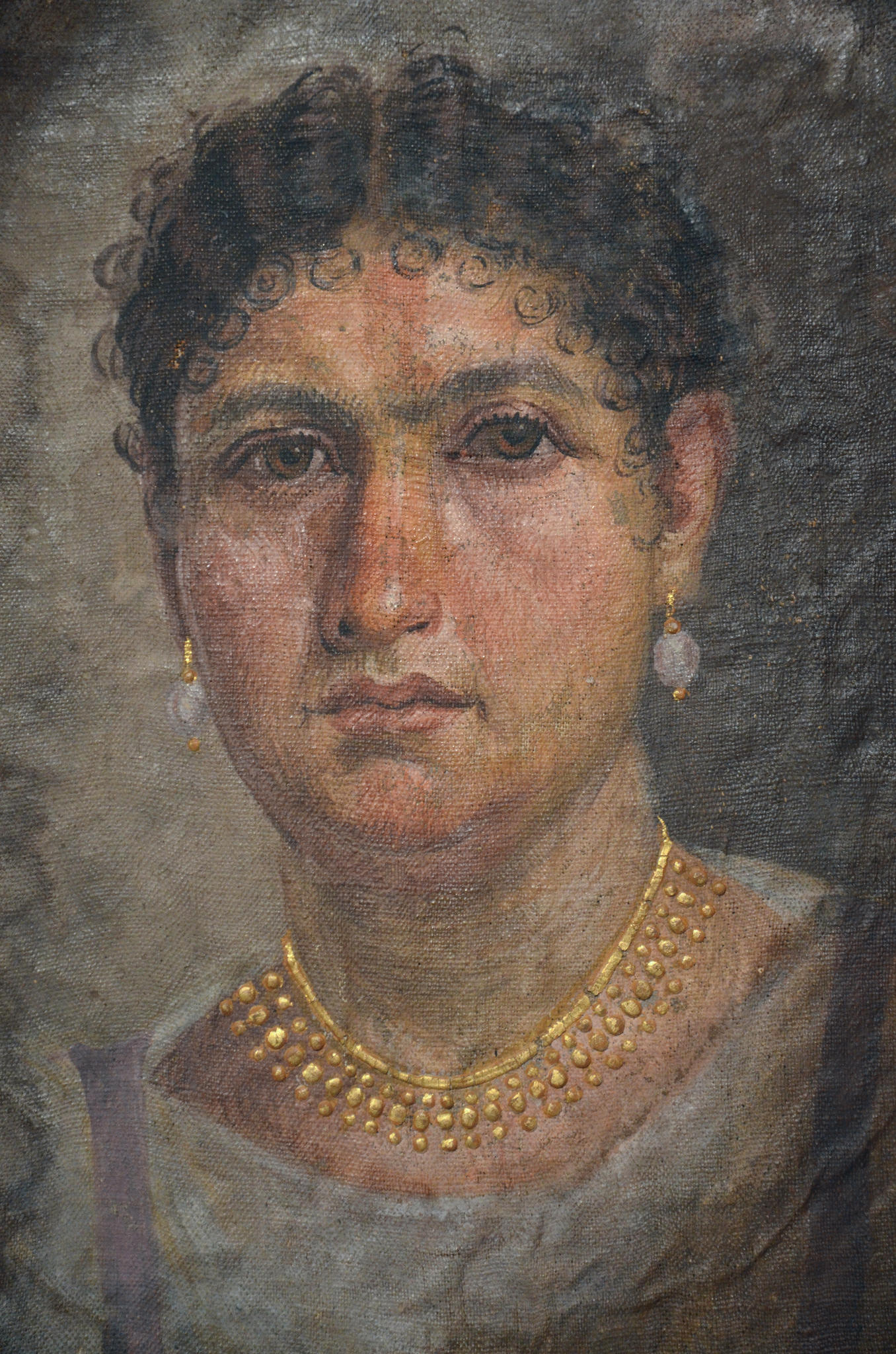
In the popular imagination there's a gulf between Roman realism in 3D and 2D art, but Roman art history shows many examples of realism in both mosaics and paintings. Shading was also used in those two forms, and realism was put into woven and gold-glass objects as well. Most painted realism comes from domestic frescoes and Romano-Egyptian mummy portraits. Many of these are shockingly life-like, such as this woman at the Antikensammlung in Berlin, and I'll link to a few of the hundreds. Mosaics can have as much expressive realism, my favorite is Oceanus at the Bardo museum, if you aren't satisfied here's a another shot with zoom.
Why does wikipedia and most basic textbooks not show these expressive pieces of art when talking about Roman paintings and mosaics? Well, that is another question all together.
First, Roman frescoes with exquisite shading: My two top picks would be this panel from the Villa of the Mysteries in Pompeii, via wikimedia, and a maenad from the Casa del Criptoportico also at Pompeii, via wikimedia.
But Italian frescoes pale in comparison to the hauntingly expressive realism of Romano-Egyptian mummy portraits, my favorite and perhaps the most unique is “Aline” from Hawara at the Neues museum. If I was shown this man from Hawara, now at the Ny Carlsberg Glyptotek with no context, I'd think it was 16th century.
It's debatable whether these are exact copies of individuals or if the artists took great liberties with the deceased's visage, but regardless their skill in rendering expressions in the human face is par none, see a woman from Hawara, at the Manchester museum, or an older man from er-Rubayat, at the Neues museum, or a woman, at the Altes museum, or a man from Akhmin at the Met NYC, or a man from er-Rubayat, at the Altes museum. This guy is giving you the "stern father" glare from 1800 years ago, a man from Abusir el Maleq, at the Egyptian museum Cairo.
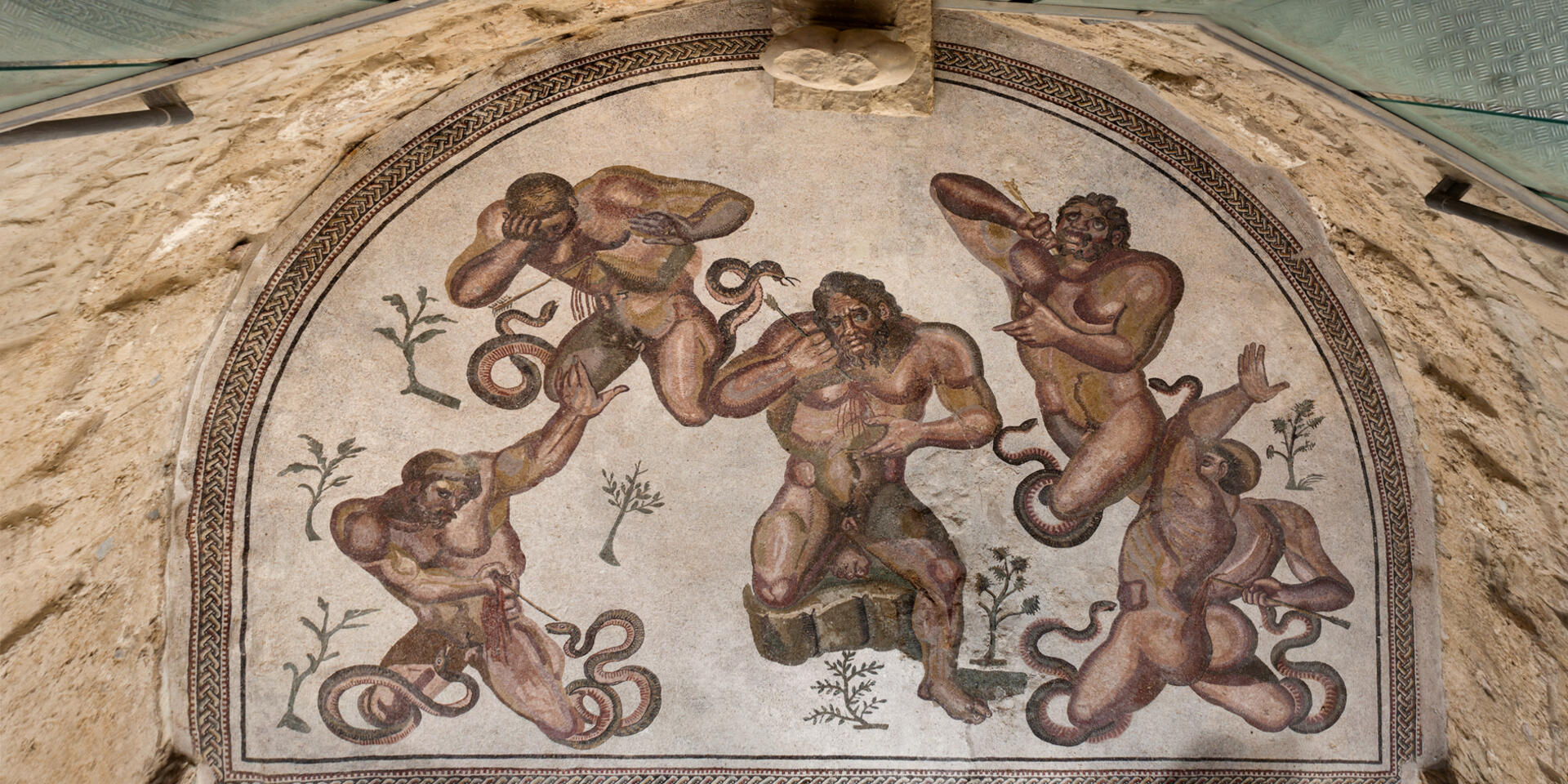
Mosaic artists attempted a similar level of realism, most spectacularly in that Oceanus mosaic but it was not always so grandiose such as a woman from the cubiculum of a house at Pompeii, at the Museum of Capodimonte. While mummy portrait realism wasn't always achieved, other mosaic artists could try to be both grandiose and realistic, such as the Scene of the Giants, at the Villa Romana del Casale in Sicily.
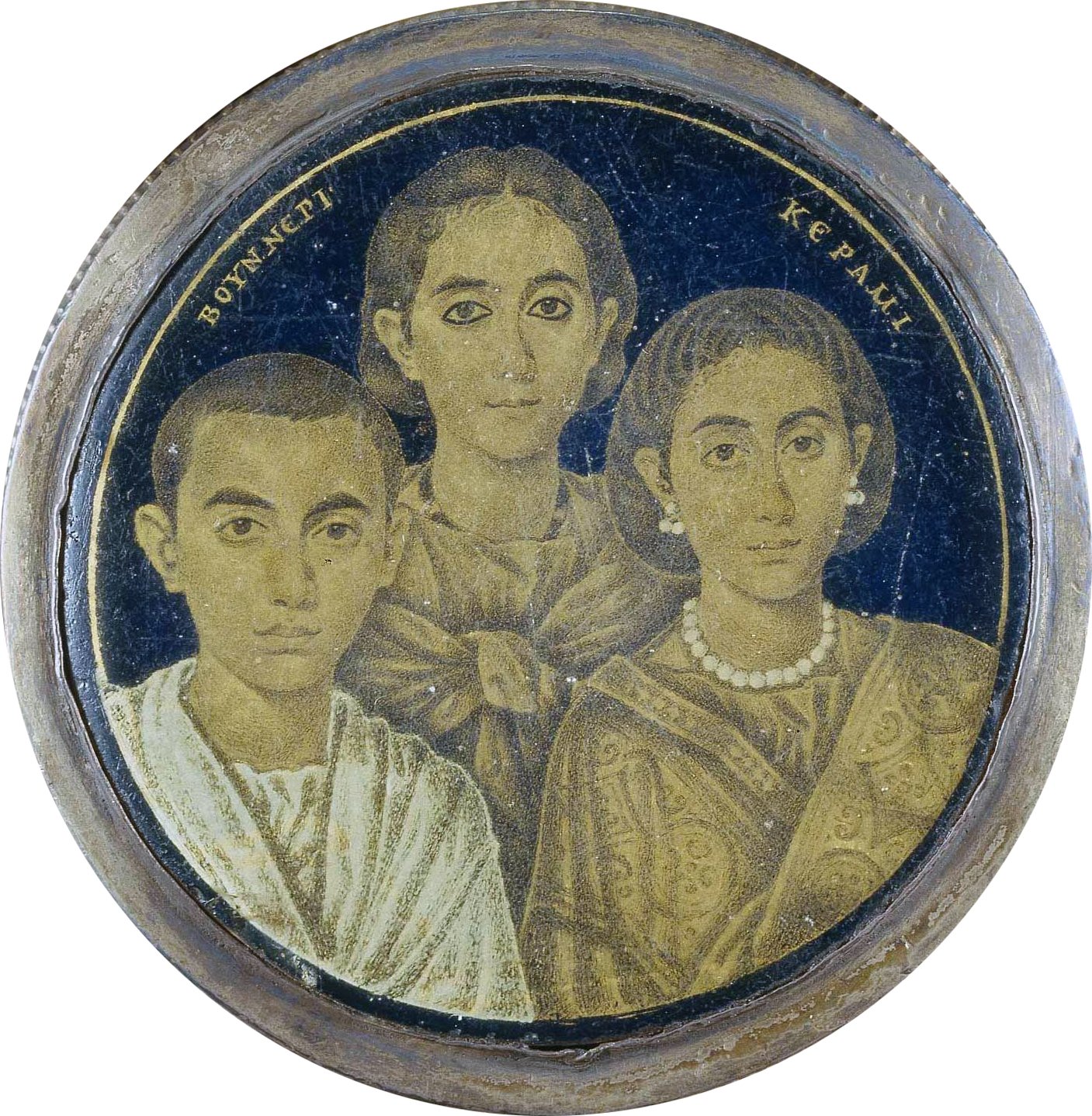
Aside painting and mosaics, we also see a great deal of realism in scratched art such as gold-glass portraits, such as The Brescia Medallion, made in Alexandria now at the Museum of Santa Giulia and a portrait of a man at the Arezzo Archaeological Museum. Incredibly, artists even attempted realism in glass blowing through creating fused glass bars which when cut into slices revealed faces, such as this Roman or Romano-Egyptian mosaic inlay, ca. 100 BCE to 100 CE, at the Corning Museum of Glass.
Now we shouldn't forget, Hellenistic period Greeks used realism in woven textiles such as The Sampul Tapestry (which had quite a life after its creation). Later Romans continued this tradition, in fact this Coptic period wall hanging showing Dionysian figures from Antinoopolis, at the Met NYC is dated to late 6th to early 7th century which is about 600 years after the Sampul tapestry.
Lastly, just at the time when most people imagine the Roman empire collapsing and "high art ending," we see Christian Romans continuing realism in mosaic art and in my humble opinion it rivals or exceeds earlier Roman attempts, such as Jesus and Pope Felix I in the 6th century Christ Triumphant apse mosaic in the basilica of Saints Cosmo and Damiano in Rome.
Although a word of caution, while there are many examples of great Fayyum paintings and gold glass portraits in museums, some are forgeries made for the art market while others include such heavy antique "restoration" that they are de-facto forgeries.