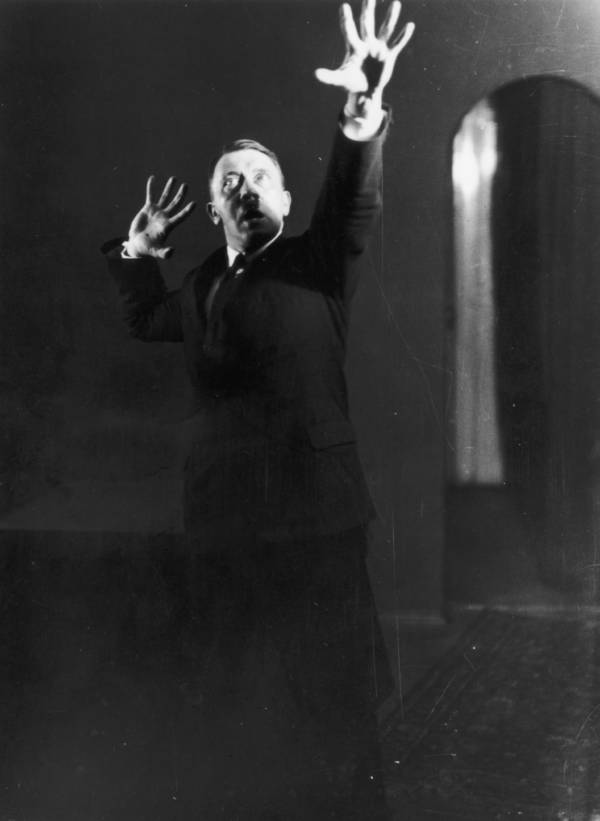
Title. We've all seen it before: footage of Hitler speaking at various rallies and party events. He's animated, raving mad, maniacal, shouting, loud, and generally sort of "crazy" looking. I thought "surely this is taken out of context. there's no way his entire presentation could be this crazy." So I started digging around and seeking out various speeches and memoirs... As far as I can tell, Hitler only ever had one speed during his speeches: "raving mad man."
So what am I missing here? Nobody in modern American antiquity would consider Hitler's presentation compelling. Typically, a charismatic and dynamic speaker knows when to "dial it up" and when to be more subtle and reserved. Yet everybody seems to unanimously agree that Hitler was a "charismatic and brilliant speaker." Is this a difference of culture? Is violently flailing about, fist shaking, and shouting more acceptable in German culture?
I was shocked to learn that Hitler even went so far as to hire a drama/acting "coach" to improve his presentation. Look at this: https://allthatsinteresting.com/wordpress/wp-content/uploads/2017/10/looking-scared.jpg
As far as I can tell, Hitler only ever had one speed during his speeches: "raving mad man."
During Hitler's up-and-coming years with the NSDAP, from 1925 to 1933, the general public certainly had mixed opinions on him. It is very true that some Germans who met him were almost instantaneously struck by his charisma. Of course, these persons were already predisposed to the core NSDAP beliefs. Others, both Germans and foreign journalists, thought of him as a laughing stock and a clown. The Weimar Republic was trying at being a modern, industrialized, liberal European nation; whereas Hitler on any given day might be seen in either military dress (not totally unusual for Great War veterans) or lederhosen (a little unusual outside of folk events; akin to an American unironically wearing something like a Revolutionary War uniform and expecting to be taken seriously).
Nobody in modern American antiquity would consider Hitler's presentation compelling.
Ah, but Americans did find him more than compelling, both before and after the war. As late as February 1939 National Socialism was popular in America. Many Americans were German immigrants or their direct descendants; the Madison Square Garden rally was organized by the German American Bund, which promoted National Socialism as patriotic and pro-American. The same rhetoric that appealed to struggling German nationals (international Jewish finance conspiracy, fear of the growing communist movement, and a restoration of hardcore national pride) appealed to Americans. Some 20,000 people attended this event and by all accounts it was little different than the mass rallies at Nuremberg, only with more American flags. National Socialism only became unpopular in the United States in 1941 when the US went to war.
We also have the post-war example of George Lincoln Rockwell. His American Nazi Party organization drew less of a crowd, and had at its height only a few hundred members; but his own public presence and organizing wielded a disproportionate influence.
Now as for the man Hitler himself and how and why he learned to speak that way: any public speaker is not judged on his content or manner, but in how they appeal to their audience. Hitler was without a doubt groomed for the task of appealing to popular German sentiment. He did possess some natural talent in speaking, which led to his prominence in the NSDAP in the first place. That being said, he did not become Fuehrer over night; Ernst Rohm was a leading contender for party leadership (which is why of course he was purged in 1934.) and Hitler was overshadowed by original DAP founding party members like Anton Drexler, Dietrich Eckart, Gottfried Feder, Karl Harrer. Rudolf Hess also overshadowed Hitler for some time, but would later become a leading Nazi during the Reich under Hitler.
Hitler's first real moment of glory came 16 October 1919, speaking to a crowd of just over 100 people as a representative of what was then simply called 'Deutsche Arbeiter Partei' (DAP). Hitler himself credits this moment as when he realized he could fire up a crowd; it would not be long before Drexler began grooming Hitler, teaching him all he could, and mentoring him in politics. Why did Drexler and the other Party leadership choose him? Was it just because he could speak? Certainly a driving reason, but not the only. Until Hitler, the Party had largely been composed of intellectuals and bourgeois elements (despite the fact it called itself the German Workers Party). Hitler was certainly not an intellectual, and was arguably not bourgeois. Before politics, Hitler had no real career or success to speak of. But what Hitler did understand was populism and the heart of what the greater German people at the time desired.
In 1920, Hitler was put in charge of the Party's propaganda machine, and it was here that he really developed his public persona. Virtually none of the rhetoric belonged to Hitler originally; Drexler drew up the twenty five point plan of the Party, and he and other German intellectuals were the primary driving sources behind the propaganda. Hitler spoke over 30 times in this year alone and despite the relatively complex official Party platform, Hitler's speaking points were rather simple. He always attacked the 'Jewish Question'; this was already in vogue in Europe, and while Hitler certainly believed his own rhetoric, he also knew that inflaming this rhetoric to the masses would earn many willing ears willing to listen to whatever else the Party had to say. His other primary talking point was the Treaty of Versailles, also wildly unpopular among the German people.
As for his mannerisms and method of speaking, it really comes down to overcompensation. Germany was humiliated after the loss of the Great War and Hitler felt this humiliation personally. His fiery manner and driving will to instill national pride and character into his audience was the opposite of what the masses felt in a post-Great-War, economically-failing Germany.
Thats really what it all comes down to, in the end. Just populism.
Bibliography / Further Reading
Langer, W. C., Langer, W. L., Waite, R. G. L., & United States. (1972). The Mind of Adolf Hitler: The Secret Wartime Report.
Heiden, K., Manheim, R., Guterman, N., & Heiden, K. (1944). Der Fuehrer: Hitler's rise to power.
A note on these sources. The Mind of Adolf Hitler was originally prepared by the OSS and remained classified until the 1970s. It was a complete psychological profile of Hitler, released only for Allied intelligence, and is notable in that it successfully predicts death by suicide. The mass-consumption version I cited is essential reading if you want a very thorough understanding of the answers to your questions. Der Fuehrer was prepared by a civilian journalist who attended the University of Munich and fled the Reich to the US, where he published the above. Both are contemporary understandings of Hitler and the NSDAP movement; they still hold up today.
While we await other responses, here is a thread of someone asking almost the same question and /u/AbandoningAll 's thoughtful analysis in response.
There's been some great answers, including u/Cyberpunkapostle in this thread and an archived answer by u/AbandoningAll, and probably others, since this is a crucial question.
Here's a slightly different view on it:
I find it helpful, when teaching about Hitler's rhetorical talents in relationship to the rise of Nazism, to emphasize how Hitler had very different "audiences" at very different moments... and proved capable of adapting to these changes-in-audience as his popularity expanded. But what 'worked' at an early stage would not necessary be the same thing that 'worked' later on...
For instance, in 1919-1920, when Hitler first was 'noticed' in Munich, his audience was a fairly small, fringe group of angry, antisemitic conspiracy theorists on the radical right. (for comparison--think of the KKK or American Neo-Nazis in the 1980s.) Among this small group, Hitler stood out... mostly because many of the other 'speakers' were pompous, self-righteous, wordy, and recursively self-referential to the point of incomprehensibility (as angry, racist fringe-conspiracy-theorists are prone to be). Hitler, on the other hand, had a focused clarity and dramatic oratorical style, using short, pithy phrases, and speaking in absolutes. This was unusual... or rather, unusual for this group. It was common in other groups, such as socialist circles, as socialists and communists relied heavily on powerful, focused, dramatic public speaking, and SPD and KPD politicians honed their speaking from early in their careers. But on the fringe/conspiratorial right wing in Bavaria, these oratorical skills were NOT so common. So, in this group, Hitler stood out for his rhetorical skills--NOT his ideas. And this got him noticed.
Once Hitler became a "star" on the political fringes, he entered into more mainstream Munich society as a radical... and thus, as a form of entertainment. When you think about his audiences at the Bürgerbräukeller in 1923, or at the Hofbrauhaus in 1926 (after he became famous for his failed coup attempt in '23), these people were coming in part to hear him for his radicalism, almost as a form of entertainment. It's worth remembering that before the late '20s, a great deal of Hitler's speaking was in beer halls... in front of audiences who were drunk --often very, very drunk--who were having an evening out for a bit of beer & vitriol. Here, Hitler's radicalism set him apart. His snideness, even viciousness, also set him apart. Hitler was saying things that--in THIS group, which included Munich sophisticates--were just not heard in polite company. (for a comparison, think of the speakers who come to universities to say provocative things...and draw large audiences who come for the provocation. Or the radio 'shock jocks' who thrive on breaking verbal taboos.)
This radicalism and even nastiness was expressed most often as antisemitism (The Jews are To Blame). Now, in the fringe circles that Hitler originated in, nasty antisemitism was so common as to be almost passé ... but in these new wider circles, which included businessmen and high society, it was pretty titillating.
2b) Nonetheless, as others commenters have pointed out, there were real limits to radicalism and/or vituperativeness in attracting a broad audience. Hitler was well known nationally by 1928, but still got under 3% of the national vote (which is still just the crazy vote.)
Still, Hitler demonstrated even in the mid-20s that his radicalism was "flexible"; in 1926, for instance, when Hitler spoke to the Hamburg Hamburg Nationalklub (a socially-exclusive club of high-ranking officers and powerful businessmen) at the elegant Hotel Atlantic, Hitler did not mention "the Jews" once. Instead, Hitler switched focus entirely on with the threat of Marxism--a threat which 'spoke' more directly to his audience of business leaders.
After the disastrous (for the Nazis) 1928 elections, Hitler steered his own oratory and the focus of the Nazi party away from antisemitism, towards anti-marxism. The main "target" (or audience) for Hitler in this pivot was the nationalist right wing across Germany. This was 30-40% of the electorate (as Peter Fritzsche has shown in Germans into Nazis) that was potentially up-for-grabs, because of the shocking incompetence of the other right-wing parties, namely the DNVP and DVP. Hitler's anti-socialist/anti-marxist message was hardly unique among this nation-wide right wing, but--as Fritzsche argues--Hitler's populist, 'social' message that he attached to it was unique. Call it an anti-socialist populism inflected with a socially-minded rhetoric, which in this sphere (i.e. the nationalistic right wing), was provocative. (It would have been tame in the left wing circles.) Hitler's radicalism was also a draw: Hitler was more absolute in his attacks on the Treaty of Versailles (demanding immediate German rearmament, etc.), for instance, which made his 'competitors' in the DVP and DNVP look weak and vacillating by comparison.
(Hugenberg, head of the DNVP in the early '30s, mistakenly thought Hitler's successes in 1929 and 1930 came from his radical antisemitism, and so tried to get the DNVP to imitate it, only to see the collapse of DNVP support as former DNVPers all fled to the "real thing"--the Nazis. Hitler, meanwhile, knew very well that his successes came by tamping down the antisemitism and ramping up the anti-socialism and nationalism.
After the Nazi "breakthrough" in the 1930 elections, and in the face of ongoing economic collapse and governmental paralysis, Hitler again shifted tack, and rhetorically now presented himself as Germany's "savior"... though this meant, in practice, making full use of his new status... as a celebrity. He was increasingly known for being known. He was The Latest... Hitler began speaking to stadiums with huge audiences and highly-staged performances, and going to hear Hitler speak was a bit like going to a pop concert: the audience was predisposed to "see" his greatness... and project it onto him even if they didn't see it.
Meanwhile, Hitler kept double-messaging and coded "dog-whistles" in his 1930s speeches: even as he presented himself to ordinary Germans as a moral messiah--yes, moral!--that would return all Germans to greatness, Hitler confirmed to his long-time loyal (and racist) followers that he was still at heart an antisemite who would "deal" with the Jewish "problem." Claudia Koonz's too-often-overlooked book The Nazi Conscience is really great here, where her first chapter spells out this double-messaging in detail.
TLDR: In short, not only did Hitler have different "messages" for different audiences at different stages, but different stylistic elements in Hitler's speechmaking appealed in different ways to those different audiences. For the cranks in the early years, it was Hitlers's clarity and focus. For the bored Munich literati, it was the tittillating radicalism and even savagery of his words (and of his racism). For the nationwide right-wing in 1929-30, it was his anti-socialism, plus the socially-minded populism... the latter of which was actually showcased by Hitler's speaking-style, which was more populist. And for "Germany" as a whole, his dramatic pretensions and megalomania dovetailed perfectly (like that of a modern pop-star/diva) with the audience's expectations, turning him into a true celebrity and projecting onto him the role of savior.
sources:
In addition to Fritzsche and Koonz, mentioned above, the way Hitler interacted with different audiences at different stages becomes clear from Ian Kershaw's biography of Hitler (Hubris). To a lesser degree, it's also glimpsed in Evans, Coming of the Third Reich.
Can I add to this question, but somewhat orthogonal to it?
However skilled Hitler was judged to be as an orator, incredible or poor, what was the relative contribution towards his capture of power between: (a) the circumstances which Germany found itself and (b) Hitler's oratory prowess?
I know the stereotype that OP's question presents, but find it hard to imagine that there would have been any traction were Germany in a booming economy?
Welcome to /r/AskHistorians. Please Read Our Rules before you comment in this community. Understand that rule breaking comments get removed.
#Please consider Clicking Here for RemindMeBot as it takes time for an answer to be written.
We thank you for your interest in this question, and your patience in waiting for an in-depth and comprehensive answer to show up. In addition to RemindMeBot, consider using our Browser Extension, or getting the Weekly Roundup. In the meantime our Twitter, Facebook, and Sunday Digest feature excellent content that has already been written!
I am not a bot, and this action was performed manually because of an issue with Automoderator