I posted this question a couple of weeks ago but never received an answer. If I'm doing something wrong or breaking the rules of the sub it is unknowingly but I will gladly edit however needed or instructed by a moderator. I'm very interested in this question. Thank you.
The Stanford study from 2014 indicates that America is actually an oligarchy.
https://www.youtube.com/watch?v=5tu32CCA_Ig
It states that, overwhelmingly, when the wealthy support or oppose a policy their wishes are fulfilled a much higher percentage of the time than when the middle class opposes/supports a policy. There have been critiques of this study since it was made public but generally even the critiques agree that there is a discrepancy, generally only disagreeing on the egregiousness of the bias rather than its existence. The historical data analyzed in the study suggests this discrepancy started well before policies like citizens United were passed which is one of the most cited Supreme Court decisions pertaining to why the wealthy have disproportionate influence in policy-making.
My question then is, can someone identify for me a single or even handful of important policy decisions that coincide with and are the probable cause of this discrepancy if it is in fact not due to the citizens united decision? Thanks in advance.
That would probably be 1968-1972, with the new deal coalition falling apart, and a threat to the dominant Keynesian economics of the time. Milton Friedman and the rest of the Chicago school, sought to patch up the failed parts of (classical) liberal economics and reintroduce it as Neoliberalism. Broadly, Keynesian Economics was "Demand-Side" oriented and focused on the needs of consumers and how to meet them. (Neo) Liberalism on the other hand is 'Supply-Side" oriented, and focuses on producers and how to let them produce as efficiently as possible, with the assumption "If you build it, they will buy it". Its very closely associated with so-called "Trickle-down Economics"
Neoliberalism is traditionally thought of as having gone into full-swing in the west with the election of Ronald Reagan and Margaret Thatcher, in the US and UK respectively. In the states, the Democrats had gone through a hellish decade or two, only holding the Presidency during Carter's single (arguably disastrous) term, not to mention the absolutely catastrophic campaigns of McGovern, Mondale, and Dukakis, who together managed to carry a combined 12 states total across their 3 elections. Come the 1992 election, a significant portion of the Democratic Party adopt a "If you can't beat em, Join em" attitude, at economically/fiscally. Thus is born the "Third Wave" Democrats, who are culturally progressive, but adopt many of the same neoliberal economic policies as the Republican party.
At this point, 1992, it becomes the standard in the two party system that no matter which major party you vote for, you're going to get an economic policy that based on the same ideology: Neoliberalism. And as said before, this particular system focuses much more on "What can we do to keep the producers at the top as happy as possible, so that the rest will fall in place" (The answer usually being deregulation). There's an attitude that privatization solves everything, because public enterprises will always get bogged down in beurocratic inefficiency. and Labor? Forget about it, Reagan's toppling of the ATC union set off a domino chain reaction that decimated the power of unions, to the point where they are practically non existent today outside of niche industries.
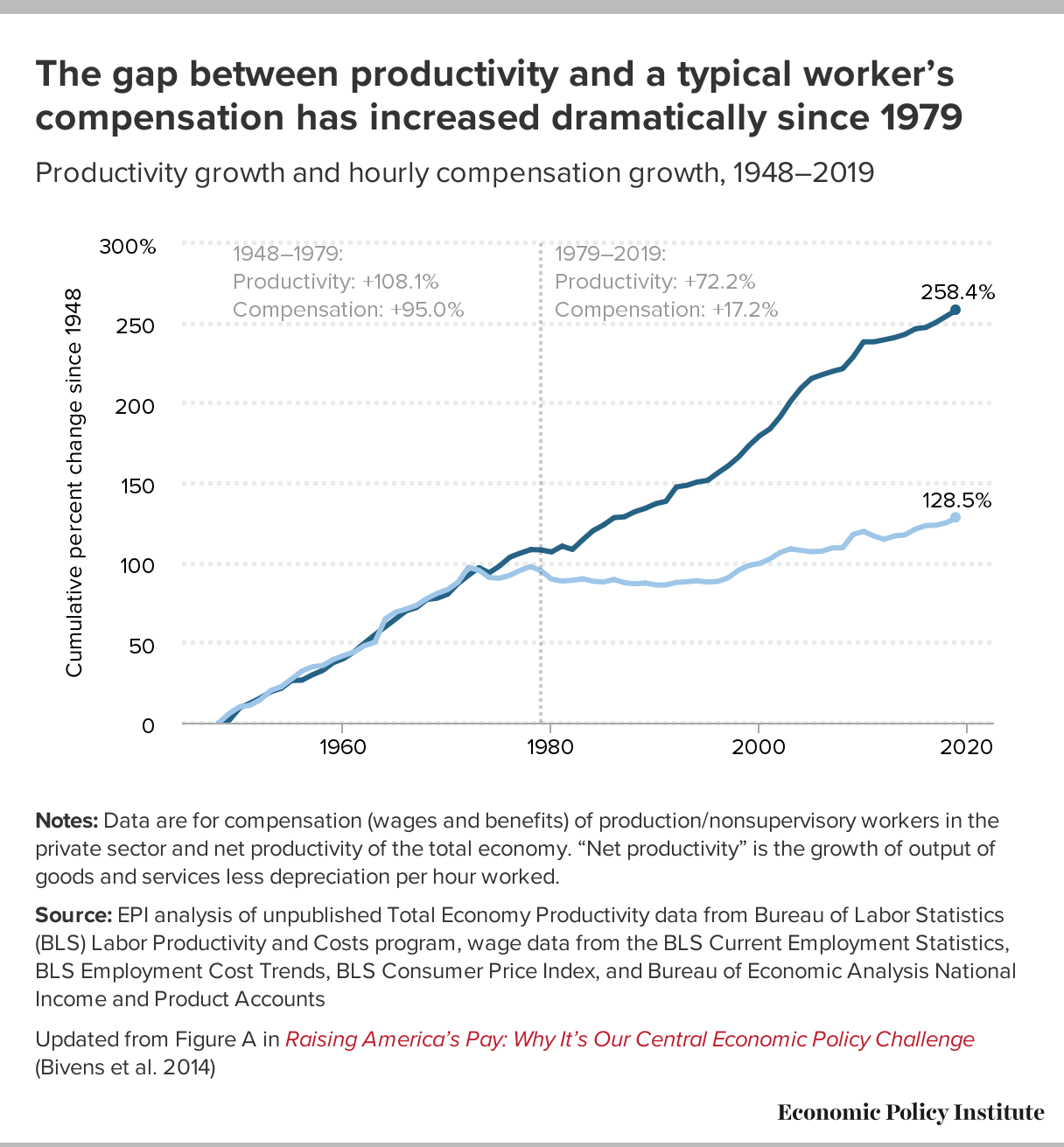
This graph: https://files.epi.org/charts/img/172791-21692.png I think explains it most succinctly in terms of benefits for the average everyday worker, vs benefits for the top 1% producing class that employs those workers. There was an opportunity for the trend to be disrupted up until '92 when the Third Way Democrats took sway, but arguably with the collapse of the New Deal coalition the Democrats were already going down that route, with Carter actually implementing some of the first bits of Neoliberal policy (Deregulation of Truck Drivers, Airlines, and several other industries)
And one last bit: I'm be succinct here, because I'm really not that familiar with how things happened in the UK, but a parallel to Third Way Democrats happened on the other side of ocean as well. So much so, that when Margaret Thatcher was asked what her proudest accomplishment was, she responded with "Tony Blair and New Labour. We forced our opponents to change their minds." (Conor Burns, April 11, 2008) Blair's Labour Party was defanged of much of its leftist-leaning positions, and adopted many neoliberal-aligned views)
I'm re-reading your question right now and not exactly sure this is what your were asking, its kind of ambigious. I'm assuming you're wondering how something like the $2000 checks or medicare for all can get ignored even when an overwhelming majority support them and need them, and its only a very few (millionaires and billionaires) who would be set back by it passing.