I've read that princesses would only be able to attend balls after their debutante, so how did they celebrate their birthdays? Did they just have a dinner with a family? What if they wanna invite their friends? Did they just eat a dinner and that's it? Or did they have unofficial balls?
Sorry if my question is childish/immature.
I think this is a lovely question and not immature at all. If you're young, or only recently became interested in history, then congrats to you! Curiosity is the basis of wisdom.
In Medieval Europe, there were a lot of feast and festivities. The Middle Ages were a deeply religious time and many of the feasts were tied to religious holidays. To see an example of all the different feasts, Saint's name days and holy days, you can look at this illustrated medieval manuscript. The word "feast" occurs 29 times.
We know sometimes birthdays were celebrated, mostly King's birthdays. The "Squire's Tale", one of Chaucer's Canterbury Tales (14th century), opens as King Cambuskan proclaims a feast to celebrate his birthday. We also have a diary note of King Richard III about his birthday.
Sometimes princesses were celebrated, but the examples we have are of betrothals or marriages. We know of a celebration for the marriage of Louis XII of France and Anne of Brittany. This was recorded in this beautiful tapestry.
We also know there was a big party for the marriage of Amadeus VIII and Mary of Burgundy. In fact, their chef wrote a cookbook and instruction on throwing a big feast, a book that became one of the most important sources on Medieval cooking and feasting. This book is called Du fait de cuisine, by chef Chiquart Amiczo, written in 1420.
I have not found evidence of a princess' birthday party. There are multiple possible reasons for this: it is possible that birthday parties of princesses were not celebrated, women being seen as less important than men (and a princess as less important than a king). It could also be that these parties existed, but were never recorded. The Middle Ages were a highly oral society, not a lot was written down. Most writing concerned religious matters. There were very little diaries being kept and especially not by women, which makes it harder to find out things about their daily lives.
We know that in ancient Rome, birthdays were celebrated. Weather birthdays were celebrated in the Middle Ages, by whom and on what scale, we do not know.
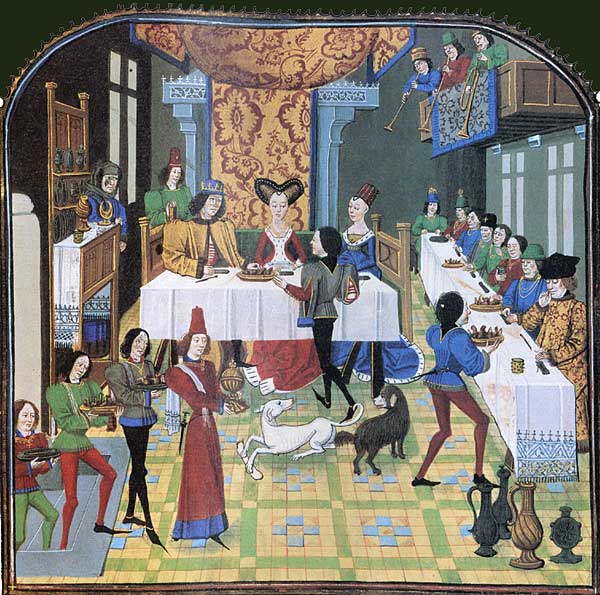
So what did a Medieval party look like? Actually quite a lot like modern parties (except for the outfits). There were large platters of food, impressive and decadent. There was drink being poured from large bottles or carafes. There was music (live, of course.) A lot of people around a large table sharing platters. Animals running around in a frenzy. Everyone wears their best suit.
At the wedding party of King Henry in 1404, cygnet, bittern, woodcock, plover and snipe were served, alongside suckling pigs, rabbit, brawn, venison, salmon, plaice, lamprey, crayfish and ‘porpoise in furmenty’. Pastries, tarts and jellies also appeared in almost every course. At Christmas 1251, Henry III and his guests were served 830 red, fallow and roe deer, 200 wild boar, 1,300 hares, 385 young pigeons (squabs) and 115 cranes; and that was merely the wild game. For the knighting of Edward II in 1306, the cattle required numbered 400 oxen, 800 sheep, 400 pigs and 40 boars.
Here are some illustrations of Medieval parties:
https://cdn.historycollection.com/wp-content/uploads/2018/04/15th_century_French_banqueting.jpg
From a manuscript of Olivier de Castille and Artus d’Algarbe
Source: History Extra magazine May 2017
A feast of the Duc de Berry: painted around 1410
https://julianharrison.typepad.com/.a/6a013488b55a86970c022ad3659666200c-500wi
source: http://www.bl.uk/manuscripts/Viewer.aspx?ref=royal_ms_14_e_iv_f244v
15th century medieval feast, attributed to the Master of the Dark Eyes – British Library MS Harley 2838 f.45
https://i.pinimg.com/originals/b5/00/37/b50037f8a6e09193218135e77773e7cd.jpg
Mid 15th-century diners sit down to an elaborate meal in this illustration from an anonymous artist. (From Wikimedia commons)
I like this one especially because an entire peacock is served. The peacock would be cooked and then the feathers are replaced, to serve something truly spectacular. As you can see, a lot of attention was paid to beautiful and lavish dishes.
Side note: there is a book dating from the 11th century about party crashing: https://www.medievalists.net/2013/06/how-to-be-a-party-crasher-in-the-middle-ages/