I had to skim through some of the game's weapons on the internet, and I was not disappointed in seeing that roughly 90% of them are (sometimes simultaneously) anachronistic, malfunctional, impossible to use or plainly false.
Starting with the anachronistic ones, the numerous flails found in the game. Apart from the ongoing debate on this weapon's historical existence in the first place, it's most likely a mid XIII-early XIV century weapon possibly fashioned from agricultural tools used to separate wheat from the stems, as shown here in this XIII century miniature used in this book's cover (the Italian 2014 edition of Karl Gunnar Persson's book on economic history). It pops up in Paulus Hector Mair's (1517-1579) treatise on martial arts Opus Amplissimus de Arte Athletica, from possibly 1540-1550, in this illustration here. They are most likely false if not in their aspect, in their time period.
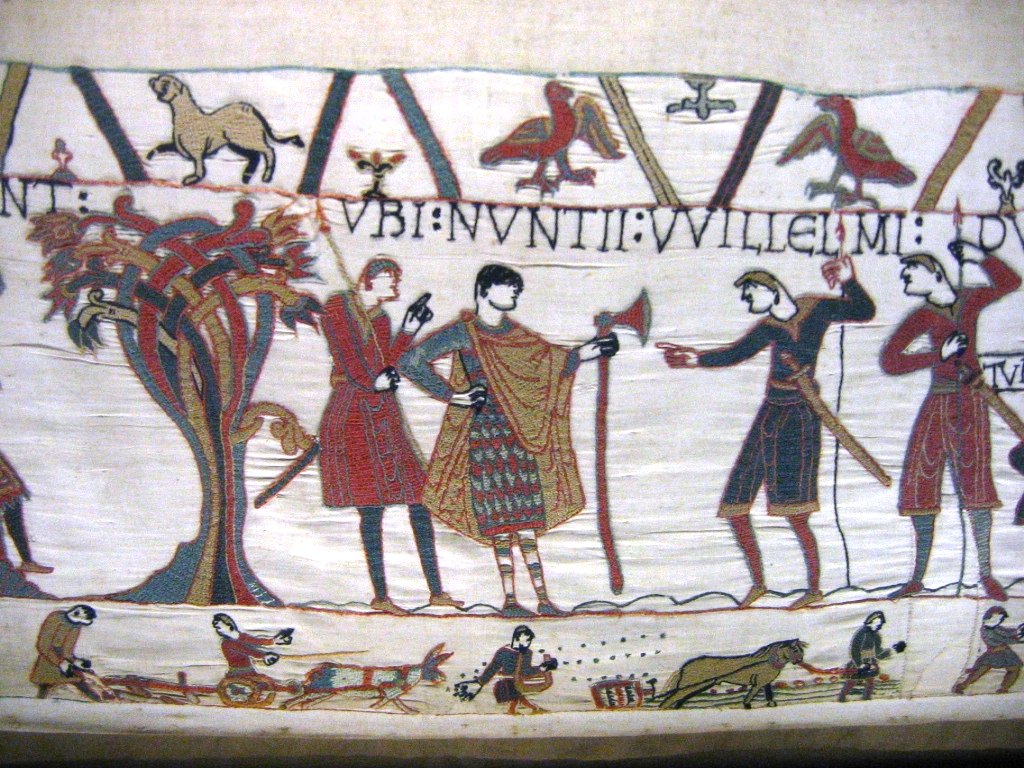
A very similar discussion stands for the hammers found in game. They all resemble Thor's hammer as portraited in Marvel movies, which would be fine for godlike being but totally unusable for a mortal, as the hammer's head would weigh in the region of 30 kg (or 70 lbs.), also being wrong in the construction as the haft and handle are comically short in comparison with the massive striking head. Early Medieval maces are speculated to have been similar to later, XI-XII century examples, like this reproduction of a Norman mace from 1100s. However, the Bayeux Tapestry shows duke William's brother Odo wielding what looks like a crude mace (with the inscription overhead reading "baculum", which can usually mean cudgel), possibly studded. As far as I have been able to research, there is little evidence for elaborate blunt weapons in Scandinavia for the VIII-XII centuries, leading to the speculation of cheap, wooden clubs possibly reinforced with nails and studs or with simple mace heads as above. Nothing like the chunks of metal shown in game.
The greatswords shown are all both technically wrong and out of place time-wise. Greatswords as these could be found in Europe at the end of the XV century and during all of the XVI as an evolution of the longsword during the change in metallurgy and military techniques. They are mostly famous for their heavy usage by German mercenary soldiers, the landsknechts, during assaults of dense pike formations. This landsknecht officer armour and weapon from 1560 ca. can give you a taste of how technologically and theoretically (martial arts-wise) they were when this equipment was conceived and had evolved. Even an earlier iteration of said weapon from the late XV century is astoundingly huge (and thus difficult to forge), like with this greatsword credited to have been belonged to Pier Gerlofs Donia (1480-1520). As you can see in these examples, the hilt is rather long where it isn't accompanied by curvatures, bends and other elements used both to protect the user's hands and to catch the opponent's weapon in order to perform counters or specific techniques. Way too advanced for IX century England or Scandinavia.
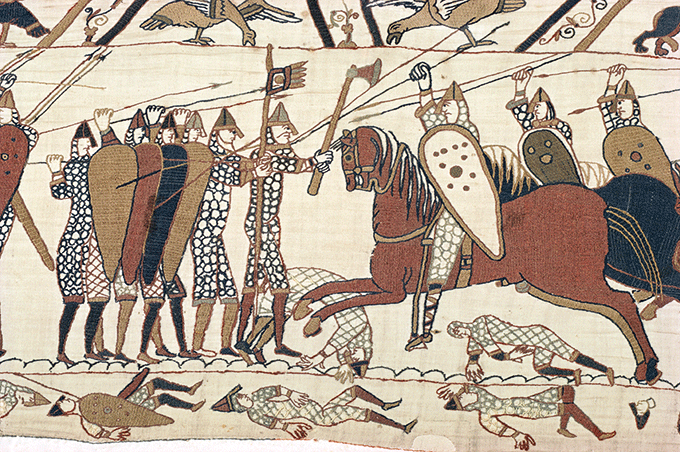
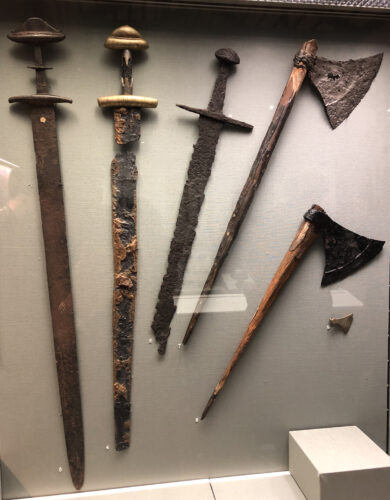
Two handed axes as shown are hideous and wrong. Few examples of what historians call "Dane axes" have been found in archeological sites, most depictions are rather clear about their overall design. The Bayeux Tapestry, when depicting Anglo-Saxon forces, shows some of these axes like here, here and here. These axes from Dublin's museum and dating from around 1014 can also be used as comparison to those who might have existed a century or so prior.
They got the one handed axes right (most of them at least. The simple ones, at least), as they are plain and simple as many other axes from this period might have been as, lest we forget, axes were the weapons of poorer warriors and raiders. These items found at Oseberg's burial ship mound (mid IX century ca.) do show us the shape of at least two axe heads and a spear.
The two plain spears are rather accurate too, as these shapes can be seen not only in Scandinavian related findings but also by other Germanic populations, such as this Frankish spearhead from the IX-X century ca. Also, this one spear discovered in the Lendbreen Ice Patch dates approximately between 825-950 AD.
The square shaped shields are completely bonkers. They resemble Roman scuta or much later Norman "kite" shields, both of which were non-existant in the time period the game is set in. As for the round shields, they are more realistic. Once again, the Oseberg ship burial shows both the shape and possible construction of these round shields, like these ones. Again, similar Germanic populations used these round shields, like what is shown in the Stuttgart Psalter where a Frankish warrior is wielding spear and shield and the shield is tapered towards the iron boss, feature possibly shared by Norse shields.
I'm not really an expert on bows, but the Bayeux Tapestry shows some archers which use bows not at all dissimilar to those used many centuries later. The ones in game have way too many decorations and odd shapes to function properly, I believe.
I am confused by the lack of one handed swords in the game. I believe the site I've used doesn't list them.