I will provide a quick answer with a few sources while we wait for more on in this interesting topic.
The quick answer is that in the mid 17th century, a pair of scientists in France lugged a mercury barometer a mile up (1.5km) up an extinct volcano to see if elevation changed the height of the mercury column. It did, in fact, increase decrease*! Discussing what this meant, the pair concluded that the weight of air above an elevation decreases as you climb. They reasoned that if you went high enough, you would find a vacuum. This was fairly revolutionary, as most scientists at the time thought that space was filled with some invisible matter such as ether.**
The pair of scientists were Blaise Pascal and his brother-in-law Florin Perier. Pascal's contribution to hydrostatics and hydrodynamics was recognized by applying his name to the SI unit of pressure, Pascals. 101325 Pa is equivalent to 1 standard atmosphere pressure at sea level.
But what did this mean for engineers? Still centuries away from air travel, let alone space travel, it wasn't useful for that. But the scientific understanding from hydrostatic pressure -- which works for a fluid such as air or water -- impacted the engineering of dams and oceangoing vessels long before the 20th century. Such as in the 18th century, British engineers began building large-scale arch dams, which were shaped to push against the pressure as the water deepened. By the 19th century, submarine designs must deal with hydrostatic pressure. By the 20th century, air and space travel became a reality.
On the fiction side, travel between the Earth and other heavenly bodies has been the source of myths and stories for hundreds of years. But works prior to the late 19th century were more fantasy than science fiction. In 1856, Reuss wrote Hviezdoveda or Životopis Krutohlava in which a man journeyed to the moon via a balloon and returned in a dragon-like machine to explore the rest of the solar system. Just a decade later Jules Verne, who wrote From the Earth to the Moon, is the earliest popular science fiction author who recognized some of the life support challenges when departing the Earth's atmosphere -- his fictional engineers must deal with removing carbon dioxide and replacing the oxygen used.
Verne raised awareness with his works -- it was then more commonly understood that any crew would have to traverse through a vacuum once they left Earth.
"History of Discovery of the Atmosphere", National Center for Atmospheric Research.
"The History of Science Fiction", Adam Roberts, Palgrave Macmilan, 2005.
EDIT: Corrections and clarifications.
* - this should, in fact, say decrease! kudos to u/cryptonengineer for catching that
** - to clarify per a few great comments, ether still remained as an explanation for several centuries until the Michelson-Morley experiment. Please refer to u/kel_o_l's comment in particular.
Great question! The history of Sci-Fi is older than one might think! As my colleagues have told a bit about your question in particular, I am going to tell a little about Sci-Fi books in general, and try to show how the Sci-Fi genre has developed and thought of in the past. Basically you could say: Sci-Fi has always existed, since Sci-Fi means to think about your current issues, and your own future. But all right, here goes:
The gentleman on this admittedly somewhat dated spaceship is Domingo Gonsales. Around 1635, Bishop Francis Godwin sends his literary character on a journey to the moon in "Man in the Moone" (its in the upper left corner of the etching). Dominigo Gonsales lives on an island for a time and uses geese as oversized carrier pigeons until he realizes they can carry an amazing amount of weight. He flies them to the moon, without any safety precautions, as the understanding of space was pretty basic at that time. He lands in an environment he can barely comprehend. Huge trees, unknown animals and plants cavort around him and he meets the moon's inhabitants, who live in utopian conditions.
There are many things in Dominigo's journey that are typical of sci-fi. He could have landed on James Cameron's "Pandora" and his situation would hardly have changed: Everything is different, as you would expect in a sci-fi movie. "Avatar" didn't surprise anyone thematically in 2009 - but geese-powered space travel in the 17th century, how does that happen?
Around 1635, the question of extraterrestrial life is raised in England, as it is only a logical consequence of the numerous discoveries and conflicts in the church. For a long time in Europe there was just one orthodoxy that taught you the reality, and now this condition is destroyed. So how can one be sure what is right? These religious crises, of course, also have origins in the European voyages of discovery to the "New World." One can ask pointedly: After Humans were discovered outside of Europe, why shouldn't there be some living on the moon as well? The fact that the foundations for sci-fi were laid in times of uncertainty and change comes as no surprise when you think about the genre more closely: that's exactly what it's there for today. Of course, people want to be entertained first and foremost on galactic journeys, but underneath that, sci-fi is always dealing with issues in contemporary society. Star Wars is in places a discussion of democracy, Wall-E or Interstellar deal with the final consequences of climate change, and The Tributes to Panem are ultimately social criticism, with bows and arrows that is.
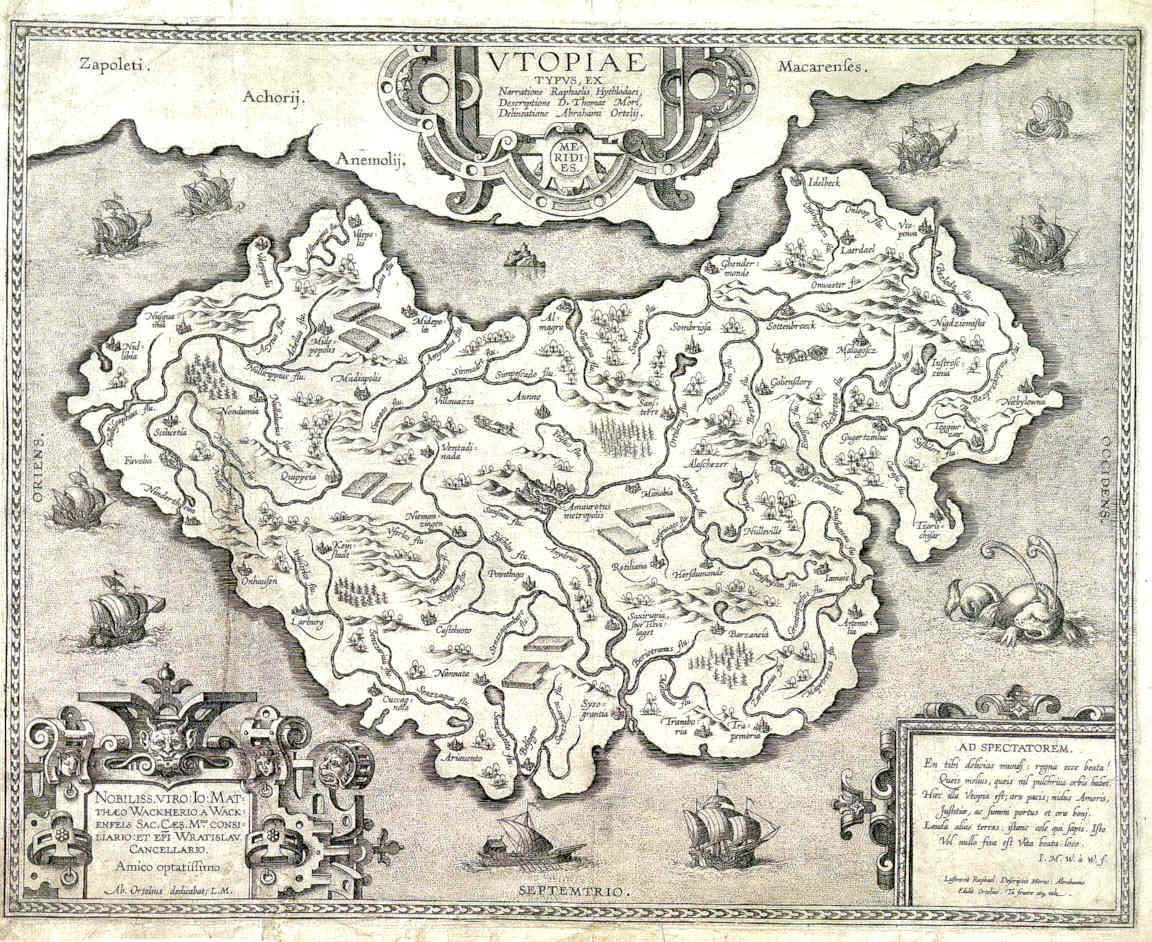
It's no different in early modern literature. Why sci-fi is so well suited for this can be seen in Thomas More's "Utopia," or in "Gulliver's Travels." While these are not sci-fi books in our sense, both books are about countries with different social systems. Utopia shows how a regulated state can appear just and benevolent, and thus indirectly takes sharp criticism of the conditions of the time. Gulliver's Travels - actually an entertaining adventure - shows a similar side: political offices are given to those who can jump the highest, for example, and the inhabitants of the floating science city of Laputa are otherwise almost incapable of living, despite their high intellect - The book is a satire of England at the time throughout. Admittedly, it doesn't sound very sci-fi, so please excuse the brief digression, because the concept of fictionality is very important in this question: both books fictionalize their fantastic journeys, which is a key moment for establishing a sci fi literature genre. The protagonist in Utopia forgot to write down where the island was, and it's similar in Gulliver's Travels. This may have been due to the somewhat ruffle stricter censorship and legal authorities of the time, but it also helps to present social criticism in a more abstract way, so that you can better apply it to your own circumstances.
Fair enough, though, I've babbled long enough. Now what would sci-fi be without the future? Besides this spatial travel, it already needs something else: time travel.
Basically, it doesn't matter when a sci-fi story takes place: Star Wars happened thousands of years before our time, and yet it's futuristic. The idea of time travel, however, was first tested in literature in 1770: by Louis Sébastien Mercier. In his book "2440", a Parisian unexpectedly wakes up in the then distant future and finds himself, you guessed it, in utopian conditions. What is so important about this is that fictional islands become reality here, or rather, future. So it's not quite "utopia" anymore. An important step is made here, this makes Sci-Fi realistic.
From this point on, sci-fi rapidly evolves into what we are used to today, and this is mainly due to industrialization and advancing mechanization. Voltaire goes on an intergalactic journey in 1752 and "Le Dernier Homme" from 1805 shows an end-time scenario of the last remaining humans. In 1826, the first human being wakes up from cryo-sleep and in 1864 Jules Verne sends us to the center of the earth. And with H.G. Wells' War of the Worlds the first invasion of extraterrestrial invaders follows.
In the 20th century, sci-fi established itself as a genre in its own right, according to the motto: 75 percent literature, 25 percent science. Thats where I'll cut off, after that there'll come Metropolis, which will have repercussions up until today and Sci-Fi has already evolved to what you know of it today.
TLDR. In early modern literature, to get to Sci FI, we went from Utopia to dystopia. Sci-fi is a mirror of our times - and through exiting the here and now, both in time and space, it can draw societies as they might emerge and discuss our ideals and issues today. Whether these are positive or negative projections doesn't matter in the end. Thats why early examples of Sci Fi Literature, there is no heavy aspect laid on the scientific or technical side. Just like today, a good book should tell a compelling story and thats what these "Sci-Fi"Books cared for; explaning what could be possible.
By the way, there are quite a few sci-fi works from antiquity that I haven't listed here. That's because it's not my area of expertise, but also because they've had little influence on the development of our genre today.We started here with Thomas More's Utopia. Sci-fi elements can be found earlier, but they are quite decoupled with the development of the genre. These are, for example: the Sanskrit epic Ra-Mayana with flying machines and weapons of mass destruction, or Anthonios Diogenes' lost journey to the moon. The Thousand and One Nights also has sci-fi gadgets at the ready. But as I said, these works have relatively little to do with the ongoing development of our genres.
Sources (Mostly in German language):
Francis Godwin: The man in the moone or A discourse of a voyage thither. London 1638.
Louis Sébastien Mercier: L'An Deux Mille Quatre Cent Quarante. Rêve s'il en fût jamais. Londres 1771.
Thomas More: Libellus vere aureus nec minus salutaris quam festivus de optimo reipublicae statu, deque nova insula Utopia. Löwen 1516.
Jonathan Swift: Travels into several remote nations of the world. In four parts. By Lemuel Gulliver, First a Surgeon, and then a Captain of several ships. Dublin 1726.
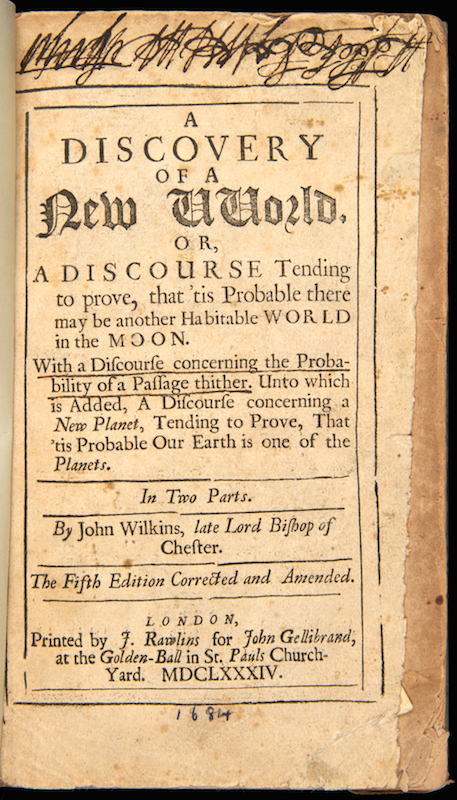
John Wilkins: A discovery of a new world, or, A discourse tending to prove, that 'tis probable there may be another habitable world in the moon. With a discourse concerning the probablitiy of a passage thither. 4. Aufl. London 1684.
Alkon, Paul Kent (1987): Origins of futuristic fiction. Paul K. Alkon. London.
Behringer, Wolfgang; Ott-Koptschalijski (1991): Der Traum vom Fliegen. Zwischen Mythos und Technik. Frankfurt am Main: Fischer.
Canavan, Gerry; Link, Eric Carl (Hg.) (2019): The Cambridge History of Science Fiction. Cambridge, New York, Post Melbourne, New Delhi, Singapore: Cambridge University Press. Available online: https://www.cambridge.org/core/books/cambridge-history-of-science-fiction/3D2698E9F76268359D4C6603A90F0C7A.
Cressy, David (2006): Early Modern Space Travel and the English Man in the Moon. In: The American Historical Review 111 (4), S. 961–982. DOI: 10.1086/ahr.111.4.961.
Galilei, Galileo (2008): Lettera a Cristina di Lorena. Italienisch - deutsch = Brief an Christine von Lothringen. 1. Aufl. Hg. v. Michael Titzmann und Thomas Steinhauser. Passau: Verlag Karl Stutz.
Günther, Ludwig; Kepler, Johannes (1898): Keplers Traum vom Mond. Mit dem Bildnis Keplers, dem Faksimile-Titel der Orginalausgabe. Leipzig: Teubner.
Hagel, Michael Dominik (2016): Fiktion und Praxis. Eine Wissensgeschichte der Utopie, 1500-1800. Göttingen: Wallstein Verlag. Available online: http://gbv.eblib.com/patron/FullRecord.aspx?p=4718241.
Saage, Richard (1999): Merciers „Das Jahr 2440“ und die „kopernikanische Wende“ des utopischen Denkens. In: UTOPIE kreativ 10 (102), S. 76–87.
Schmedt, Helena (2020): Antonius Diogenes. Die unglaublichen Dinge jenseits von Thule. Berlin, Boston: De Gruyter.
Scholes, Robert; Rabkin, Eric S. (1977): Science fiction. History, science, vision. New York: Oxford Univ. Pr.
Vu, Ryan (2019): Science Fiction before Science Fiction: Ancient, Medieval, and Early Modern SF. In: Gerry Canavan und Eric Carl Link (Hg.): The Cambridge History of Science Fiction, Bd. 148. Cambridge, New York, Post Melbourne, New Delhi, Singapore: Cambridge University Press, S. 13–34.
Wegner, Phillip (2013): The Shape of Utopia. Studies in a Literary Genre. 1. Aufl. Bern: Peter Lang AG Internationaler Verlag der Wissenschaften (Ralahine Utopian Studies, 10).