I don't want to ascribe any value to Renaissance paintings over other styles of paintings. But up until that point paintings had been more representational. Perhaps faces were rendered with a lot of detail, but weren't drastically shaded, or animals were in detail, or it was most entirely representational (thinking of: Egyptian, Roman, Greek, Medieval English, Indian, Chinese, Japanese, Medieval Arabic, Byzantine). It might be my lack of exposure to photo-real-ish art from the pre-Renaissance time period, but it seems to me that there was quite the shift in painting styles in Europe during that time that did not occur prior to that time or in other cultures around the world. Curious if there was some reason behind that style change.
This is a great question with no simple answer - art is like anything else, subject to fashions and fads that change over time. A number of factors converged to make Renaissance art more “realistic” (though we should say “naturalistic”). These factors were religious, spiritual and often political in nature and developed alongside advancements in geometry, artistic technique and philosophical thought. I’ll limit my discussion to European (particularly Italian) art as that’s my area of study - would love to hear perspectives from students of non-European art!
Greek and Roman artists had an excellent understanding of anatomy and the mathematical values of perspective - which we can see in extremely realistic Ancient sculpture, such as the breathtaking Lacoön Group circa 27 AD and 68 AD. Unfortunately many examples of Roman painting had degraded with the passing of time, and there wouldn’t be good examples available to Europeans until the 1730’s with the excavation of Pompeii and Herculaneum. The preserved murals uncovered showed a capacity for naturalism - take a look here at some examples of naturalistic wall paintings found at these sites.
Pre-renaissance art was also highly influenced by spiritual values and the need to educate a largely illiterate populace through narrative art. For example, the newly ordained Franciscan order - known for their vows of poverty, preaching in urban centres to the lower classes and patronage of the arts - commissioned the artist Giotto to adorn the walls of the Basillica of St Francis of Assisi (consecrated in 1253) with narrative murals of the story of Christ alongside representations of the life and miracles of their founding member St Francis of Assisi. This served the rhetorical purpose of elevating the newly canonised saint to the level of Jesus Christ himself - St Francis was often considered as a kind of ‘Second Christ’ - a saint who lived his life according to the example of Christ and as such had the extreme and singular honour of receiving the stigmata, the physical embodiment of the wounds of Christ. The narrative murals were less concerned with naturalism and more with imparting a message - that St Francis was an important saint whose example should be emulated, as well as illustrating without words the history of how the order of St Francis came to be, something we might call marketing, or even religious propaganda, in modern times!
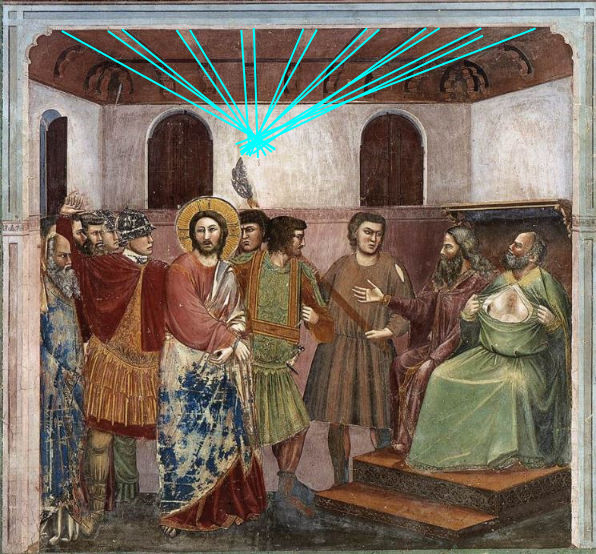
In the Basillica and his later work, Giotto was responsible for numerous innovations in the art of perspective. He (and others) developed the use of one point perspective and vanishing points to create a realistic sense of space - see how in this c.1305 fresco the lines of ceiling rafters converge into a single point in the distance. Giotto’s popularity as an artists and the practice of religious pilgrimage to churches such as the Basillica of St Francis meant his early use of geometric perspective was diffused throughout Europe and elaborated upon by other artists in the coming decades.
By the 1400s, the rules of linear perspective were codified by Leon Batista Alberti in his book De Pictura and by the 1500s masters such as Da Vinci, Brunelleschi and Raphael utilised mathematics and geometry to create a sense of depth and realistic space in their works - a particularly masterful example is The School of Athens where the vanishing point is at natural eye level just behind the central figures of Plato and Aristotle. Alongside advances in geometry, it became once again in vogue to study Antique Greek and Roman sculpture - an artist’s formal eduction would include hours of copying from sculptures and casts in their masters workshop.
Alongside these geometric advances was the growth of philosophical movements such as Neo-Platonism and Renaissance Humanism, movements that prioritised realism through observation of nature and drew inspiration from the natural world as a way of venerating the perfection God’s creation. Da Vinci had a key role in this development, his art combines naturalistic looking humans with an idealism that emphasises the spirituality of these “ordinary” looking people.
Further, the growing accessibility of oil paint in Europe between the 13th and 15th centuries meant that artists could build up layers of colour, light and shade; blend colours into one another; paint over mistakes and dilute their paint to create delicate layers of colour known as velatura (or “veils”). Personally I think this added an introspective quality to the art of the time, work progressed slowly and meditatively as oil paint dries quite slowly. In contrast, frescoes such as those in the Basillica of St Francis were worked quickly over wet plaster in tempera - meaning mistakes could not be corrected and light and shade could not be blended together in the same way as with oil paint.
Finally, between the time of Giotto in the 13th century to time of masters such as Titian, Giorgione and Tintoretto of the 14th and 15th century, the role of the artist shifted from one of the skilled artisan (similar to a carpenter or stonemason) working to the exact specifications of his commissioners to one of a public intellectual, expected to have deep thoughts on spiritual and cultural issues of the day that were reflected in their art.
If you’re interested in some practical examples of how artistic values progressed during the Renaissance, Catherine Whistler’s dense but meticulously researched book ‘Drawing in Venice’ is incredibly informative and while she focuses on Venice she also speaks to art in Italy and Europe in general.
Edit: fixed links