I don’t understand the advantage of the dark age knight shield over a shield like the old Roman shield or Persian immortal shield. The Dark age shield is way smaller and way harder to build a shield wall with so why did they use it?
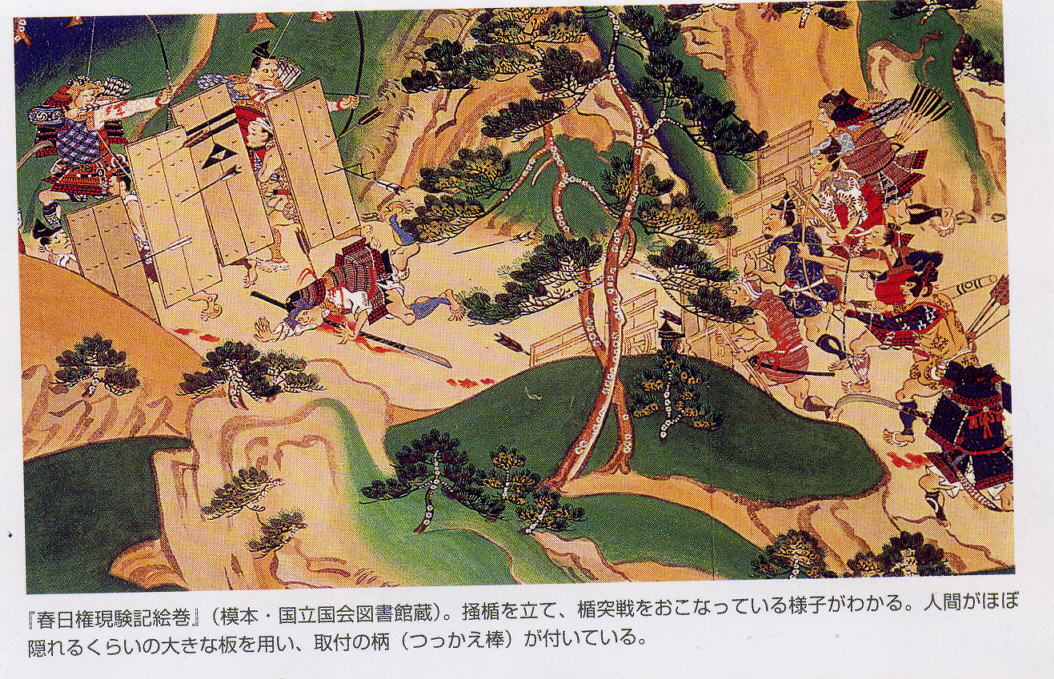
A broad variety of shields was used, and while sometimes bigger was better, this wasn't always the case - it isn't just the size of the shield that matters, but also how well you can use it. We can divide shields by size, into huge, large, medium, and small shields. The largest shields in common use were pavises, mostly used by crossbowmen or other missile troops:
http://blog-imgs-16.fc2.com/t/e/i/teitodennoumou/20071207163240.jpg
https://commons.wikimedia.org/wiki/File:Ashigaru_using_shields_(tate).jpg
although other infantry might use them too:
Pavises were usually quite heavy, and were not held while fighting, but instead used as a portable wall for cover.
The next step down in size was the large infantry shield, suited for fighting in formation, and often (but not always) used in shield walls:
https://en.wikipedia.org/wiki/File:Stele_of_Vultures_detail_01a.jpg
https://en.wikipedia.org/wiki/File:Glanum-stele_legionnaires.jpg
https://commons.wikimedia.org/wiki/File:Heracles_Geryon_Louvre_F55.jpg
https://commons.wikimedia.org/wiki/File:Boudjas_-Soci%C3%A9t%C3%A9_de_G%C3%A9ographie(1907).jpg
https://commons.wikimedia.org/wiki/File:PRIMITIVE_SOLDIER.jpg
https://commons.wikimedia.org/wiki/File:Cernuschi_Museum_20060812_124.jpg
Sometimes, these large shields were the only armour used, or the only armour other than a helmet. Large shields like these were often oval or rectangular. Otherwise, round shields were common, often about 75-90cm (30-36") in diameter. The disadvantage of these shields was bulk and weight - they were large enough to be awkward to run with, and could be quite heavy.
If infantry valued mobility more highly, smaller shields could be useful. Infantry who fought in open mobile formations, and skirmishers, often used smaller shields. Some examples of such medium-sized shields:
https://commons.wikimedia.org/wiki/File:Alfred_Raquez-Groupe_de_guerriers_Khas-Kaseng_(Laos).jpg
https://commons.wikimedia.org/wiki/File:Bodyguard_(far_right)_detail,_from-_Sir_Ugyen_Wangchuck,_with_his_bodyguards,_Tongsa_Dzong_in_Bhutan,1905(cropped).jpg
Smaller shields like this were also useful away from the battlefield, for duelling, for emergency self-defence, etc. The more extreme version for such tasks was the buckler, a very small shield which was easy to carry:
The disadvantage of the buckler on the battlefield is that it is poor protection against incoming arrows compared to a larger shield. In a duel, it is light and quick, doesn't tire the user, and doesn't block the user's vision or attacks.
However, you asked about the classic knightly shield, which were medium-sized shields, but not usually used for the same purposes as the ones above. The classic knightly shield was a cavalry shield, and cavalry shields were typically medium-sized shields - 50-60cm (20-24") round shields were common. Some cavalry used quite large shields, but these present a difficulty: they are not easy to move from one side of the horse to the other, and the enemy sometimes inconveniently attacks from the unshielded side. A smaller shield can be moved more easily to protect from more directions than a large shield. One notable example of cavalry preferring smaller shields was a reduction in the size of shields used by indigenous North American peoples from about 75-90cm to about 50-60cm when the horse came into use. Some examples of cavalry with shields:
https://commons.wikimedia.org/wiki/File:Bataille_de_v%C3%A2liy%C3%A2n_(1221).jpeg
https://i.pinimg.com/564x/bf/27/3b/bf273bad9a15567814a792b383c9bd8d.jpg
https://commons.wikimedia.org/wiki/File:Bataille_entre_mongols_%26_chinois_(1211).jpeg
The classic "shield-shaped" knightly shield is a variant on the medium-sized cavalry shield:
https://i.pinimg.com/564x/3e/ce/03/3ece038455fbc3dc3e15a04124919735.jpg
https://i.pinimg.com/564x/30/9d/32/309d320c6139d4ec2d3b7073cd494deb.jpg
Cavalry use explains the main point your asked about: the smaller size. As for the specific shape, "shield-shaped" rather than round, this is possibly a functional development, to allow the shield to sit closely by the horse. It could also be primarily due to fashion, since round shields were more common in cavalry use, worldwide.
For more on the pros and cons of different sizes and shapes of shields, see my past answer in https://www.reddit.com/r/AskHistorians/comments/9etn35/why_did_shields_tend_to_be_circular/
.jpg)


.jpg)


.jpeg)


.jpeg)

