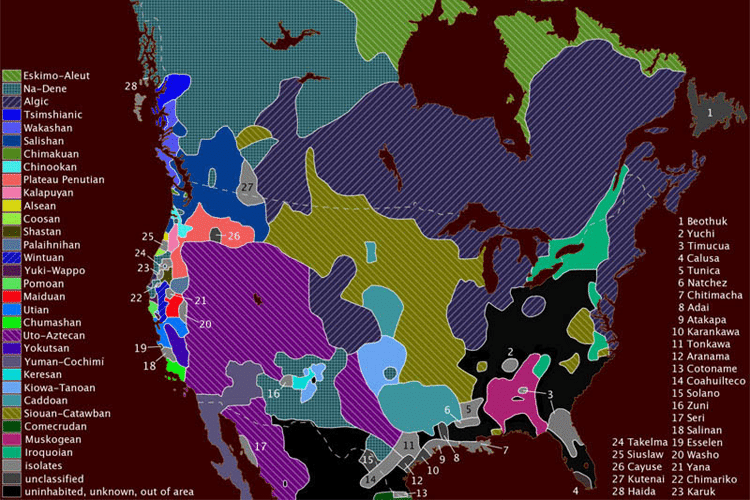
Looking at maps showing distribution of various bands and tribes around North America, the West Coast markedly stands out from the rest of the continent as having a tremendous number of different tribes and languages in a relatively confined area, whereas other large swathes of territory have only a few.
There are multiple questions packed together here:
Is it actually more diverse, or is the diversity simply more well-attested? Perhaps are more fine distinctions drawn between bands in this area than in others, giving a false appearance of being more diverse? Was past diversity in other regions wiped out before being mapped, and therefore undocumented?
Could it be that the area remained diverse due to later spreading of disease brought by European settlers, with the region furthest from first contact acting as a sort of refuge while other populations were decimated?
As waves of Siberian migrants entered North America, the West Coast would have been a primary migration corridor, so is the diversity due to various groups arriving and remaining there for long periods, or are they echoes of later waves of migration, not all of which had yet moved out into the rest of the continent?
Is the area more bountiful and easy to survive in compared to other regions, causing people to remain rather than move on?
These are only a few of the suppositions and thoughts which came to mind, and I'm certain there are many other aspects and factors I'm blind to and unaware of.
So, why do we see so many more different tribes attested in that area than in other similarly-sized areas of the continent.
Someone could go into more depth, but you might be interested in a previous comment I made here addressing a similar question.