Growing up with a love of history, I tended to view him as "the good guy" in the Chinese Civil War. Now, I know that history is never black and white.
Chiang Kai Shek's legacy in Taiwan is complicated. Since you are asking about his legacy today, here's a few recent quotes from my grandfather:
"Chiang Kai Shek only did two good things: improve the education system and get people to follow instructions" [with reference to COVID regulations and KMT authoritarianism]. The second part is kind of a joke but kind of not.
[Holding up a 10元 coin featuring Shek's face] "If this weren't worth money I'd throw it out the window"
On the other hand, Shek's face is on most of the money and the twice-renamed Chiang Kai Shek Memorial Hall holds a prominent place in the capitol. Five kilometers away is the Cheng Nan-jung Liberty Museum dedicated to a Tainan newspaper editor who self-immolated protesting Guimindang (KMT) suppression of free speech.
The KMT government's characterization in American cold war era discourse as "Free China" is a convenient piece of propaganda with no more basis in reality than descriptions similar descriptions of anti-communist authoritarian regimes in South Vietnam and South Korea. Chiang was an ultranationalist authoritarian bordering of fascism who ran Taiwan under martial law for over three decades. It is true that he fought the communists, and he did so with a policy that arresting 100 innocent people was worth it if you caught a single one.
With the Japanese surrender and end of WWII in 1945 and Japan leaving, there was serious optimism for Taiwanese/Chinese self-determination in Taiwan. Though Taiwan did not suffer as badly under the Japanese as other Asian countries and the Japanese era is viewed reasonably well today, Taiwanese generally assumed that a Chinese government would be an improvement. However the KMT quickly managed to squander this good will with heavy-handed repression, corruption, economic mismanagement, arbitrary seizures of property and a ban on political participation by those outside the party. These culminated in the 288 Incident in 1947 when the KMT government killed thousands or tens of thousands of Taiwanese following anti-government protests, particularly targeting Taiwanese intellectuals. Mind you, this is prior even to the KMT loss on the mainland and retreat to Taiwan. The 228 incident kicked off a period known as the White Terror wherein any form of political dissent was punishable by tortured confession, detention, and sometimes execution. Writer Tehpan Tsai recounts that one of his fellow prisoners was charged with spreading communist propaganda when he taped up a broken window in a way that vaguely resembled the flag of communist China. Tsai himself was imprisoned as the result of an acquaintance's tortured false confession.[1]
With Taiwan's transition to democracy starting in the 1980s, Taiwan had to grapple with Chiang and the KMT's legacy. Since the transition took place over over a decade and mostly with the blessing of KMT leadership, Taiwan never went through a political or cultural revolution to wipe the slate clean, so to speak. The KMT remains one of the strongest political parties, the flag is still the KMT flag, and practically every city still has a Chiang Kai Shek street and a Chiang Kai Shek park. Chiang family still occupy prominent positions in the KMT party and government at times.
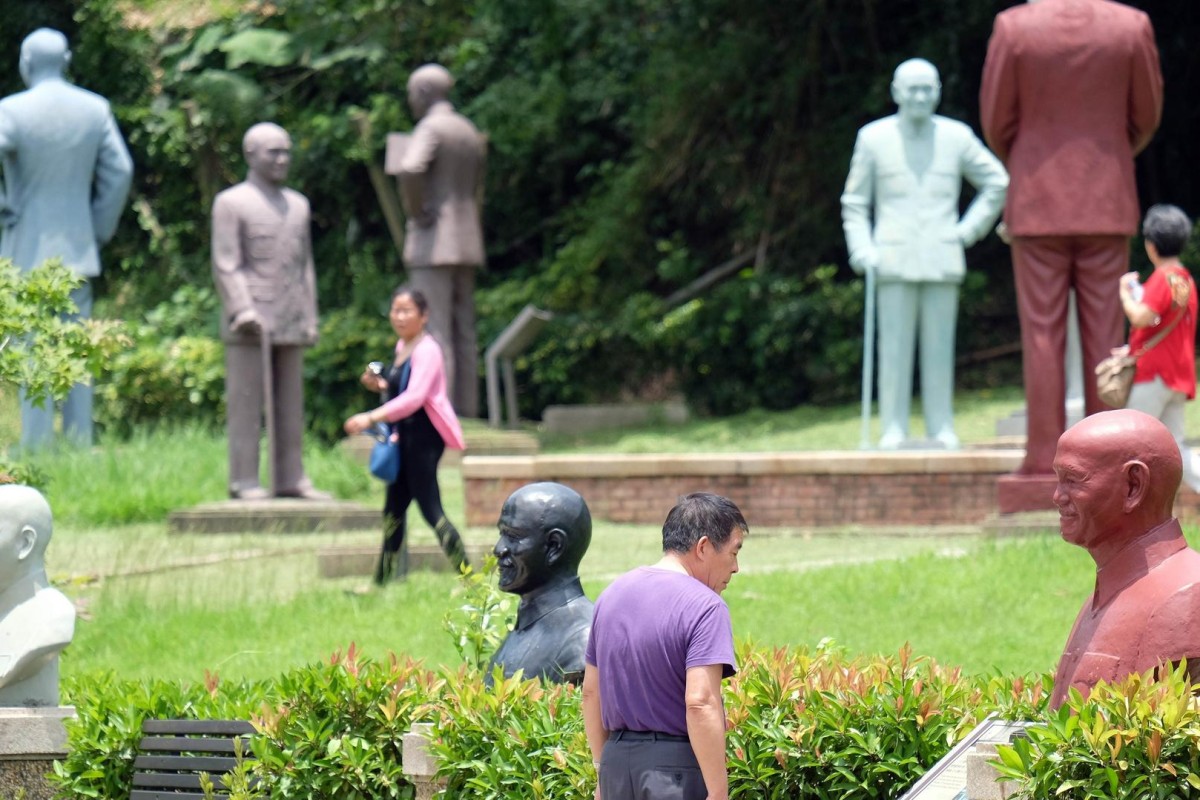
Since the first opposition election in 2000 some opposition supporters and governments have pushed for quJianghua, or de-Chiang-ification as well as a promotion of a Taiwanese, as opposed to Chinese national identity. One interesting example of quJianghua and dismantling of the Chiang personality cult was the issue of the roughly 43,000 statues of Chiang being displayed in schools, government buildings, and other public places. With no statue-toppling revolution and a significant portion of the population and political elite still supporting Chiang and the KMT legacy, the Democratic People's Party elected as a compromise to place a large number of those statues in a park adjacent to Chiang's mausoleum. To Chiang supporters the park is a respectful monument. To the opposition it is a reminder of the dangers of a personality cult. To foreigners it is an amusing attraction.[2] Taylor argues that quJianghua is partially a reaction against the Sinocization of Taiwanese culture and education under the KMT.[3] Some Taiwanese people complain that their history classes were a history of Chinese dynasties that never even occupied Taiwan. QuJianghua has also been embraced by Chiang supporters in a way, opening some former Chiang family residences to the public or converting them for public use. In a more reactionary direction, some Chinese civil war veterans have set up a temple elevating Chiang to the status of a literal god.[4] Less extreme Chiang rehabilitation has taken the form of marches and formation of advocacy/educational organizations emphasizing Chiang's role resisting the Japanese and the Communists.
Today, identity politics play a major role in Taiwanese politics, with a major debate raging whether Taiwan should declare 獨立, often poorly translated "independence" but more meaning "separation" from the Chinese legacy. This essentially entails codifying the status quo that the Republic of China does not actually occupy any territory in mainland China and should therefore be renamed something like Republic of Taiwan. Naturally those identifying with Chinese history, the KMT, and those who arrived during the retreat to Taiwan tend to support the ROC status quo, while those who speak Taiwanese and identify with Taiwanese rather than Chinese culture tend to support 獨立. To complicate matters more, the PRC has threatened invasion if Taiwan declares 獨立, so much of the debate is pragmatic rather than ideological. Ironically, this situation has resulted in the KMT agreeing with the CCP on the matter and being viewed more as the pro- China/business party.
Chiang's legacy is the topic of ongoing debate wrapped up in culture, history, geopolitics, and people's lived experiences. His status as the "good guy" in the USA is derived from his political convenience, not from his policies, and in Taiwan is a rather different story.
[1] Elegy of Sweet Potatos, Tepan Tsai, 1995
[2] Maybe we can do this with the confederate statues?
[3] Taylor, J. E. (2010). QuJianghua : Disposing of and Re-appraising the Remnants of Chiang Kai-shek’s Reign on Taiwan. Journal of Contemporary History, 45(1), 181–196. doi:10.1177/0022009409348030
[4] Gods in Chinese religion are maybe more like spirits or demi-gods and many other mortals have been elevated to god status over the years, so this isn't really as weird as it sounds. Chinese religion is complicated.