I understand there weren’t satellites back then and we didn’t have long range radar or sonar technologies that were developed in the couple decades following the war. But did we have no other bases/contact points/anything really west of Hawaii at that time? If I remember correctly the Philippines fell after the Pearl Harbor attacks right? So was that fleet unnoticed due to lack of scouting technology we have today mostly?
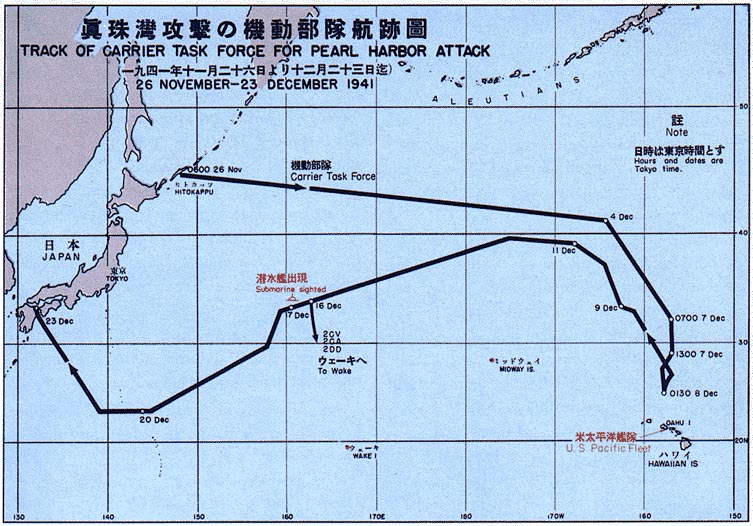
The United States did have bases west of Pearl Harbor, but none along the route that the Japanese fleet took to strike at their target. The Japanese fleet sailed from Hitokappu Bay in the Kuril Islands, to the north of the main islands of Japan, on an easterly route before approaching Oahu from the northwest. Here is a map of the fleet's route, from the Pearl Harbor museum. The route was chosen specifically to bypass American bases, and took the fleet through weather that is usually overcast and foggy in late November and early December. The fleet operated in radio silence to avoid detection.
The attack on Pearl Harbor was carried out in coordination with strikes on allied bases elsewhere in the Pacific, including the Philippines, because the attack was intended to destroy the American fleet to buy time for Japan to build out a defensive perimeter. I wrote more about Japanese war aims here and here if they are of interest.
The IJN took a great deal of precautions in order to ensure that their forces remain undetected, but perhaps the most important thing to stress is that the ocean is big. Even if you know hostile ships are operating in an area, locating them with any degree of precision is a major piece of naval warfare. It is entirely possible for two forces, both aware that their enemy is in the area to blunder past each other.
That being said, for context here is a map of the course of the Kidō Butai took on its way to reach strike range of Hawaii.
As you can see, it is not so much a matter of bases to the west of Hawaii (which the US definitely had in Wake, Guam, and other island holdings), but a matter of bases north of Hawaii. There's simply not many landmasses between the Aleutian Islands/Alaska and Hawaii to build bases on, and the Japanese deliberately sailed around them. There were concerns that the fleet could be spotted by merchant shipping, which is another reason for the fleet taking such a northerly course. Quite simply, there's not much shipping that passes through the northern Pacific Ocean, and the seas in that area are noticeably very rough in the winter, reducing the chances for detection even more. Finally, the Japanese fleet operated under complete radio silence, making no radio transmissions in order to avoid detection via electronic means.
That being said, the Japanese were also lucky. Their gambit of sailing north payed off, and they ran into no civilian traffic which could have reported their location, nor any US warships. The US hoped to have extensive patrols originating from O'ahu itself, but the aircraft to have the kind of long range patrols envisioned were unavailable, with many being instead forwarded on to the Philippines.
So, it was a combination of deliberate action to avoid detection and luck on the part of the Japanese, combined with certain failings on the part of the US that enabled the Japanese to strike with almost complete surprise.
So I will split this into 2 parts.
How the Kido Butai managed to get to a position off Oahu undetected the morning of the 7th.
USN/USAAF Scouting and warning signs in general and especially in the Philippines.
So on point 1, my peers have touched that so I will hit on the state of affairs around the US Asiatic Fleet and the Philippines just before the start of the shotting war.
Throughout the second half of 1941 as tensions grew Admiral Hart had removed many of the exposed units under his command back. This included those patrol craft and shore detachments in China, and a concentration of his forces where possible.
Not that he had much to fight with, the Asiatic fleet was made up of mostly WW1 vintage destroyers and subs, 1 modern Heavy Cruiser, 1 old light cruiser, and 1 modern light cruiser that had recently escorted a transport convoy. There were also several small craft including gunboats, support ships, and the like. The one notable reinforcement before the war was 20 newer submarines it is worth noting. But for instance, just 1 ship in the fleet had a fancy new Radar set, and most were still mounting only the barest amount of modern AA weapons or even things like modern large searchlights for night fighting.
But the increasing tension had these forces aware war was very much an immediate possibility. Indeed Admiral Hart had sent most of his surface forces as far out of harms way as he could to avoid a surprise attack. Either elsewhere in the PI, or to Dutch controlled Borneo.
That does not mean there were not plans to patrol the waters between the Philippines and Taiwan, and Vichy controlled Vietnam, which was thought to be a gathering point for IJN forces before an attack on either the Philippines, British Malaysia, or the Dutch East Indies. And Japanese forces moving forces into Vietnam had been a major escalation in tension earlier in the year.
To that end Hart did use the handful of PBY scout planes at his disposal to monitor the sea approaches, and submarines were prepared to close in on any invasion fleet found.
The most controversial part of this comes on December 2nd, when FDR orders a very specific "Defensive Information Patrol" to be made towards the Vietnamese coast. To consist of armed yachts under Navy command. The use of civilian auxiliaries is nothing new, but the order has become something of a smoking gun to some circles for all sorts of conspiracy theories. Included in this was the USS Isabel, a yacht used as the relief flagship for the Asiatic Fleet's commander. She makes it to off Cam Ranh Bay, is spotted and tailed by Japanese aircraft, but is recalled to Manilla before the war begins. Another craft the Lanikai was finished being armed and ready to take up station on the morning of the 8th and did not leave Manila Bay before the war began. It is also worth noting the Japanese landings only began after the destruction of Clarke Field on the 8th, taking out most of the Army's air power, and the bombing of Cavite Bay on the 10th putting most of the Navy's shore installation out of the fight, and damaging several subs and other small craft.
So we are left with the command being run on a shoestring, with poor cooperation between Army and Navy units in the Philippines, and whose force has been mostly sent out of immediate danger or is being husbanded for when the conflict starts. And even when additional forces had been surged, like with subs, and a few extra large aircraft there was little support structure, for instance, subs and seaplanes require tender ships to establish bases for them in the absence of shore installations. Greatly limiting where they could operate from given what the Asiatic Fleet had on hand. Against an enemy with large numbers of long-range shore-based air that was able to neutralize the defenders even before the invasion fleets moved in.
That leaves little ability to conduct aggressive reconnaissance, even in the face of ominous intelligence and warnings from higher command. MacArthur's force of B-17's might have been used for scouting to supplement the PBY's, but they too were according to the plan going to be kept safe in airfields far from Manilla, and stay massed to strike Taiwan. Of course the first day's attacks by Japanese aircraft ruining most of those plans.
MacArthur, in command of the Army and Filipino forces, also was staggeringly uncooperative with Admiral Hart, despite the two of them going back near 40 years, Hart had even served with Mac's older brother Arthur who was a naval officer. But personal pride, and differing opinions in how best to defend the islands, and likely Japanese actions scuttled what should have been a close professional relationship.