The short answer is, "Yes."
The medium answer is, "Obviously yes, humans are no different today than they were thousands of years ago."
The long answer (or at least a demonstrative example thereof) is as follows:
Lu You (陸游) was a scholar and poet of the Southern Song Dynasty [1127-1279 CE]. Born only a little more than a year before the tearing apart of the already weakened realm, and the permanent expulsion of the Song from all territories south of the Huai River, Lu grew up knowing very well what it was to be "down on one's luck."
As with any good son of a relatively well-positioned family, Lu You received a good education and support, and grew up to be very patriotic - assured of his country's right and ability to retake what had been so egregiously stripped from them: both the North, and their pride. Such a victory would prove rather less than forthcoming.
At age 29, he passed the infamously difficult Imperial Civil Service Examination, on his second try (his first at 19 being a failure)... this time, he was the valedictorian of the Lin'an Region (Hangzhou, the S Song capital). Sadly, because such a prominent position threatened the ascension of one of the rising stars of the time (the grandson of the infamous traitor Qin Hui), he and scores of other candidates were therefore disqualified from the National Examination the following year. 2 years later, his first wife - fed up - divorced him.
In spite of his (unfair) exclusion from the Civil Serive Exam, Lu You was nevertheless able to score a government job, seemingly through little more than sheer moxy. Sadly, due to his fervent belief that the Song fight fight to reclaim their northern homelands - against the prevailing sentiment of the times that it was a lost cause not worth spilling more blood over - he was shortly dismissed from his initial government position. He would be hired on in 1172 as a military adviser, further spurring his patriotic sentiment and fervor, but it would all prove to be hopelessly out-out-tune with the sentiments of the era, and largely went nowhere.
By 1175, largely defeated by age, time, and the apathy of his entire society, the 50-year-old Lu You had given himself over to indolence, drink, and hedonism... and poems. Oh yes, of course, poems. Always a hobby of the literati class, Lu You had spent his career waxing poetic about the virtues of patriotism and fighting the good fight... and they'd gotten him less-than-nowhere.
but then...In 1183, now 58, Lu You's life irrevocably changed...
POEM FOR MY CAT #1
裹盐迎得小狸奴,I got a little kitty-servant with a bag of salt,
尽护山房万卷书。He'll be the protector of my house's countless books.
惭愧家贫资俸薄,What a shame that my salary is so small,
寒无毡坐食无鱼。He has no blankey to sleep on, or fish for dinner.
Thus would begin Lu You's spiraling love affair - and voluntary enslavement, to the mouser that would take over his life...
RATS WERE DESTROYING MY BOOKS SO I GOT A CAT AND NOW THEY'RE ALL GONE!
Military conscription has left the house empty
Only my cat keeps me company.
It's so soft to touch and warm to hold in bed!
Such a brave mouser! So capable in destroying the rat's nest
As valiant as the soldiers on the battlefield!
I regret that I don't have much fish to give it, but it doesn't mind
It doesn't even waste time catching butterflies among the flowers
So, that went well! Some 8 years later, Lu You (now 66) adopts another kitteh... this one he calls 雪儿 (Xue'er), meaning "Snow Child," or just "Snowy:"
I GOT A CAT FROM A NEARBY VILLAGE THAT I'M NAMING SNOWY!(1191)
He looks like a tiger and climbs trees,
He thinks he's a horse, but can't possibly pull a cart!
He vanquished those pesky rats
But asks for nothing in return - not even fish!
Every once in a while, he gets drunk on catnip,
But every night, he snuggles up cozy on his rug.
I swear, he must've been my own child from a past life,
Reincarnated now to keep this old man company!
He can't stop now. He's officially a cat-person...
A POEM FOR PINK-NOSE(1193)
Night after night you used to massacre the rats,
Guarding our grain so ferociously!
So why do you act now like you were palace-born and bred
Demanding your daily fish and claiming my bed for your own?
It becomes increasing unclear who is the master, and who is the slave...
POEM FOR MY CAT #3
I do not scold you failing to catch mice,
Your fish arrives on-time!
Every day I see you sleeping without care
Why, then, do you scamper about here and there?
Reality dawns: "I've Made a Huge Mistake..."
SOME THOUGHTS
The cat is sleeping on my bed, totally oblivious to the rampaging rats
My books are gnawed to ruination, the birds wake me at dawn every morning! I can't believe it - was this really all just a ruse to get food from me?! He's so lazy! Warm and safe now, he just doesn't care! Impossible to train with a full stomach! Oh, how naive I've been! I'm totally stressed out now...
But he accepts his fate as Cat Person with alacrity:
RAINSTORM ON 11/04(1192)
Wind sweeps the world and rain darkens the village, Thunder rolls off the mountains like ocean waves churning. But the furnace is soothing, and the blanket is warm. Me and kitty, we're not going anywhere today.
So, as you can see... pet owners (or, perhaps more accurately... owned) have always been thus. In fact, in modern China it's commonplace that cat "owners" refer to themselves and one another as 猫奴 ("cat slave") and 铲屎官 ("Officer Turd-Scooper").
Giles, Herbert. *A Chinese Biographical Dictionary.*Zhao, Xiran Jay, Thread.
Addendum: Please consider checking out my podcast on China's amazing history: The History of China Podcast! We're entering the 1390s - the final decade of the first ruler of the Ming Dynasty, the Hongwu Emperor!
I would say that it’s not a recent phenomenon, but neither is it a universal human phenomenon. Domesticated animals, especially dogs, but also cats, horses, cows or cattle, are a as far as I know universal feature of human civilization. They have been with us from the very beginning, taking a great role in defining what it means to be human. One can go back to the earliest literary texts to find references to this special connection, just think of Odysseus returning to his home of Ithaca after twenty years, to find that his old hunting dog Argos had been waiting for him all this time, only to die after seeing his master again. That being said, the nature of our relationship to animals and dogs in particular is variable, from being used as a source of food or objects of blood-sports, to working as draft-animals or guardians, as hunting-dogs, racing-animals, or close companions and pets. Most of the dogs in history will have been part of the first two categories, the latter categories being clear status markers of luxury. I’m going to talk a bit about Roman antiquity, since that is what I know best. In antiquity, while dogs were also commonly used as sources of food (usually it seems the puppies) or working animals, or roaming the streets and fields as feral dogs who would be killed as a nuisance, for members of the aristocracy, especially hunting dogs were a prized object of conspicuous consumption, and a clear status marker. Funerary reliefs from Greece, f.e., will often depict the young aristocrat with an elegant hunting dog to show his status as a member of the elite – someone who could afford both a dog bred for hunting, and someone who could afford this luxury pastime. In Rome, the conquest of the Mediterranean during the first two centuries BC brought with it a great influx of wealth and the establishment of a larger class of people with the means to live a lifestyle disconnected from the need for subsistence farming – also a disconnect with the world of animals-as-a-workforce. Urban rich, senators and aristocrats, but also a growing middleclass of traders or artisans, whose pride in their new status found its expression in lavish funerary monuments. At the same time, contact with foreign areas brought an appreciation for exotic animals as status markers, who often were paraded through the streets in triumph, such as lions, crocodiles, elephants, hyenas or bears. In the first century BC and increasingly from then on we have more and more evidence for pet-keeping – keeping animals just for pure enjoyment and not exploiting them for their work or talents. Roman poets referred to their or their friend’s favourite animals, historians mentioned the pets of emperors, and dead pets were honoured with their own epitaphs. The language used to refer to these pets often reflect that used for kids or lovers, for example, deliciae or delicius. This doesn’t refer to their taste, but means something like ‘lovely’, ‘dearest’, used of close companions or favourite slaves. Cicero uses it to refer to his daughter, Tullia, Seneca to refer to the pet dog of the emperor Claudius in his satire Apocolocyntosis (the Pumpkinisation), Catull to refer to one of his lovers. Conversely, animal names could also be used to refer to beloved humans, in a way that shouldn’t feel too out of place to modern observers (‘my dove’, ‘bunny’ and so on).
The most interesting evidence of how widespread this phenomenon was are probably the funerary inscriptions for dogs, some of which with elaborate poems that sometimes reference popular works such as Vergil. This is the case for one of the most famous examples, a marble epitaph for the gallic hunting dog Margarita, from 2/3rd century Rome, on a marble slab now housed at the British Museum in London (CIL VI 29896 = CLE 1175):
Gallia me genuit nomen mihi divitis undae / conchae dedit formae nomini aptus honos / docta per incertas audax discurrere silvas / collibus hirsutas atque agitare feras / non gravibus vinc(u)lis unquam consueta teneri / verbera nex niveo corpore saeva pati / molli namque sinu domini dominaequae iacebam / et noram in strato lassa cubare toro / et plus quam licuit muto canis ore loquebar / nulli latratus pertimuere meos / sed iam fata subii partu iactata sinistro / quam nunc sub parvo marmore terra tegit / Margarita
Gaul gave me birth, the shell of the rich waves my name: the honour of the name is fitting for my beauty. Taught to roam the unexplored woodlands with courage, and chase hirsute game across the hills, unaccustomed to be held by heavy shackles or to endure savage beatings with my snow-white body. For I used to lie in the lap of my master and my mistress, and mastered the art of resting wearily on a spread-out blanket. And though I was able to express more than I was entitled to say with the mouth of a dog, no-one feared my barking. But I have already met my fate, stricken down giving ill-fated birth, I, whom now covers the earth beneath this small marble plaque. Margarita.
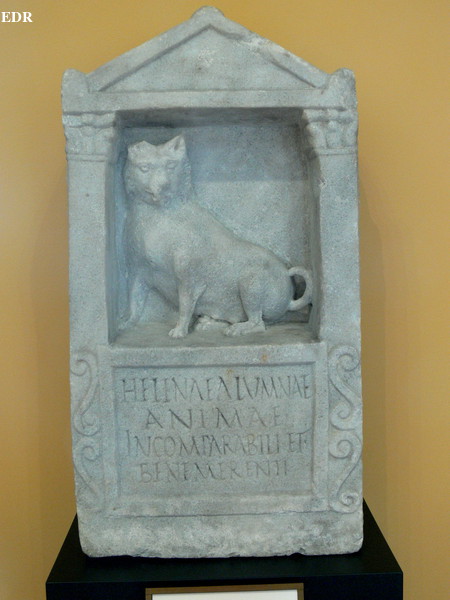
This has been taken as a parody of Vergil, and more tongue-in-cheek than honest sentiment, which Irene Frings has argued against convincingly I think. Also, this is by far from the only example of such epitaphs for dogs. On the one hand, dogs (or cats) are often seen accompanying tombstones of little kids, as an upbringing and education together with pets was seen as something desirable and an indicator of higher socio-economic status, since not everyone could afford pets. Here's an example from the province of Germania superior, near modern Saverne, the tombstone of the girl Belatula, depicted together with a small dog (or maybe cat?), holding a ball in her hand, both symbolizing a carefree elite childhood, put up by her father (AE 2015, 995). They are thus also expressions of social ideals and need not reflect actual reality for small girls or boys all over the empire, but certainly something their parents aspired to afford for their children. This stele from 1st century Rome (CIL VI 19019) for the slave girl Helena eschews depicting the little girl and instead displays the dog (if Helena is not the dog, which is unlikely). (For Helena, foster-child of incomparable spirit, well-deserved).
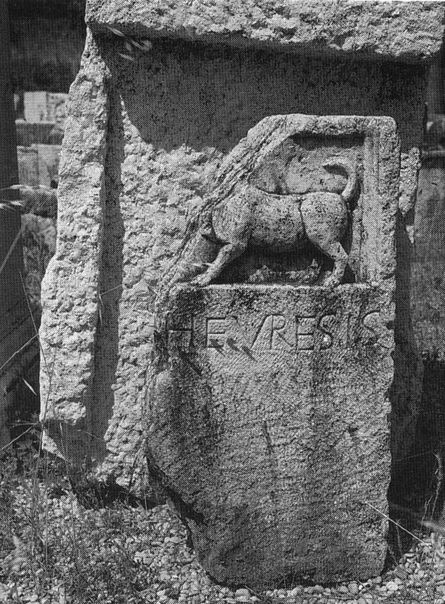
Further, there are lots more epitaphs specifically for dogs that show that this was not an uncommon phenomenon. Sometimes, they are very simple, such as this funerary stele for the dog Heuresis (the Finder/Tracker) from Rome (CIL VI 39093), late Republic or Augustean age.
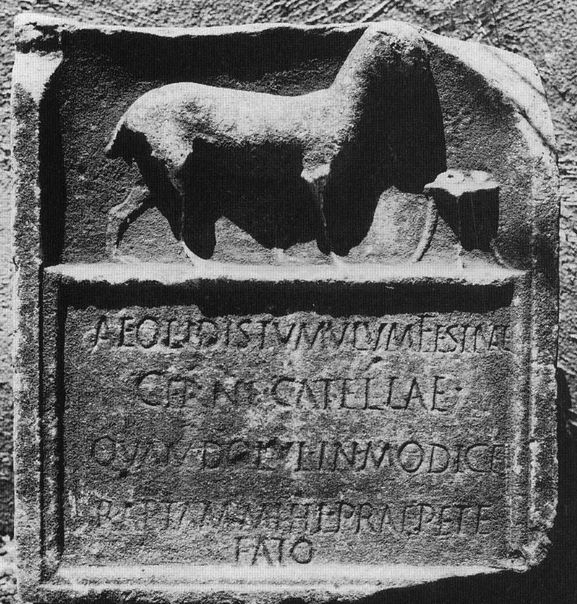
Others are again more elaborate, referring to the terrible feeling of loss every pet-owner knows, like this funerary monument for the dog Aeolis from Praeneste in Campania (AE 1994, 348):
Aeolidis tumulum festivae / cerne catellae / quam dolui inmodice / raptam mihi praepete / fato
The tomb of Aeolis, the cheerful little dog, whose loss to terrible fate gave me unmeasurable pain
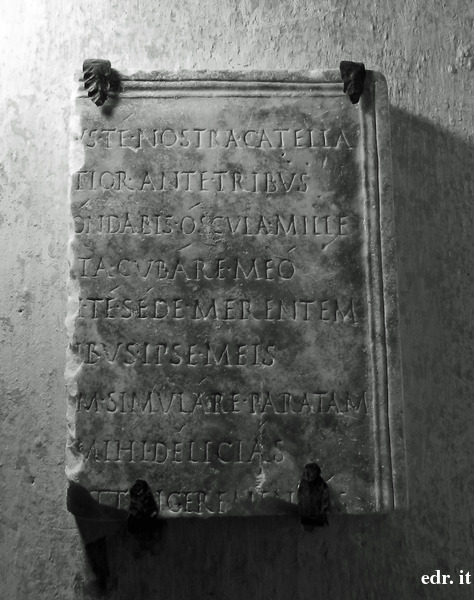
Another poem is used to commemorate the loss of the dog Patricus, on a marble slab from 2nd century Salerno, again using a very expensive material (CIL X 859), and apparently buried in the same plot which his master had chosen for himself, referring to their 'spirits' (manes) being joined together:
Portavi lacrimis madidus te nostra catella / quod feci lustris laetior ante tribus / ergo mihi patrice iam non dabis osculla mille / nec poteris collo grata cubare meo / tristis marmorea posui te sede merentem / et iunxi semper manibus ipse meis / moribus argutis hominem simulare paratam / perdidimus quales hei mihi delicias / tu dulcis patrice nostras attingere mensas / consueras gremio poscere blanda cibos / lambere tu calicem lingua rapiente solebas / quem tibi saepe meae sustinuere manus / accipere et lassum cauda gaudente frequenter / [---
I have carried you covered in tears, our little dog, as in happier times I did fifteen years ago. Now, Patricus you will no longer give me a thousand kisses, nor will you be able to lie affectionately round my neck. Sorrowfully, I have placed you in this well-deserved marble tomb, and I have joined you for ever to my own spirits. Your manners showed you equal to a human, alas! What a pet (delicias) we have lost! You, sweet Patricus, were used to joining us at the table and panting asking for food in our lap, you were accustomed to lick with your stealing tongue the cup which my hands often held for you, and often to welcome your tired master with wagging tail . . . .
I could go on with quite a few examples (many of them are collected in Herrlinger 1930), but I think they will suffice to show that then, as now, dogs were more than just companions. Was this just an elite phenomenon, restricted to the upper classes? We don't know - our sources are mostly from members of precisely those classes. Archaeology and History have recently been putting a new focus on our entanglement with animals, so our picture may get clearer in the future. What is certain is, that many animals in that time led a deplorable life. But for many others, they were members of the household that were, in death, honoured in much the same way as one would a dead child or slave (for which we often find the same kind of epitaphs). Some of them seem to have spared no expense to secure an adequate commemoration for their beloved pets, something most common people in the Roman Empire weren't able to afford for themselves. Then, as now, this comes close to a form of luxury consumption that for some may seem to border on the perverse, but, as /u/cthulhushrugged said - some things never change.
Oh my goodness, I can actually answer a question. Hooray.
Depending on how you categorize "relatively recent," then no. This is not a new phenomenon. The use of language in regards to pets is buried within archival sources and may take some teasing out to infer the meaning, but it is there. This language is often tied to consumerism, which we have a lot of records for. To understand this, let's learn about pets!
The concept of pets have been around forever. Katherine Grier in her book Pets in America: A History argues that a pet is an animal that has been “singled out by human beings” and “receive(s) special attention.” Colonial America saw pets designated by crude collars, special names, or simply by being mentioned inf diaries or letters. In Creatures of Empire by Virginia DeJohn Anderson, she writes how colonial farmers gave names to their favorite cows or expressed sorrow in diaries when their favorite animals died. Depending on the region of the colonies, farmers may have increasingly talked to their animals with words of comfort or praise to get them acclimated to human touch and voices.
The late 19th century is when pets and pet keeping begin to take place. Harriet Ritvo in her book The Animal Estate: The English and Other Creatures in the Victorian Age describes pet keeping as something that was limited to only the wealthy. Ritvo uses the term the " Victorian cult of pets," in her analysis. Simply put, wealthy had money to spend on their new furry friends. Wealthy Victorians purchased everything from jeweled dog collars, state of the art pet care books, and lavish household accessories for their beloved pets. The biggest expenditure was clothing. Designer clothes for dogs (and cats) allowed wealthy Victorians to dress their furry friends up as tiny children and parade them around. Pets were not only status symbols of the wealthy by monetary designation, they were family members that could be dressed up and shown off. In her study in pet-keeping in France, Kathleen Kete has found much of the same attitude existed among 19th century Parisians. They promoted pet keeping as a hobby and activity that the rich could enjoy. Of course, as in England, pets were found in lower and poor homes as well, but it was maintained that pets were strictly for the rich echelons of society because they had funds to spend on them.
As we hop across the pond, we find that still much of the same attitudes permeate late 19th century America as well. In her book, Pets in America: A History, historian Katherine Grier maintains that: “Over the course of the nineteenth century, pet keeping developed its own set of intellectual, social, and emotional justifications that included, but went far beyond, simple pleasure.” Pet keeping in America really took hold during the Progressive Era. Among temperance movements and labor reforms, anti-cruelty campaigns burgeoned. For white Progressives, children and animal were linked by one thing: helplessness. They could not communicate any distress or request help. They needed to be protected. According to Susan J. Pearson, as domestic ideology came into the forefront: “…keeping pets was a practice closely linked to domestic ideology, as pets were transformed, like children, into beings that had sentimental rather than economic value.” Pets no longer were property, but beings that had their own thoughts and feelings. Bodies that needed to be protected from cruelty. The ASPCA had been founded in 1866, and was the leading force in anti-cruelty activism in North America. However, it was not just anti-cruelty campaigns that led to the belief that animals would make good companions. The temperance movement had a bit of a say as well. The Women's Christian Temperance Union (WTCU) was formed in the beginning to preach abstinence from alcohol. Eventually the WTCU soon covered a multitude of reform campaigns including anti-cruelty and humane education. Members involved with the WTCU and reform believed that the keeping of pets could help children become good Christians and outstanding members of society. Pets allowed children to learn morals including how to “be gentle, kind and benevolent toward man and beast alike.”By caring for an animal, their cruelty was reformed and they became hallmark citizens. Morals were the key to the WTCU. If children were raised with morals, they would not fall to the temptations of alcohol, prostitution, gambling, or other evil vices.
The focus on pet keeping and combating cruelty faded away as America headed into the twentieth century. Focusing on animals in anti-cruelty light was gone, replaced instead by looking at pets and pet keeping for building character of children. Writer Jacob Biggle believed that “the character of the young person is formed” by pet keeping but the child needed to be “old enough to care for them properly” before receiving their animal. In addition to building character and morals in children, pets became family members. As we have seen in the 19th century, consumerism often helped drive that point home. The twentieth century brought more disposable income for Americans who freely purchased items of affection for them. Pets lived vicariously through their owners and these owners purchased many items only manufactured for them in mind. Big box pet stores such as Petsmart and Petco that appeared in the 1980s firmly cemented the idea of a pet as a consumer patron in their own right. Pets now were allowed in specialty stores that were catered specifically to their needs.
I may be missing some points and I would be happy to clarify anything that you have questions on. So, the language of referring to pets as "children," really is not new. That language was really driven by consumerism and the idea that disposable income could be lavished on pets.
Sources:
Who am I?
A tiny PhD student who is studying Dogs for Defense and war dogs in World War II. I did an AMA on my research a few months ago. Pets and the notion of pet keeping is really one thing that has continued to interest me throughout my research. If we spend so much money on pets and clearly love them, why do we willingly donate them to war?
The evidence for infantilization of pets is not so explicit in medieval Irish material as in some of the other examples listed here. However, there are suggestive links to this idea in the strong association between women, children, and pets in Old Irish legal and literary materials. While the normal Old Irish word for pet is petta, another common word was treitell, which was used both for pets or for favourite children.
Irish legal texts break dogs down into four broad categories: the guard-dog (árchú, literally 'slaughter-hound'); the hunting dog (mílchú, literally 'animal-hound); the herd dog (conbúachaill); and the pet dog (orcae or messán). The word messán is an affectionate diminutive of the word mess meaning 'pet, favourite', and appears commonly in Old Irish texts to refer to pet dogs. Orcae was also frequently made into the diminutive oircne. These dogs were bred to be smaller lap dogs. The law text Críth Gablach, which dates to the early eighth century AD, says that an important lord should have a hunting hound, whereas his wife should have a pet dog. These pets were considered to be an important form of entertainment at parties, and hospitality was an important part of a high-ranking woman's role in society.
Pet dogs were a status symbol appropriate to a physician, harpist, queen, or hospitaller, so they were not exclusively associated with women. However, pet dogs were legally recognized as having a special supernatural protective function for women. When a woman was in labour, her pet dog was responsible for protecting her from the fairies. If someone killed a pet dog while its owner was in labour, they had to pay a steep fine and pay for a priest to read Scripture constantly to replace the dog's protective function. While this is not infantilization and relates to the protective functions ascribed to other types of dog, it does show a link between children and dogs.
With cats we get an even more explicit link with both women and children. One medieval Irish glossator notes in his legal commentary that the kitten (catín) was a children's toy. Cats were provided with blankets to sleep on, and some were even allowed to sleep on their mistress's pillow. Other than the cowherd, who might have cats in his care who were drawn to the milk of his cows, cats are almost always associated with women or children in legal texts.
We even have fragments of a law text known as Catslechtae, or 'cat-sections'. This gives us some special insights into how cats were viewed in society. Cats had a remarkably high economic value in early medieval Ireland. On one hand, this was due to their protection of grain stores from mice and rats. However, their companionship as pets was also valued. A cat who could hunt mice and purr was worth three cows. But if it can't hunt mice at all yet can still purr, it's still worth one and a half cows.
Many surviving cat names are diminutive, which is usually a sign of affection and is often associated with children. Catslechtae refers to a ginger cat named Bréone, or 'little flame'; a kitchen cat named Méone, or 'little meow'; and Cruibne, 'little paws'. Perhaps the most famous poem from the Old Irish literary corpus is the 9th century Pangur Bán, about a white cat belonging to a monk:
I and Pangur Ban my cat,
'Tis a like task we are at:
Hunting mice is his delight,
Hunting words I sit all night.Better far than praise of men
'Tis to sit with book and pen;
Pangur bears me no ill-will,
He too plies his simple skill.'Tis a merry task to see
At our tasks how glad are we,
When at home we sit and find
Entertainment to our mind.Oftentimes a mouse will stray
In the hero Pangur's way;
Oftentimes my keen thought set
Takes a meaning in its net.'Gainst the wall he sets his eye
Full and fierce and sharp and sly;
'Gainst the wall of knowledge I
All my little wisdom try.When a mouse darts from its den,
O how glad is Pangur then!
O what gladness do I prove
When I solve the doubts I love!So in peace our task we ply,
Pangur Ban, my cat, and I;
In our arts we find our bliss,
I have mine and he has his.Practice every day has made
Pangur perfect in his trade;
I get wisdom day and night
Turning darkness into light.
(1/2)
This from an Irish Monk in the 4th Century
I and Pangur Ban my cat,
'Tis a like task we are at;
Hunting mice is his delight,
Hunting words I sit all night.
'Tis a merry thing to see
At our tasks how glad are we,
When at home we sit and find
Entertainment to our mind.
'Gainst the wall he sets his eye,
Full and fierce and sharp and sly;
'Gainst the wall of knowledge I
All my little wisdom try.
So in peace our task we ply,
Pangur Ban my cat and I;
In our arts we find our bliss,
I have mine and he has his