Depictions of cavalry from steppe tribes (Huns, Mongols, Turkic tribes, etc) occasionally shows them wearing complex full armor that covers both man and horse. How were nomadic peoples able to get access to this kind of armor? I imagine that it would be very hard to build up manufacturing capability while constantly on the move.
They had two ways to get heavy armour: buy it from their neighbours, or make it themselves.
If they make it themselves, if the armour is rawhide, they have plentiful raw materials for it. Cut the hide into pieces, and join them together to make scale armour or lamellar armour:
3rd century AD, from Dura-Europos: https://i.pinimg.com/564x/94/bc/0f/94bc0f39002035d969f0541edd21bdab.jpg
18th century Yunnan: https://i.pinimg.com/564x/a0/43/fe/a043fef4f385bf851218f68f971f5f58.jpg
Rawhide armour can suffer from the weather, since it isn't waterproof without further treatment (e.g., by lacquering). Also, the hide needs to be quite thick to be usefully protective - Japanese rawhide armour was usually at least 3mm thick, with 50% overlap side-to-side, so the minimum total thickness was 6mm (not counting up-down overlap of rows of lamellae). Generally, to be as protective as iron scale or lamellar armour, the rawhide version needs to be heavier, and is much thicker.
One can make similar types of armour with iron scales or plates. Where can the iron come from? Iron ore is relatively plentiful - the limiting resource is often charcoal. Thus, the forest zone to the north of the steppe was often a source of iron. The iron would be acquired by trade or as tribute. Iron could also be obtained from the civilisations adjacent to the steppe (e.g., China, Sogdia), potentially in the form of complete armour. Iron could be turned into armour on the steppe - just forge the iron into small sheets, and cut scales/lamellae, and punch holes.
For more on metalworking on the steppe, see my past answer in
I imagine that it would be very hard to build up manufacturing capability while constantly on the move.
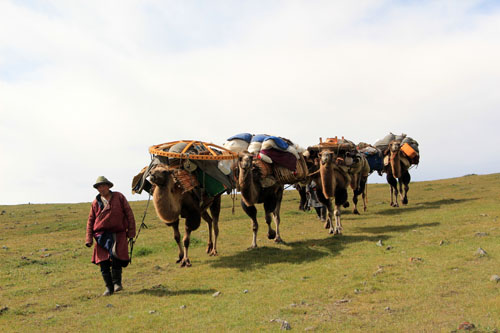
One thing that steppe herders have a relatively plentiful supply of is transport, either animal traction to pull wagons/carts or pack animals:
https://mongoliatravelmarket.com/wp-content/uploads/2015/09/nomadic-mongolia.jpg
https://tourmongolia.com/jp/wp-content/uploads/2015/02/The-Silk-Road-Camel-Caravan.jpg
This means that raw materials and tools can be carried. A basic steppe blacksmith's kit is simple and portable, and fuel is plentiful - dried dung can be used (dung isn't an adequate fuel for smelting, but forging doesn't need as high temperatures, especially if welding isn't necessary). Given the materials and basic tools, it's just a matter of labour, and long winters can provide plenty of time to do things like lace rawhide (or iron) plates to make lamellar armour.
References:
Mongolian transport photos are from https://mongoliatravelmarket.com/about-mongolia/mongolian-nomads/ and https://tourmongolia.com/jp/?cat=13