I studied electrical and computer engineer in college, and my professors would often bemoan the state of our power grid. A brief look-up seems to confirm that it is true, "most electric transmission and distribution lines were constructed in the 1950s and 1960s with a 50-year life expectancy". I also remember they were so desperate for power engineers, that there were substantial scholarships for students even just considering going into power, because apparently the average age of a power engineer is over 60 (I can find no source of this, so I assume it isn't true).
Specially, I had a professor claim it was largely due to privatization of the power grid in the 80s. Is there any truth to this? More generally, what is the history of the US electric grid of the 20th century?
The US power grid has evolved significantly since 1950. First, it has developed from small-scale local grids into an integrated continent-wide grid. More precisely, it has become three major grids, with limited connections between those three grids. The Western Interconnection covers the western US (and extends north into Canada), the Eastern Interconnection covers the eastern US (and extends into Canada, up to the area covered by the Quebec Interconnection), and the Texas Interconnection covers most of Texas (and keeps the feds out of Texas power):
A big part of this change has been a large growth in long-distance transmission of power.
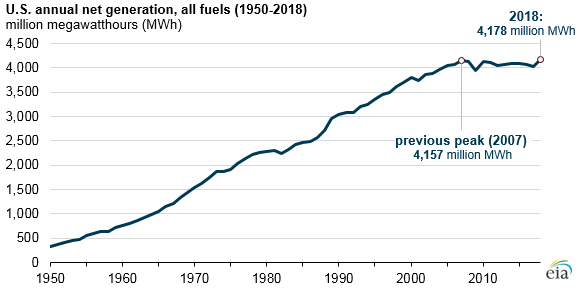
The other large change has been an enormous growth in the amount of electricity generated and used. From 1950 to about 2007, the amount of power grew approximately linearly by a factor of about 10 times:
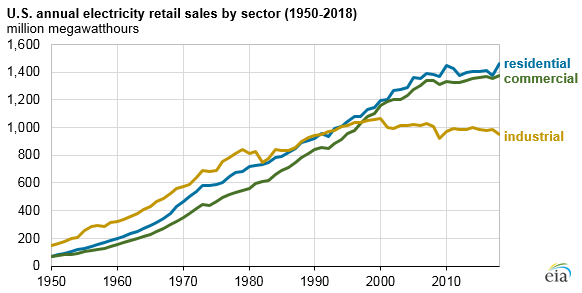
Industrial use of electricity plateaued in about 1990, while domestic and commercial consumption kept increasing until about 2010:
This combined growth in interconnection and generation/consumption has required a large growth in long-distance transmission capacity:
It is failures in the long-distance transmission system that are most likely to result in large-area extended blackouts (faults in local distribution will result in small-scale blackouts and are usually fixed more easily).
The growth in electricity usage and long-distance transmission is largely responsible for the age of the current grid. Much of the local distribution networks dates to the 1950s and 1960s, and the long-distance transmission network is on average newer - from the last graph above, if there had been no replacement of old lines or components, the median age of the long-distance network would be about 40 years (the half-way point in length of lines was in the late 1970s). Since some old lines and components (e.g., transformers) have been replaced, the average age is about 30 years. Until the 1990s, most of the investment in long-distance transmission infrastructure was new lines, not overhaul of existing infrastructure. Most of the grid is over 25 years old, and if one includes depreciation, the total value of the grid is decreasing, with loss of value through depreciation exceeding the value of new infrastructure. The grid is aging.
This aging impacts reliability. The old distribution network was a passive network, designed for locally-generated power to be delivered to relatively predictable local consumers. Today, the network is much more interconnected, and designed to be able to deliver power over long distances in response to changes in demand. Consumer demand is often difficult to predict in the medium term - heating and air-conditioning are major drivers of consumer demand, and depend on the weather. The old sections of the distribution lack sensors, communication, and smart switching. Proper integration of energy from renewable sources such as solar and wind, which don't provide steady generation, requires control and switching. Making things worse, the older infrastructure is less reliable. Together, these have resulted in larger and longer blackouts ( Fairley, 2004; Amin, 2010). A large drop in R&D investment in the grid since the mid-1990s has also contributed (Amin, 2010).
Specially, I had a professor claim it was largely due to privatization of the power grid in the 80s. Is there any truth to this?
Privatisation of utilities is known to often lead to reduced investment in infrastructure, including maintenance. This is likely to have contributed to the drop in R&D expenditure in the last 30 years. However, much of the aging of the long-distance transmission network appears to simply be due to the way it grew rapidly from 1950 to 2010. In the 1980s and 1990s, the older parts of the network were old, but still functioning well enough, and investment went into further growth. Now, after another 30-40 years, those older parts are even older, and not capable of meeting the demands of an integrated smart network.
Investment in the transmission network has increased since 2010:
even when measured per kWh (King, 2017). Privatisation hasn't stopped investment in infrastructure. It has, however, slowed down the modernisation of the system (Amin, 2010). Long-distance transmission in the US grid is controlled by non-profit corporations, largely owned by the power utilities operating in the area they cover. Here is one point where privatisation has an impact on infrastructure: who should pay for modernisation of infrastructure in an area when the benefit will be for customers outside that area (which is common for long-distance transmission)?
apparently the average age of a power engineer is over 60
Power has, on average, the oldest electrical engineers (the members of the IEEE Power & Energy Society have an average age about 8 years higher than the IEEE average age). It doesn't attract as many engineering students as the field will probably need - it isn't a fashionable field, and it is (or at least was, about 10 years ago) worse paid than other fields in electrical engineering. 60 appears to be an overestimate, but it is a field with an aging workforce (Grice et al., 2008; 2011).
References:
S. Massoud Amin, "U.S. Electrical Grid Gets Less Reliable", IEEE Spectrum, 2010. https://spectrum.ieee.org/energy/policy/us-electrical-grid-gets-less-reliable
P. Fairley, "The unruly power grid", IEEE Spectrum 41(8), 22-27 (Aug. 2004) https://doi.org/10.1109/MSPEC.2004.1318179
Amy Grice, Jackie M. Peer and Greg T. Morris, "Today's Power Engineering Shortage - An Alarming Problem With a Powerful Upside", 2008. https://cms-cdn.selinc.com/assets/Literature/Publications/Technical%20Papers/6303_TodaysEngineeringShortage_JP_20071026_Web.pdf
Amy Grice, Jackie M. Peer and Greg T. Morris, "Today's Aging Workforce - Who Will Fill Their Shoes?", 2011. http://dx.doi.org/10.1109/CPRE.2011.6035641 https://cms-cdn.selinc.com/assets/Literature/Publications/Technical%20Papers/6429_TodaysAgingWork_JP_20110217_Web.pdf
Carey W. King, "How to Predict a Utility’s Transmission and Distribution Costs: Count the Customers", IEEE Spectrum, 2017. https://spectrum.ieee.org/energywise/energy/policy/how-to-predict-a-utilitys-transmission-and-distribution-costs-count-customers-served
The first 2 graphs, of growth in electricity generation and consumption, are originally by the US Energy Information Administration, and linked from https://www.ajot.com/news/record-u.s-electricity-generation-in-2018-driven-by-record-residential-commercial-sales
The 3rd graph showing also showing growth in transmission lines is linked from https://science.nasa.gov/science-news/science-at-nasa/2010/26oct_solarshield