I remember learning in one of my classes about the modern Middle East that apparently the Arabs rejected the idea of giving Jews their own state. But in the creation of Palestine, Jewish people living there would be given 100% equal citizenship and be treated more-or-less no differently at all than Palestinians, but it would be the latter that ran the government. Is this accurate to what was planned for the Palestinian state?
As far as I'm aware, Muslims and Jews lived side by side for centuries with few problems and the anti-Jewish attitude the Middle Eastern countries have now came from the creation of Israel in the 40's. If that's the case, I have no problem believing Jews and Palestinians would have been pretty much treated as equal citizens in a Palestinian state where the Jewish settlers never rose up.
I remember learning in one of my classes about the modern Middle East that apparently the Arabs rejected the idea of giving Jews their own state. But in the creation of Palestine, Jewish people living there would be given 100% equal citizenship and be treated more-or-less no differently at all than Palestinians, but it would be the latter that ran the government. Is this accurate to what was planned for the Palestinian state?
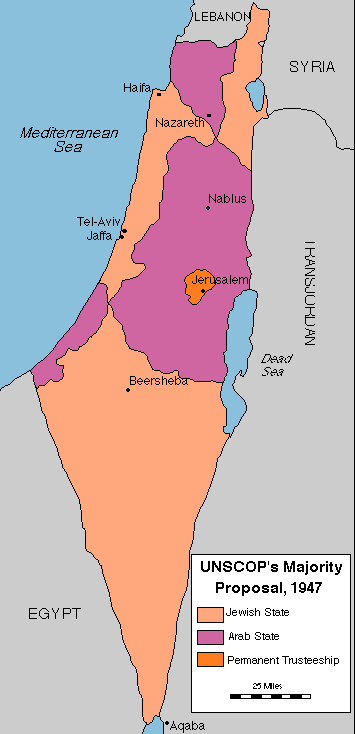
If you're referring to the 1947 proposal for partition, that's one thing. However, you appear not to be referring to the proposal for partition, in which a Jewish state and Palestinian state would exist side-by-side, and both states (under the plan) would have to ensure rights to all minorities, among other things. There would be a sizable Arab minority in the Jewish state portion, but almost no Jews in the Arab state proposed. You can read that proposal here, and I'm happy to answer questions there.
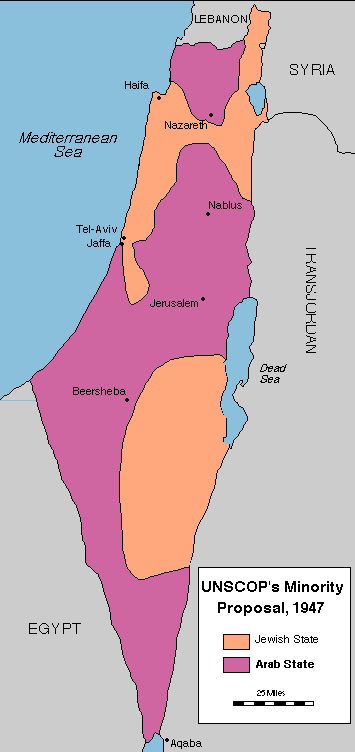
However, you seem instead to be referring to what Palestinians wanted, which would be a rejection of any Jewish state's existence. Perhaps you're referring to the minority report proposed by the UN Special Committee on Palestine (Palestine being the name used for the British Mandate for Palestine, a British-run area, not Palestine as a state, which it was not). That proposal was for a "federal" state, and rejected by the UN and by the UN Committee mentioned. The state would be nominally "binational", and the plan was envisioned to protect the minority (Jews) "from the fear of domination" by "political structure".
The broad structure of the federal state proposal was:
An independent state of Palestine would be created after an up-to-three-year transitional period.
The federal state would have two component states: Arab and Jewish.
The land distribution would be very different from the majority proposal for two independent states. The minority plan is here, and the majority plan is here.
The system of government would include federal and state components for both federated states.
One legislative body would be proportional to population, and the other would be equal Jewish-Arab in composition.
All legislation would have to go through both chambers. Think of this as a House-Senate proposal, in the US context, where one body is proportional to population (House) and the other to states (Senate).
Any disagreement between the two bodies would go to an arbitral body, which would be composed of one person from each legislative body (2 people), the head of state (1 person), and two others picked by the federal court (2 people).
That arbitral body would have to have a minimum of 2 Arabs or Jews, so while one group would have a majority in all cases, it would be a 3-2 majority always.
The head of state would be elected by both legislative bodies together, by a majority vote of both bodies, and a deputy head of state (who would act in the capacity when the main head of state was unavailable) would be elected from the other community. So an Arab head of state would mean a Jewish deputy head.
The federal court would have a minimum of 4 Arabs and 3 Jews.
Equality would be part of the constitution, and forbid discriminatory legislation.
So in theory, this sounds relatively good. Was it likely to be? We can't ever know, but why would the Jewish population not like this?
The ultimate problem would be that there would be no Jewish state. Simply put, Jews were quite tired of living as a minority in various states around the world, and sought to have self-determination and the ability to decide their own fate. Jews had faced significant discrimination around the world, including in the Middle East (and yes, including pre-1940s, I believe your impression there is incorrect, as I explain here), and did not want to be a minority yet again.
The principles of equality and the rest are certainly nice, but in practice seemed less likely to be realistic. As you may have noticed, in reality the proposal would skew the federal state to Arabs. The judiciary would be run by a larger minimum of Arabs than Jews (4-3), which would make the arbitral body likely to be Arab majority as well.
To expand on that, imagine this (very likely) scenario. The judiciary is 4-3 in favor of Arabs, by default, so they pick two Arabs for the arbitral body. The head of state may be Jewish, maybe not, but let's say they are for the sake of argument. At any rate, the federal legislative bodies are likely to have an equal representation in one, but the other would be proportional to population, meaning an Arab majority. That would make 3-2 in favor of Arabs almost by default. In the end, Jews would be unlikely to ever have a majority in this scenario for any legislation, and the state itself might very well reject Jewish immigrants using this method, preventing any growth of the Jewish population through that way (despite many Jews hoping to enter their ancestral homeland following the Holocaust, or to flee antisemitism in the Middle East).
It's worth noting that this proposal requiring close cooperation and good faith in favor of everyone being "equal" would come on the heels of over 25 years (and more) of unrest, resulting in Arab riots and a revolt in 1920, 1921, 1929, 1936 (revolt), and constant sniping and tit-for-tat fighting between Jewish and Arab leaders. A federal system, Jews felt, would be a stepping stone to a civil war they might very well lose, because they would once again be stripped slowly of power they had managed to gain by that point.
So given that history, and given the facets of the plan would not exactly create equality in practice in the eyes of most Jews, but would only mean equality on paper, most Jews simply opposed it.
There was some division over whether even the minority plan was sufficient to meet Arab demands, within the Arab world. After the threats of bloodshed and war if the world supported the proposal for partition (one Palestinian Arab politician, Jamal al-Husseini, said "Blood will flow in the rivers of the Middle East" if anyone supported partition, for example), the minority report was sometimes also slammed. Hajj Amin al-Husseini, a prominent Palestinian Arab politician as well (especially pre-WWII, less so afterwards since he joined the Axis during WWII and preached antisemitism), called it "undercover partition" and called it part of the "Zionist imperialist plan" because it would supposedly solidify a part of the area as Jewish by recognition, as Elad Ben-Dror explains in "The Arab Struggle Against Partition". While some treated the minority plan sympathetically, however, Husseini tipped the scales against it decisively; Arab states met in September and denounced even the minority report as bad. Nothing but another Arab state would do for them, and a Jewish state would be unacceptable, they made very clear. Jews, as I mentioned, believed they deserved self-determination and were not exactly enthusiastic about returning to minority status once again in their homeland, after enduring discrimination and rising antisemitism that, yes, preceded Zionism's rise as well.
Well, war came, and eventually both plans were never implemented. But hopefully this gives you some insight into alternative proposals that were brought up and rejected, and why Jews were not enthused by the idea of living in yet another Arab state where their existence would not necessarily be secure.