I watched this video from the 90s TV show Sharpe (set in 1800 during the Napoleonic Wars):
https://www.youtube.com/watch?v=nuQhvoHXcys
In this clip, a British general chews out a colonel for his failings on the battlefield. The worst failing of all is that the colonel lost the King's Colours (ie the British flag). The general loses his cool over this one. He thinks it worse than all the casualties the unit suffered. I get that losing the flag could be embarrassing, but worse than the loss of human life? Is this scene realistic? How was this sort of thing viewed in the real world?
Before going anywhere, it is important to remember Early Modern Warfare and how chaotic it was. Men and animals are shoved into a battlefield of usually no more than a few dozen square kilometers or less with smoke, fire, and steel everywhere. Since this is the age of black powder, every shot you made caused a plume of thick smoke that hangs in the air and depending on the weather conditions (hot or cold, windy or still, humid or dry) it can and will build. With the sounds of drums, trumpets, muskets & artillery, men and horses dying, there's many opportunities for soldiers to become lost, confused, and disorganized. The regimental standard is important and useful to recognize who is what, especially since black powder smoke causes colors to become washed out in vision (personal experience rather than one that could be sourced) but also due to a multitude of allies, regimental coloration, and changes in clothing due to weather (such as taking jackets and coats off during high heat or putting on more jackets that cover your uniform during the winter).
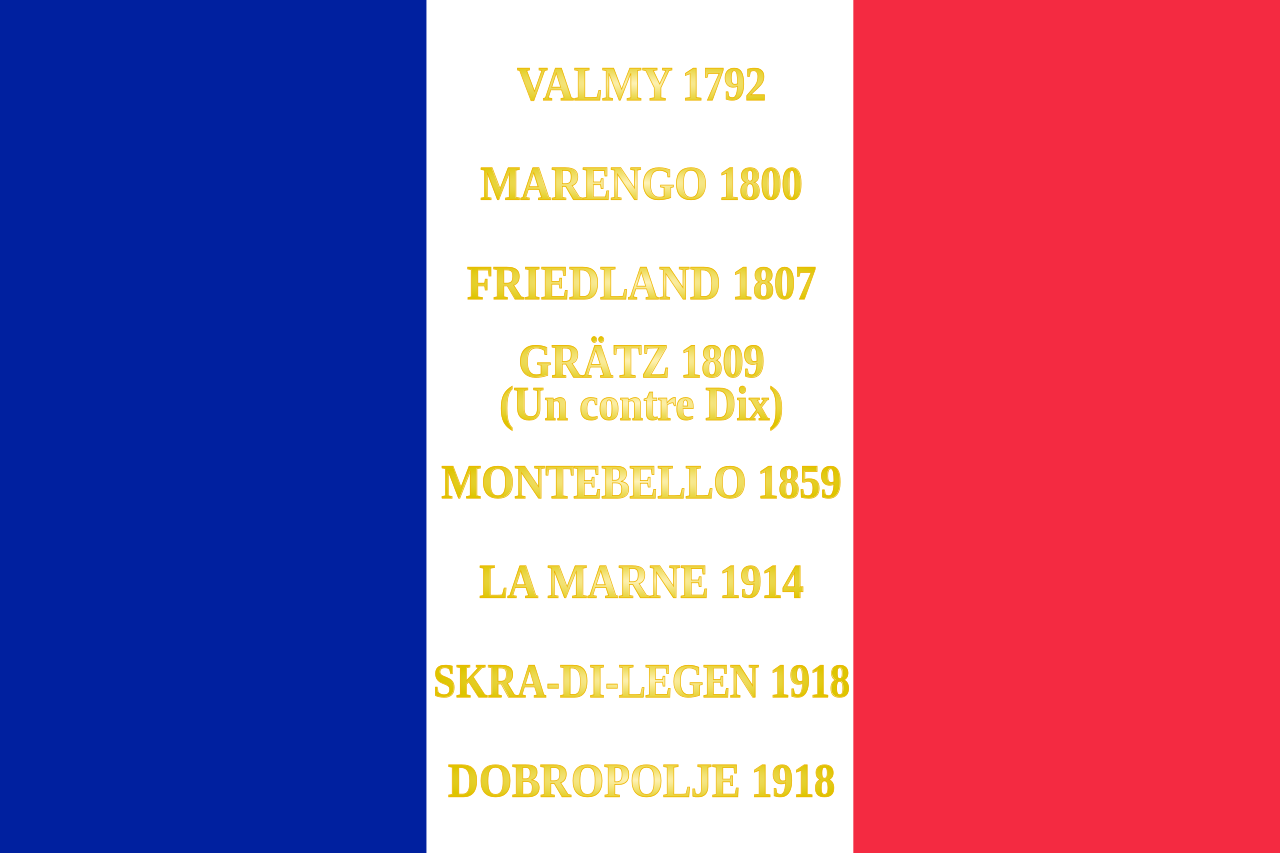
However, the practical aspect of a standard is secondary to the larger truth, a regimental standard is the identity of that regiment/unit. One of my personal favorite regiments of note is the 84th Infantry Regiment (84e regiment de infanterie), the "One Against Ten" (un contre dix); during the Baattle of Graz during the War of the Fifth Coalition right before the climatic Battle of Wagram. Reportedly, this regiment held a bridge during the battle against a division of Austrian Soldiers, one regiment against ten. Upon hearing this, Napoleon gave the regiment a battle honor which would allow the regiment to place the name of thr battle on their regimental flag. It would look like this. As they showed particular bravery, Napoleon named them the Un Contre Dix, a nickname for the regiment that was rare within the French Army as there were just a handful of such, and as they had one given by Napoleon, they had a silver plaque made to hang from the regimental flag under the Imperial Eagle at the top of the flag pole. They would follow Napoleon into Russia and on the retreat, the colonel would destroy the Imperial Eagle and bury it but he would keep the plaque with the name of the regiment.
There is a particularly notable painting that I would like to bring up and contemporary to the era, The Distribution of the Eagle Standards by Jaques-Louis David, 1810. One of the first things Napoleon did as Emperor was lavish honors on his Army, including the event depicted above and inspired by the Roman Empire that Napoleon was inspired by. Within the French Army, the Imperial Standard was gifted by the Emperor to his men, their direct connection to Napoleon. Considering the vast number of stories concerning Napoleon and his men, the level of adoration that he received by those men, and the deep interest still inspired by him, Im inclined to believe the painting, while mythical and spirited, grasps that love and special aspect of the French Imperial Standard.
However, it is also represented in one other piece of media. I will admit that I focus more on theory and organization within this era, so I lack individual stories to confirm this, but it is important to see that within the lifetime of these soldiers, this was a common theme. In the novel Les Miserables by Victor Hugo, the father of Marius Pontmercy was a Colonel at Waterloo that stole several battle standards and presented it to the Emperor, who was instantly made a Baron of the Empire. A short time after that was written, the French Painter Edouard Detaille would paint Le Trophee. 1898
One final piece of evidence to mention is Imperial Bulletins. What are effectively "news" from the front (and I put quotes because they're little more than propaganda pieces in the guise of news), they would be a source for news in respect to battles and victories (as defeats were rarely reported, such as the lack of reporting on Trafalgar to not diminish Austerlitz). However, they would also list numbers, numbers of soldiers lost and captured (always exaggerated to outright lies), number of guns (artillery) captured, and the number of flags captured. Effectively, the last two are a means of showing the level of success of an army as a lost standard means that the enemy regiment was defeated or captured and dropped or let the standard be captured. A savvy commander might take time to burn or bury their flag but the capture means that it wasn't possible to destroy the standard before.
However, all Empires must end. During the dark days of 1814, the Allies were descending on Paris. Marshal Oudinot is the Governor of Les Invalides reportedly rushed back to Les Invalides where these standards are kept on display, including the fabled Sash of Frederick the Great, and burned them to prevent these dear war prizes to get stolen.
The flag of a nation is a representation of that nation, which is why there are rules as to their treatment. However, on the battlefield, they are more than just a representation of that nation but also of those that hold it.
Sources: The Art of Warfare in the Age of Napoleon by Guenther E. Rothenberg Tactics and the Experience of Battle in the Age of Napolron by Rory Muir Napoleon's Marshals: Ed. By David G. Chandler The Campaigns of Napoleon by Chandler. Napoleon's Marshals: by R. F. Delderfield.
A very big deal. Since it's appropriate, I'll quote from the book that Sharpe episode is based on:
The Ensigns pulled the leather covers from the South Essex colours, unfurled them, and hoisted them into their sockets. They made a brave sight even in the middle of this comedy, and Sharpe felt the familiar pang of loyalty. The first raised was the King's Colour, a great Union Jack with the Regiment's number in the centre, and next the South Essex's own standard, a yellow flag emblazoned with the crest and with the Union flag stitched in the upper corner. It was impossible to see the flags, the morning sun shining through them, and not be moved. They were the Regiment; should only a handful of men be left on a battlefield, the rest slaughtered, the Regiment still existed if the colours flew and defied the enemy. They were a rallying point in the smoke and chaos of battle, but more than that; there were men who would hardly fight for England's King and Country but they would fight for the colours, for their Regiment's honour, for the gaudy flags that cost a few guineas and were carried in the centre of the line by the youngest Ensigns and guarded by veteran Sergeants armed with long wicked-bladed pikes. Sharpe had known as many as ten men to carry the colours in battle, replacing the dead, picking up the flags even though they knew that then they became the enemy's prime target. Honour was all. The flags of the South Essex were new and gleaming, the Regimental Colour devoid of battle honours, neither was torn by bullet or roundshot, but seeing them filled Sharpe with a sudden emotion, and it changed the farce of Simmerson's mad hopes into an affair of honour.
Whilst Sharpe is of course fiction, the attitude Sharpe holds here and the sheer outrage Wellesley shows in the episode are entirely within character for soldiers of that era. Indeed, as the South Essex was hardly the only British unit to lose a Colour, we can examine the testimony of another regiment that suffered the same dishonour. Here we have a letter from Lieutenant Crompton of the 66th (Berkshire) Regiment, who fought at Albuera:
We fought them till we were hardly a Regiment. The Commanding Officer was shot dead, and the two Officers carrying the Colours close by my side received their mortal wounds. In this shattered state our Brigade moved forward to charge. Madness alone would dictate such a thing, and at that critical period Cavalry appeared in our rear. It was then that our men began to waver, and for the first time (and God knows I hope the last) I saw the backs of English soldiers turned upon French...
Oh, what a day was that. The worst of the story I have not related. Our Colours were taken. I told you before the 2 Ensigns were shot under them; 2 Sergeants shared the same fate. A Lieutenant seized a musket to defend them, and he was shot to the heart; what could be done against Cavalry? General Stewart, who marched us wildly to this desperate attack without any support, praised rather than censured our conduct, but I should think the malicious World will take hold of it with scandal in their mouths.
Albuera was a hard, hard battle for the 66th (and, frankly, for the first three regiments of their whole brigade). They mustered about 400 men at the beginning of the action, saw 16 officers and 310 men killed, wounded, or missing, and could parade only 53 men the next day. A bad enough time for the 66th, and even so Crompton still considers losing the Colours the worst of the story. Indeed, as Elting puts it in his book: "a regiment that had allowed its colors to be taken while its men could stand and fight was disgraced before all mankind."
The Colours do have a practical purpose on the battlefield. If you'll continue along that episode, Sharpe lectures the South Essex on the experience of battle, noting that "You don't see a battle, you hear it." Gunpowder weapons of the time belched a hideous amount of smoke, enough that some of the reason for all the colourful uniforms of the period is for identification. (Only some, not all. Never underestimate the urge to look stylish.) That's also the practical purpose of the Colours: As a rallying point for the men of the unit in the smoke and chaos of the battle. If by some mischance you should be lost in the field, rally to the Colours.
But more than that practical purpose is how they're viewed by the men of the regiment. The best way to illustrate this, I think, is to look to the episode title, across the field, at the French eagles. Elting notes that "the devotion given to those eagles was astounding, almost the equal of the divine honors Rome's legions rendered theirs." Said devotion is a whole mess of heroic deeds various French rankers and officers pulled off to save their eagles from being taken, and thus save their unit the dishonour of losing them. Chef de Bataillon Tremanger of the 125th Ligne was captured at the Berezina in 1812, yet managed to conceal the eagle and accompanying flag for two years of captivity until he returned to France. The Irish Legion, later the 3rd Regiment Etranger, saved theirs twice. First as the Irish in 1809, where two officers spirited their green standard away from Walcheren on a boat, managing to evade the Royal Navy's blockade. Then, as the 3rd Etranger with an eagle at the Katzbach, they were backed against the said river and doomed, but thirty men managed to win through and swim away with their eagle, honour intact. Also at the Katzbach, a man of the 134th managed to recover the eagle of the 147th from where it lay beneath the corpse of its bearer. Unlike the Irish, he didn't have much faith in his swimming capability, and instead held on to a rock until the waters subsided.
And this is just a selection from the book. There's more in there. Elting notes that likely most of them have been embellished from the original, but most are true enough.
The colours may look to be just a flag to us, but they are a powerful talisman to the 19th-century soldier, very much the embodiment of their unit. To close off, here is a final testimony from a survivor of the French 7th Legere, as they came out of Russia. Note that, as light infantry, they should have left their eagle at the depot so as to move and fight unencumbered. And yet? The men of the 7th formed up around "our Eagle, the staff of which had only a rag of cloth, and despite having had one of its wings carried off by a bullet at Eylau, soared above these disasters like a holy rallying sign."
Sources:
Sharpe's Eagle, Bernard Cornwell
Tactics and the Experience of Battle in the Age of Napoleon, Rory Muir
Swords Around a Throne, John Elting