Hello historians! I have often read that, before the 19th century, it was pretty current to share a bed with family/friends and even strangers when people were traveling. Is this true? If yes, when and why did this stop? When did it become normal to sleep alone?
As someone who's currently sharing a bedroom (but not a bed) with a four-month-old baby, this is a very interesting question to me.
There were several reasons why people would share a bed in pre-Victorian times:
A bed was very expensive. From around the 15th century on, kings and noblemen would posess great and sumptuous beds. However a bed and mattress was quite an investment for most people, a bed could account for one quarter of the house's value. The clergyman William Harrison in 1580 said it took seven years for a married couple to buy a mattress and a sack of chaff as a pillow. It simply saved cost to sleep together as a family. Harrison also wrote that servants slept on straw, without a covering over it, and that they were lucky to have a sheet to cover them.
Secondly, while we currently see sleeping and bedrooms as very much a private and sometimes even shameful affair, pre-Victorian people just didn't see it that way. Sleeping and beds were seen as we now see eating for example: fine to do in company, not something to hide or do in private. This fits into a larger trend: just think of the 'groom of the stool', the person responsible for taking care of his master's toiletry-related needs. Or the habit at courts to watch the king go to bed or rise, or even to see newlyweds to their wedding bed.
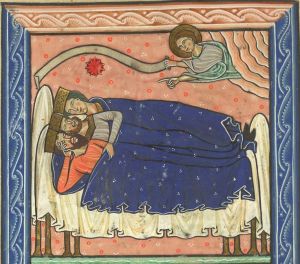
Here we have three Medieval sleepers in a bed.
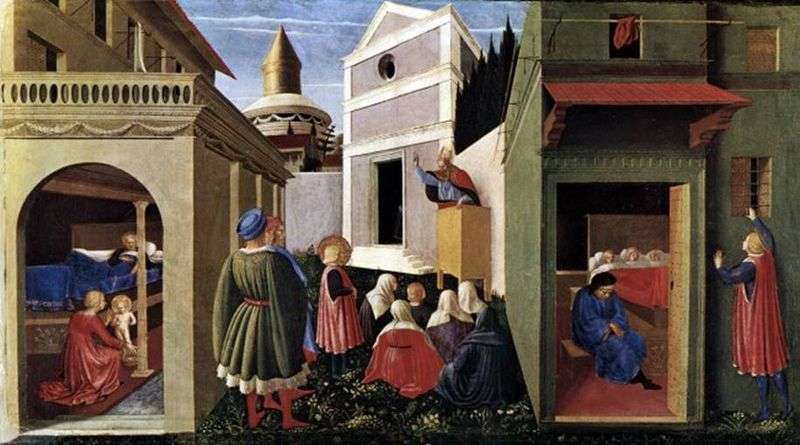
And an illustration of a bed for three, by Fra Angelico.
In rich people's houses, the bed was luxurious and sumptuous. A bed was seen as a comfortable peace of furniture, especially since there were no lazy corner couches or recliners as we have now. The bedroom was a place to sleep but also to read, think, and welcome visitors. Even judicial or diplomatic business could take place around the bed. It was not totally unusual for servants to have a trundle bed nearby, to always be at the beg and call of their master. Queen Elizabeth had her ladies in waiting sleep on straw pallets on the floor of her chamber.
We know of some famous bed-sharers: Samuel Pepys in his diaries often casually tells us he stayed over at a friend, or they shared lodgings. The often-mentioned Mr. Creed was deemed pleasant company during the night. (e.g. 20 april 1661)
In September 1776, John Adams and Benjamin Franklin famously shared a bed in a New Jersey inn with only one small window. Adams kept it shut, but Franklin wanted it open, complaining that he would suffocate without fresh air and they quarreled.
Then there was the Great Bed of Ware – a massive bed kept in an inn in a small town in England. It was said to have accommodated up to 52 people one time. However, this was more of a joke/special feature than a regular occurrence. But shared beds were still practical and economical at inns.
In 17th century American houses of English and Dutch colonist, there is no dedicated bedroom. The rooms were divided according to their value, not function. There was a parlor which held the nicest furniture, and which had a nice bed where the household members of the highest status slept. The hall or hall-parlor was the more common room where cooking and eating took place, and where lower-status members of the household slept.
Into the Victorian era
Increasing urbanization led to more houses with more smaller rooms with distinct functions. More people could afford larger houses. This gave rise to separate bedrooms. Except for at birth and death, the bedroom now became a more private sphere. Around 1855, an architectural book by Gervase Wheeler shows bedrooms on the ground floor, connected to the parlor and situated at the front of the house. This was often the master bedroom, so the bedroom still played a fairly central part in the home.
During the 19th century, marriage and family took a special place in the minds of people, it was highly idealized. The wife was seen as a pure and devout entity, the 'angel in the house'. The family was seen as a refuge and as a cure to modern life, a necessity for a man to keep function in the high pressure of the everyday life. To share a bed with visitors did not fit in with this picture, which is why guest rooms and separate bedrooms started to become more popular.
Children still slept together, as did poorer people. Servants were lucky to have separate beds in a shared room, but even this was not always the case. We see this distinction in some Jane Austen books (I think 'Emma' and 'Mansfield Park', from memory), where poor people still share beds while richer people have their own bedrooms.
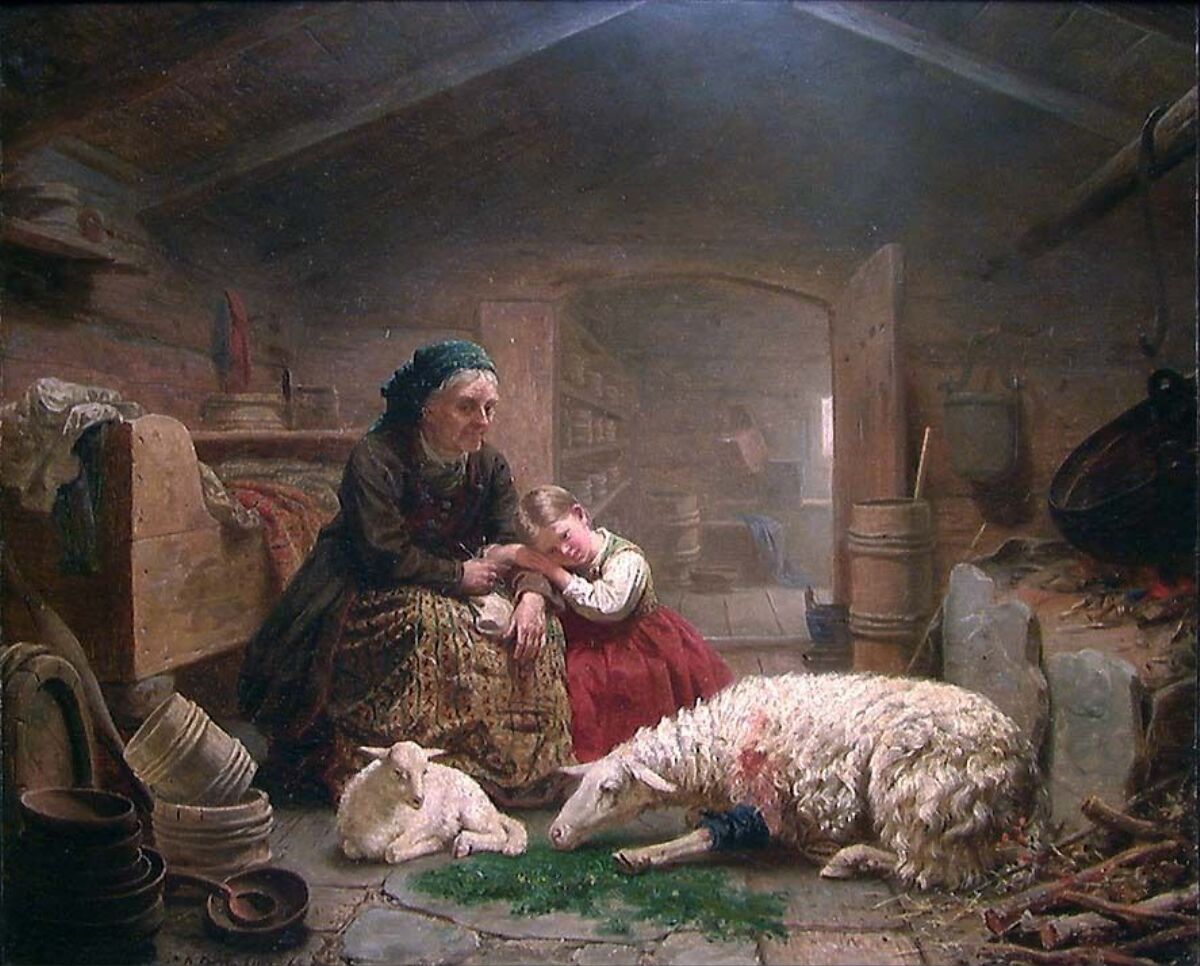
The most extreme version of this was that very poor people would not just share a bed, but share their one-room-home with animals as well. I have some pictorial illustration for you (by Knud Bergslien), and you can also find this in 'Far from the Madding Crowd' by Thomas Hardy.
Around 1860-70, separate beds and separate bedrooms gained even more traction with the concern for hygiene, preventing illnesses and healthy living. It was now thought that the sleeping body exuded poisonous vapors, and that only fresh air could provide a truly healthy sleeping environment. It was also believed that fresh air could cure or prevent tuberculosis, among other diseases. This idea culminated around 1909 when there were even porch tents for sale, or devices to sleep outside and truly benefit from all that fresh air. Many ladies magazines around this time wrote about the importance of hygiene in bedrooms. They also recommended no rugs or bed curtains, metal bed frames instead of wooden bed frames to prevent dust and bedbugs, and gave tips to prevent dust and soot in bedrooms.
There was also now an increased focus on decorating a bedroom to express yourself and develop yourself, especially among women it started to become more important to not just have a bed but have their own private sphere. It was now believed that individuals had a need for isolation and to be able to draw back from society, which a more private bedroom offered.
All these movements ultimately resulted in separate beds for every family member, for couples, or even separate bedrooms for couples, often connected by a door. This had its heyday, at least in America, in the 1950s, where couples would sleep in two separate twin beds with a nightstand in between.
Sources:
A History of American Beds and Bedrooms, Elizabeth Collins Cromley, Perspectives in Vernacular Architecture, Vol. 4 (1991), pp. 177-186
Sleeping around: A History of American Beds and Bedrooms: The Second Banham Memorial Lecture, Elizabeth Collins Cromley, Journal of Design History, Vol. 3, No. 1 (1990), pp. 1-17
Together and Apart: Twin Beds, Domestic Hygiene and Modern Marriage, 1890-1945, Hilary Hinds, Journal of Design History, Vol. 23, No. 3 (2010), pp. 275-304
Ian Mortimer, The Time Traveler's Guide to Medieval England