I don’t really get it. Early guns seem horrible. Inaccurate, no long range ability, long reloads, unusable in wet conditions.
I understand why guns became the weapons for most soldiers because in comparison to a sword or a bow they require much less training. However; why didn’t bows stay around WITH muskets?
I mean; Oda Nobunaga had this three volley system. Where below his musketmen he would have archers. So while the muskets reloaded, the archers would fire over them to keep the death rate up.
Why didn’t this happen with muskets elsewhere, and last for long periods of time? Like until rifles. Stuff like having large formations of volley fire muskets like we saw, AND trained archers in the back.
Why not?
Besides what you can find in the FAQ linked by /u/DanKensington, even in Japan, and even in Nobunaga's armies the proportion of guns steadily and quickly increased and the proportion of archers steadily and quickly decreased. By mobilization records clearly in the late Sengoku many Japanese armies did not even regard archers as important enough to record their existance. This change only stopped after a few decades of peace.
It was not that only the Japanese were smart enough to keep archers to cover for gunners while they reloaded. Guns were introduced to Japan relatively late compared to the rest of Eurasia. The Japanese quickly recognized the overall superiority of the gun, but at first they did not have enough guns to replace all their archers. So they had their archers do something useful instead.
The earliest guns co-existed with bows and crossbows for a long time, and in same places, failed to be adopted.
Early handguns were in use in China by the mid-13th century, and were possibly already in use in the 12th century. The fraction of Chinese armies using firearms in battle slowly increased over the centuries, but the bow and crossbow were still used as common infantry weapons into the early 17th century. The 17th century finally saw the gun push the bow and crossbow off the battlefield, as far as significant infantry use went. Cavalry continued to carry (and use) bows, due to the difficulty of reloading muskets on horseback. Some cavalry in East Asia and Central Asia carried both musket and bow:
19th century Mongol cavalry, with musket, bow, and lance: https://commons.wikimedia.org/wiki/File:Mongolia,_the_Tangut_Country,and_the_Solitudes_of_Northern_Tibet-_Mongol_Cavalry.jpg
Early 20th century Tibetan cavalry, with musket, bow, and lance: https://i.pinimg.com/564x/9e/02/67/9e0267c9c69b37e8c1f11d9a51197a65.jpg
The musket could be used for a powerful initial shot, and if quick shooting was needed, the bow would be used. Even if we only consider infantry use of the bow, the gun and the bow/crossbow shared the battlefield for 400 years.
In Europe, the gun arrived later, but was already in use in the 14th century. The 16th century saw the last major use of the bow and crossbow alongside the gun - the overlap between gun and bow as infantry weapons was not as long as in China, but was still 200 years. In India, the gun and bow both appeared on the battlefield in the late 18th century. In North America, the gun and bow were still used together into the 19th century.
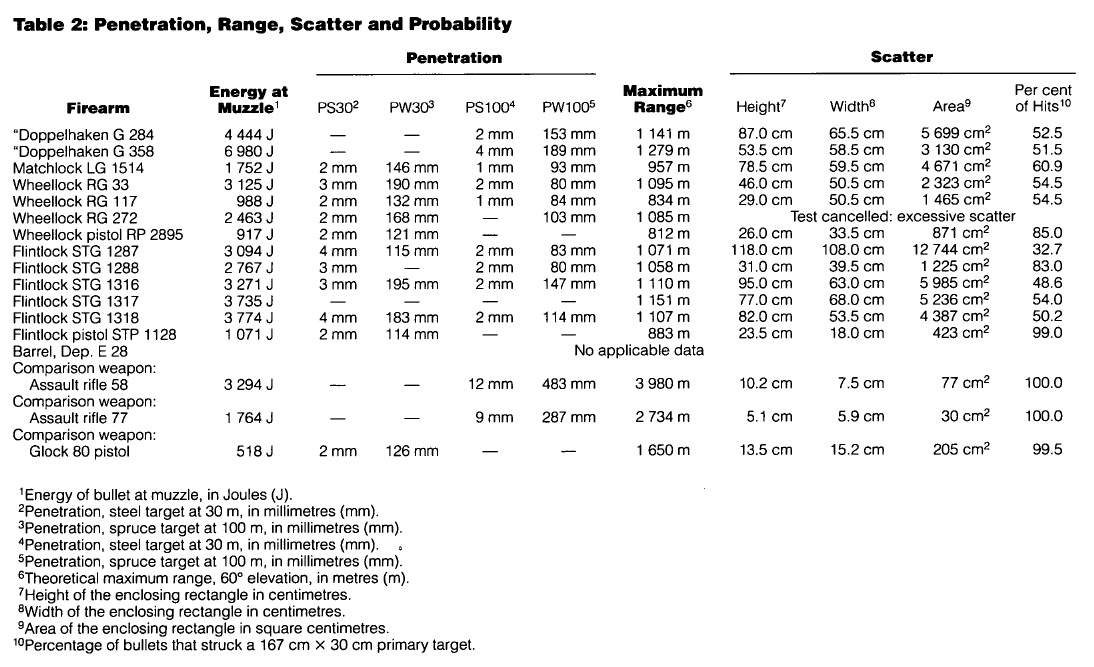
How bad were early guns? Early hand-cannons - short barrels on a stick, usually fired from the hip - were not very accurate, but a practiced shooter can hit stationary human-sized targets within about 30m. Later guns, such as the matchlock arquebus and musket, and wheel-lock and flintlock smoothbore pistols and long guns, were easily accurate to that same 30m, and long arms were reasonably accurate to 50-70m. Past this point, the ballistics of smoothbore guns causes problems: the ball tends to come out tumbling in a random direction, and this spin causes the ball to veer in some direction eventually. Aiming at a human-sized target at 100m, this causes about half of shots to miss, independent of human error by the aimer. Shooting at a formation is still dangerous at this distance, since shots that veer to the left and right can still be deadly to other soldiers in the formation. For more on accuracy and smoothbore ballistics, see:
especially table 2: https://journals.lib.unb.ca/journalimages/MCR/1995/Vol_42/mcr42art09_ta2.jpg (the accuracy results for the pistols are at 30m, the long arms at 100m).
While 30m to 70m seems small compared to the approximately 200m range of a longbow, archery at maximum range is often quite ineffective. There is an unflattering late European comment on the effectiveness of long-range archery, by the Napoleonic French general Marbot:
we were suddenly assailed by a charge of more than 20,000 Cossacks and Bashkirs. Their efforts were chiefly directed against Sébastiani's cavalry, and in a moment the barbarians surrounded our squadrons with loud shouts, letting off thousands of arrows. The loss these caused was slight, for the Bashkirs are totally undrilled and have no more notion of any forma- tion than a flock of sheep. Thus they cannot shoot horizontally in front of them without hitting their own comrades, and are obliged to fire their arrows parabolically into the air, with more or less elevation according to the distance at which they judge the enemy to be. As this method does not allow of accurate aiming, nine-tenths of the arrows are lost, while the few that hit are pretty well spent, and only fall with the force of their own weight, which is inconsiderable ; so that the wounds they cause are usually trifling. As they have no other weapons, they are certainly the least dangerous troops in the world.
in his memoirs:
as quoted and discussed by u/dandan_noodles and u/Georgy_K_Zhukov in https://www.reddit.com/r/AskHistorians/comments/7rsrep/why_is_there_an_asian_warrior_depicted_on_the/
From the 16th century, when it was more common for the gun and bow to meet on the European battlefield, the French soldier laise de Lasseran-Massencôme, seigneur de Montluc noted in his memoirs that English archers shot at close range:
when so soon as we came within four or five Pikes length of them, they let fly a great shower of Arrows upon us
which would be a range of about 20-25m. When Montluc commanded arquebusiers, they had no difficulty out-ranging English archers.
Such short ranges were common for battlefield archery in other places as well, with Miyamoto Musashi noting in his Book of Five Rings that the musket was more powerful, but the bow was still useful if rapid shooting was needed within 40m. As far as extreme range goes, gun could put a ball much further than most archers could shoot an arrow - even early hand-cannons put shoot a ball almost 1km.
Thus, while the long-range accuracy of smoothbore guns was poor, they were sufficiently accurate at typical archery ranges, and possessed good effective range. Often, when guns and bows are compared by contemporaries of the battlefield use of both, the gun is praised for its power, range, and accuracy.
Guns had three additional advantages over bows:
They caused much more damaging wounds. Against armoured enemies, bullets were much more likely to penetrate armour than arrows. Against unarmoured enemies, the wounds were simply more damaging and likely to incapacitate: an arrow cut a relatively neat hole, while a bullet ripped through flesh, breaking bones if it hit them. For a much longer discussion of this, see my older answer in https://www.reddit.com/r/AskHistorians/comments/bfm47x/were_composite_bows_effective_on_the/
Guns are robust. A hand-cannon has no moving parts; it is just a metal tube on a stick. A musket has few moving parts, and is, mostly, a tough and strong piece of metal. Early guns coped well with rough handling and battlefield use.
As is commonly said, less training is needed. In particular, a gun demands less physical strength, fitness, and skill, and exhausted and sick soldiers can still used guns effectively. This is also an advantage of the crossbow over the bow, and contributed to the popularity of the crossbow in many European armies.
Three factors drove the long survival of the bow alongside the gun:
The bow had a higher rate of fire, especially on horseback.
The bow didn't need gunpowder - if gunpowder was expensive or scarce, this wouldn't affect the use of bows. Of course, bows could suffer from their own shortages.
Armies often didn't have enough guns.
The last two factors applied to crossbows as well as bows. The importance of these last two factors depended on how good guns had become. Bows were quite competitive alongside hand-cannons, but the matchlock arquebus and musket largely drove them from most battlefields. The later flintlock musket provided even tougher competition for the bow. However, the bow could be, and sometimes was, still effective on the battlefield. The bow saw use, sometimes effective, against breech-loading rifles, and even occasionally modern firearms:
The replacement of the bow and arrow by the gun as the military weapon of choice in North America was recent enough so that we have plenty of evidence and contemporary opinions. For this case, see
Aside from the reload speed, there's a lot of room to dispute the qualities you list. More can always be said on the matter, but as the question of "Why muskets over bows?" is one of the more common military technology ones on the sub, I commend to your attention the relevant section of the FAQ - Weapons Development, then Transition from Bows to Firearms, in case your browser doesn't automatically take you there.