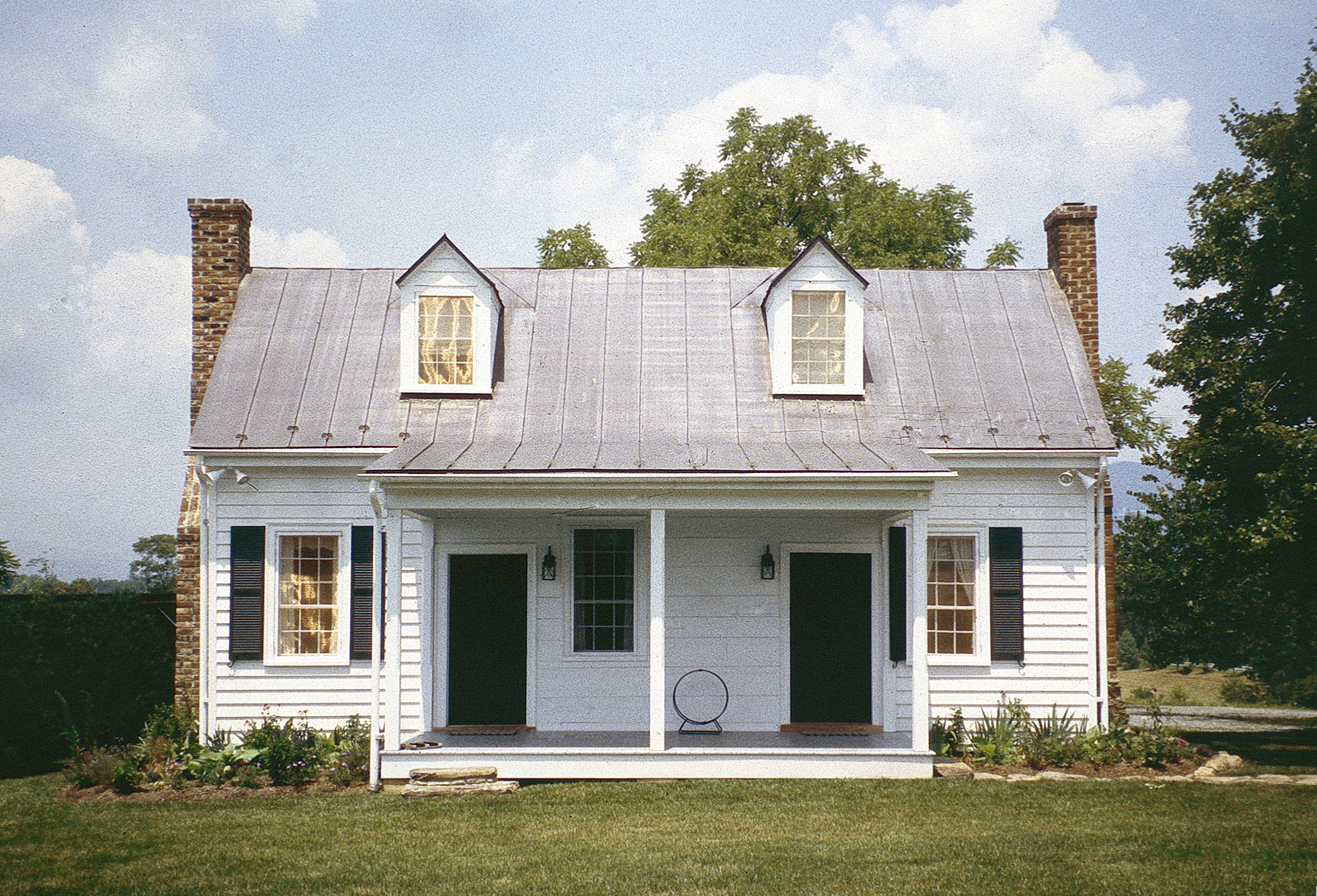
The story is that King James (not sure which one) gave the land to a family named Campbell back in the 1600's. The Campbell's sold the land in the 1800's. We would love to know more about this land, but have no clue where to start. This is in Augusta County Virginia, if that helps any.
The good news - It's very possible that the land dates to colonial times. Just across the mountains in Free Union, Va (technically... but it's actually much closer to White Hall, Va than Free Union) in neighboring Albemarle County, Maupin Farm (Plainview Farm since the 1930s) has been held by the Maupin family since 1748 when Daniel Maupin gained a land patent on the Moorman River with his wife, Peggy Via (a very common name in the county today). Daniel's parents, Gabriel and Marie (Hersent) Maupin, were the Maupins that ran an inn in Williamsburg after arriving as Huegonaut refugees in Mar 1701 (another Gabriel Maupin, grandson of this Gabriel, would own and operate Market Square Tavern on Duke of Gloucester Street during the Revolutionary War). There's still an original home (with a few additions and updates made) on the Albemarle County plot, the [Ballard-Maupin House] (https://www.dhr.virginia.gov/wp-content/uploads/2018/04/002-0326_Ballard-Maupin_House_1998-ca_exterior_front_elevation_VLR_Online.jpg), which is on the register of National Historic Places and dates to ca. 1750. But you asked about the Campbells of Augusta, not the Maupins of Albemarle - challenge accepted.
Let's start with the King James part. Kinda bad news here - There were two King James; King James I, who reigned until his death in 1625, didn't grant lands in the Shenandoah Valley. John Lederer is credited as being the first European to see the Shenandoah valley in a series of expeditions but not until around 1670. His maps were used to settle the newly formed colony of Carolina, but the new information included about the interior also allowed cartographers in London to create large maps representing from Jamestown to St Augustine and from the coast to the Appalachian Mountains. James I had became King in 1603 and authorized the Virginia Company to settle Virginia and so they named Jamestown after him, but it hadn't grown much in those 18 years preceding his death. It was actually a proprietary colony (privately owned and operated with Crown permission by charter) until 1624, just a year before James I died. Current day Augusta County was still very far from Jamestown at that time, though the General Assembly was formed in 1619 and represented 11 different settlements, the first Va courts starting soon after in 1622. None of them were in Augusta and it wasn't James I that granted the Campbells land there, I can assure you of that.
King James II followed Charles II in 1685, and by this time Virginia had been split into shires (which they quickly renamed to counties). They did that in 1634, but the first counties' extreme western borders were on a big diagonal line that runs along the current eastern border of Albemarle County extended the height of the state^1. Charles City was to the southeast, Henrico the east, and Charles River the northeast (wanna guess who was King when they named them?). James II's reign was short, lasting only until 1688 and the Glorious Revolution when William and Mary took the throne (and for whom Williamsburg and the attached College of William and Mary are named). While Virginia had grown they still had yet to actually pierce the western wilderness of the Blue Ridge Mountains - that is until an adventurous Scotsman arrived (actually he was born in Morocco, but he was a Scotsman by blood). In 1710 Lt Colonel Alexander Spotswood became Lt Governor Spotswood, and he was susequently the first person to live in the Governor's Mansion in Williamsburg. He also orchestrated the Albany Treaty with the Five Nations, but that came a little over a decade later in 1722. And he was instrumental in sending a two pronged attack on North Carolina in 1718 - he had dispatched a land force as well as one Lt Robert Maynard by sea, the latter fulfilling the objective of the expedition - capturing or killing Edward Thatch, aka Blackbeard the pirate. More pertinent to your question is that in 1716 and in response to the need for western expansion Spotswood personally led an expedition consisting of a few dozen people up the "headwaters of the James River" (today we call it the Rappahannock River and the "headwaters" they followed is the stream now named Swift Run). On 2 Sept 1716 they passed current day Stanardsville, Va (pronounced like standards-ville but without the first "d", not sta-nards-ville like it would seem) in Greene County, Va, and they soon hacked trees with axes to move their caravan up what we today call Route 33 - aptly dubbed Spotswood Trail - to the tight gap nestled between Hightop Mountain and Dean Mountain in Shenandoah National Park, where the waters of Swift Run start wandering towards the sea. Today we call it Swift Run Gap and in the gap is a large pyramid marker dating to 1921 with a plaque recognizing the historic moment on 5 Sept of 1716 that Spotswood and his party switched from walking uphill to walking downhill. The plaque reads;
In honor of Governor Alexander Spotswood and the Knights of the Horseshoe: John Fontaine • Robert Beverley • William Robertson • Dr. Robinson Todd • James Taylor • Robert Brooke • George Mason • Captain Smith • Jeremiah Clouder and others whose names are unknown, who with rangers, Indians and servants, about fifty in all, reached the summit of this pass. September 5, 1716.
Erected 1921 by Colonial Dames of America in the State of Virginia, September 5th.
Some of the earliest Europeans to walk in the Shenandoah Valley were trekking down to the (modern day) South Fork Shenandoah River near Elkton. They stopped there and drank a toast, then had a dandy campout, celebrating their achievement, on 6 Sept 1716. It had taken four days to travel the 16 miles that you can drive in ~20 min today. On the way back they formed a club called the Knights of the Golden Horseshoe; members of the party received a small "golden horseshoe" as a momento/badge of honor and today the whole adventure is commonly known as the Knights of the Golden Horseshoe Expedition of 1716. Anyway, James II died in 1701 before Spotswood ever set foot in Virginia, let alone the Shenandoah Valley, so it also would not have been James II (the most recent James).
Cont'd