The short answer: Yes.
The screw had been known in the West since about the 4th century BC, but most screws were wooden, for example large wooden screws used in olive presses. However, there are some threaded examples in metal. The two most common examples I know of are (a) some crossbow brooches, where a threaded pin is used to secure the brooch pin, and (b) screw threads on surgical instruments.
The crossbow brooch is typically late Roman, and were used to fasten cloaks, and as such appeared as part of military dress. These brooches are named after their general crossbow-like appearance, with a curved "stock" and a straight "prod" (i.e., the bow):
In a screw-thread crossbow brooch, one of the knobs on the end of the "prod" is the head of a screw. The base of the screw is threaded, and the end of the inside of the "prod" has a matching thread. These are made of copper alloys (often brass), silver, or gold. One method of making the threads was to wrap two wires around the base of the pin that would become the screw, making two close-fitting helices. One helix was then soldered to the pin to form the male thread, and the other inside the "prod" to make the matching female thread.
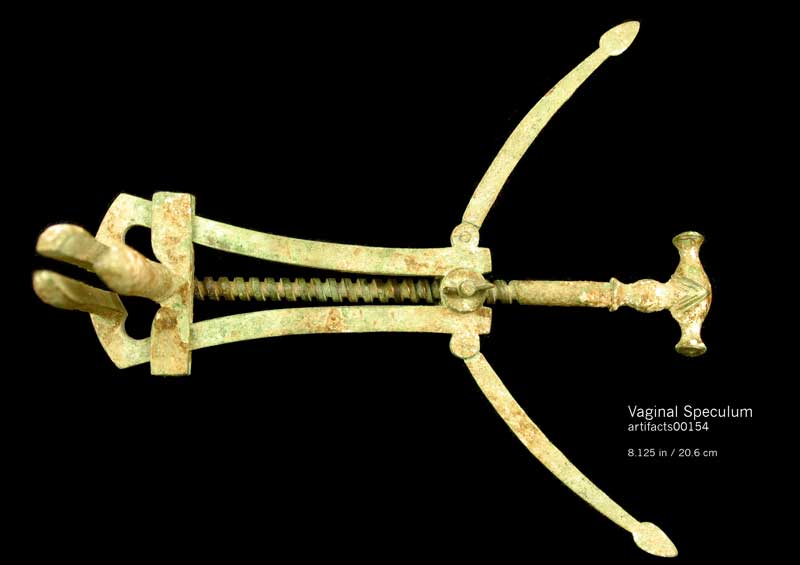
Another example of the Roman metal screw thread is seen in the medical speculum:
Examples have been found at Pompeii, and elsewhere, but are fairly rare.
References and further reading:
Craddock, P. (2019), "The Screw Threads of Antiquity: To Raise, to Adjust, to Measure, to Press, and to Hold", Mouseion: Journal of the Classical Association of Canada 16(5), 177-190. https://www.utpjournals.press/doi/abs/10.3138/mous.16.s2-4 https://www.muse.jhu.edu/article/742850
The speculum photo above is linked from
which also has another example, and discussion of these (and other) Roman medical instruments.
For comparison, some Roman and Roman-type screw presses with wooden screws can be seen in
Byzantine screws are discussed by u/Ambarenya in