[1/3]
This is exactly the kind of question I was hoping to answer! Thank you!
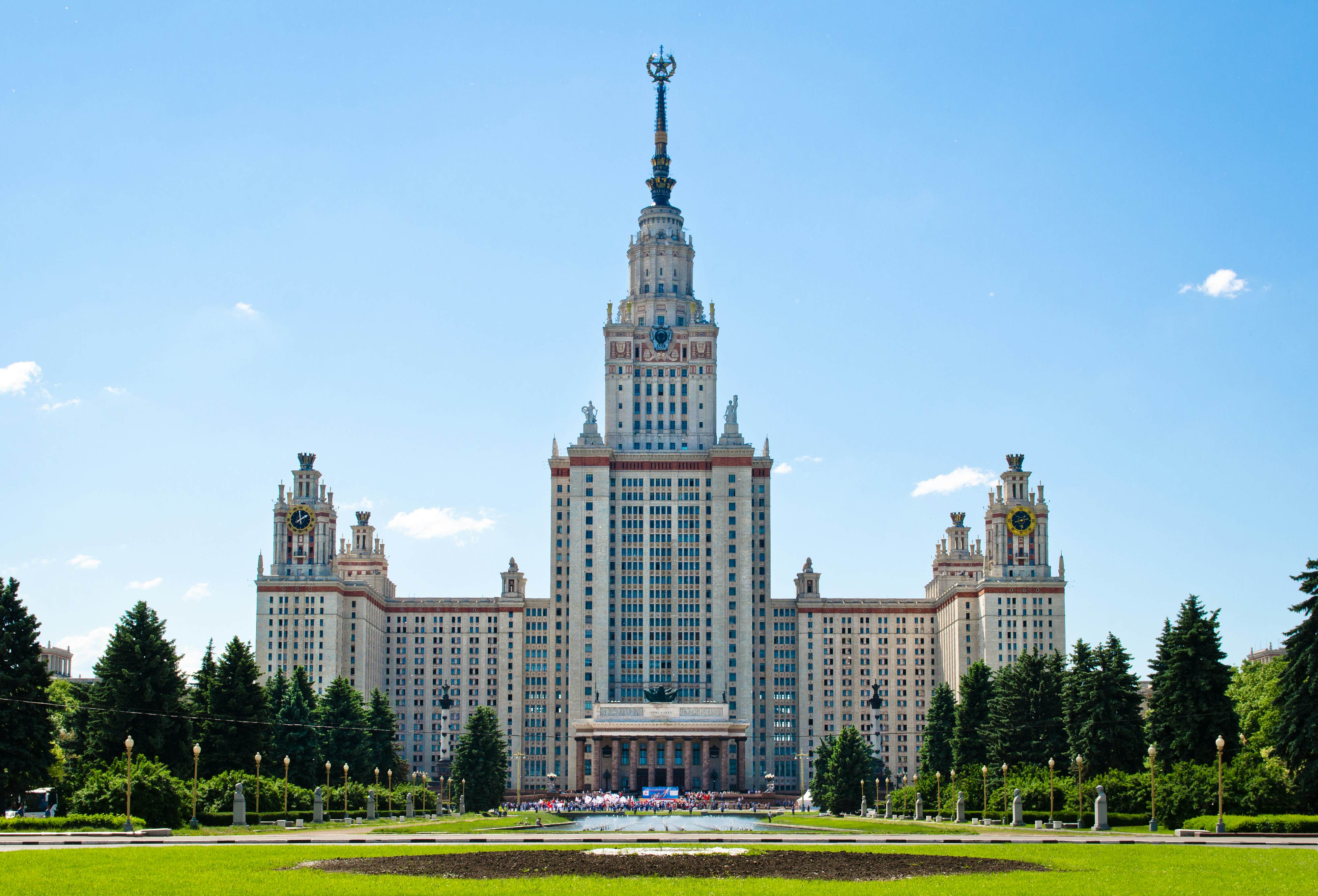
First of all, I completely understand where the idea of "bland brutalism" comes from, as well as the idea that the Metro's beauty is entirely separate from that bland brutalism. However, that distinction is not exactly accurate. Stalin was not at all a fan of blandness or Brutalism — his opposition to the former is a large part of the answer, so stay tuned, and he couldn't have been a fan of Brutalism because it didn't exist. But the Metro is not the only piece of architecture that rejects simplicity or blandness in Moscow from Stalin's lifetime. In fact, Stalin is most associated with "Stalinist Classicism", which is very ornate, so it wasn't just restricted to the Metro. Example: MGU, Moscow State University. Commonly cited as the pinnacle of the style, but built from 1949 to 1953, a little after the critical period I will discuss below. I did not study there myself, sadly.
I still have a lot to learn about Khrushchev's and Brezhnev's visions for Moscow, for socialist architecture, and for the Metro, so I will focus on Stalin in this answer, but for now I will say this: Stalin, Khrushchev and Brezhnev (or rather the Soviet state and culture during their tenures as First/General Secretary, because I'm a good post-post-revisionist) envisioned their construction of housing and of the Metro as part of the same ideological project to bring comfort and beauty into the lives of Soviet citizens. The difference is that Khrushchev and Brezhnev focused much more on the utilitarian side of that mission than Stalin. So their Metro station designs see a lot of simplification compared to Stalinist Metro stations just like their residential architecture sees compared to Stalinist residences. Nothing that any of those three built was ever supposed to be bland, or purely functional, though.
So why did Stalin decide to build a "grandiose", "ornate" Metro system, as you describe it? There are a few reasons, some of which are emphasized and some of which get overlooked, and I am apparently making it my life's mission to bring those overlooked ones to attention.
Part 1: Competition With the West
There are two reasons that everyone jumps to, and that has sort of stifled the public understanding of the Metro a little. The first reason that everyone jumps to is that Stalin and the Soviets wanted to show off to, and compete with, the West. This is an understandable conclusion to come to — much of the propaganda surrounding the Metro is couched, subtly or not, in terms that compare it to the systems of London, Paris, Berlin, and New York. Stalin and the party were indeed very intent on proving the triumphs of socialism, and the Metro was to be the greatest example of that. Especially during the construction of the first line from 1931 to 1935 and in the early days of operation in the '30s, Pravda and other press organs certainly crowed a lot about how the subway systems of those Western cities were darker, dirtier, uglier, more crowded, all in all just inferior, and how the Moscow Metro outshone (literally and figuratively) them all.
This gets a much shorter explanation than the other factors later, not necessarily because it's less true, but because it's a little easier to wrap your head around, and I think most of us have an intuitive sense of it. And maybe it is a little less true as well.
Part 2: The Congestion Problem and Soviet Comfort
But that's a little bit Euro-ego-centric. None of that is false, but it is far from the only reason Stalin and the party had in mind for building the Metro. Which brings us to the second commonly-trotted-out reason, which is that Stalin really did want to improve the lives of his people. This one is a little tricky. I won't go too far into the history of Metro planning in Moscow, but let's talk about congestion.
The main means of public transport in Moscow in the late 19th and even into the 20th century was the horse-drawn tram car. Electrification of the tram network began in the late 1890s, and was completed by 1911, but even then, much of Moscow remained reliant on horse-carts. Although trams didn't produce manure, they caused terrible congestion in the center of Moscow too. Dietmar Neutatz, whose book Die Moskauer Metro is the gold standard on the history of traffic planning in Moscow until 1935, describes a tram network already "at the borders of the possible" in the 1910s, with the main streets completely "jammed with trolleys" [my translation]. (38) This is, in fact, what led to the first ideas for a light rail/rapid transit network in Moscow in 1902, but that never got off the ground.
Congestion was improved, in a very darkly comic way, by the war. WW1 forced the tsarist regime to shelve plans for a subway due to budget concerns, but then the need for those plans was suddenly removed by the Civil War, which led to a massive depopulation of Moscow and a massive decrease in tram ridership (nearly half the 1915 population fled Moscow for the countryside by 1920). However, as soon as the Civil War ended, people began to trickle, and then flood, back to Moscow, especially because of the economic flexibility introduced with the NEP. In 1924, the Moscow City Council (Mossovet) came to the conclusion that, by 1928, the tram network would be entirely incapable of handling the required load. They began a new plan for a Metro, but for reasons I will talk about later, it was not implemented.
By 1929, the tram network was operating at 150% capacity, sidewalks were impassable, streetcars were overflowing with people, and dozens of preventable injuries happened each week when people lost their hold or were pushed off overcrowded trams and fell behind them, or even worse, in front of them. This is all according to the other great work on the planning and construction of the first line, William Wolf's Russia's Revolutionary Underground. And this is all as industrialization and dekulakization are beginning to send an even further mass of people into Moscow. Between 1928 and 1933, thanks to those programs, the population of Moscow ballooned from 2.3 million to 3.6 million, and I'll say it again: that's 1.3 million more people in just five years.
So something desperately did need to be done by 1931. But in order to answer the question of whether Stalin and his subordinates really were motivated by altruism, we have to ask, was a Metro really the best way to improve the lives of Moscow's people? I would say it wasn't the best way — investment in new housing was even more desperately needed, and transport to outlying parts of the city would probably have helped more people, even if the problem was mainly in the center. Building a Metro certainly did improve many people's lives by giving them a shorter and easier commute. But that didn't really become accessible to many people until the later 1930s, or even after WW2 for some parts of the city. So the idea of the altruistic motive isn't wrong, but it's not the full picture either.
So now let's get back to that question of beauty. The way that these two tropes above were employed, I argue, can tell us a lot about why beauty was so important.