Here is a (non-exhaustive) list of things blamed for polio:
From a letter written to Albert Sabin, polio researcher:
In the midst of my troubled thoughts -- as plain as day -- a voice said to me "IT COMES FROM BEETLES." I was actually startled and sat up in bed. Somewhere in that interrupted thought came the words, "ground hog".
No, people didn't really understand it. They were certainly terrified of it. A 1952 poll of Americans put the atomic bomb as the #1 fear. Second place was polio. This was because the visible effects generally targeted the young, either killing children or leaving them paralyzed. Pictures of paralyzed children were often used in pictures for the National Foundation for Infantile Paralysis (later named the March of Dimes).
Discarding the somewhat more off-kilter suspects above, the more sincerely believed ones were water, mosquitos, and rodents. There were major mosquito-killing and rodent-killing efforts. As you might expect especially with the fear of mosquitoes, it equated to avoidance of outdoors during an outbreak.
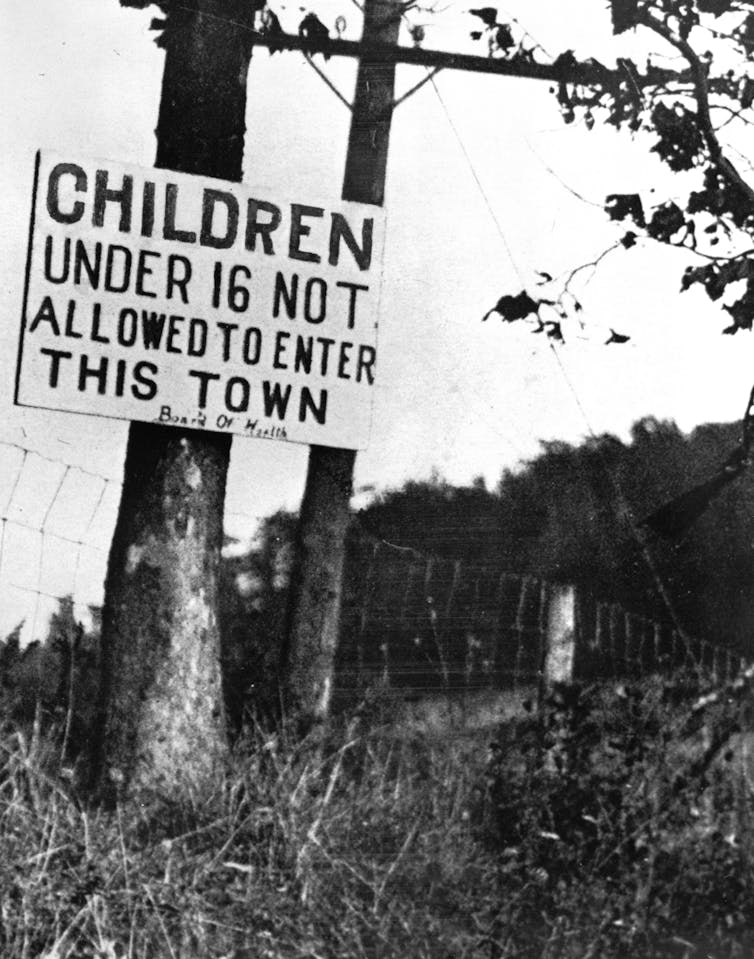
During a summer of polio, pools and movie theaters were closed, and children were simply just kept away. The outbreak of the summer of 1916 was bad enough it led to "the exodus of the children" in New York (and the infamous "Children Under 16 Not Allowed to Enter This Town" sign); many schools opened late. In the outbreak of 1937, Chicago schools closed and students took classes over the radio. In Canada, a late opening for schools led to the Toronto Daily Star and The Globe and Mail publishing lessons for high schoolers.
For the record, polio is actually spread by infected feces; this can lead to infection by bad sanitation or improper washing of food. This also made the path of polio very hard to track -- it was possible to be quarantined but still spread poliovirus through the sewer system! There were enough "mystery outbreaks" that it was hard to come up with a set safety procedure, so nothing like quarantining asymptomatic carriers was really considered (beyond the "universal quarantine" procedures I already mentioned).
...
Offit, P. A. (2007). The Cutter incident: how America's first polio vaccine led to the growing vaccine crisis. Yale University Press.
Oshinsky, D. M. (2005). Polio: an American story. Oxford University Press.
Some of this was adapted off my older answer about Did the polio epidemic change the way schools were designed? which you might also enjoy.