Like I don’t get it?
It’s not like no one knew they were there. People had colonies in Asia. Ports in China. Like people would undoubtedly know ‘hey there’s a bigass landmass there which has people on it’.
Yet it wasn’t until the 1850s with America, someone who didn’t even have territory in the pacific apart from its own coast, that Japan was forcefully opened.
Why didn’t other European powers force Japan open for that sweet trade?
Well, simply put: in several instances various European powers tried and failed, and the incentives to try harder weren't strong enough yet. This is a huge topic, so I’ll try to keep it brief, but keep in mind that for brevity I’m skimming over or omitting many incidents over the course of several centuries here.
The concept of Japan as a totally "closed country" in the Edo period is something of a misconception. Sakoku was not an absolute. Obviously, frequent foreign trade with the Chinese and Dutch was still taking place in Nagasaki. Ideas from Europe were coming into the country -- in a somewhat controlled fashion -- in the form of rangaku/蘭学/"Dutch learning." Trade with the Ryukyus, Korea, and the Ainu of Hokkaido was taking place somewhat regularly. So much foreign trade was taking place, in fact, that the Shogunate had to take action several times to stem the flow of silver and copper being exported to foreign nations.
Additionally, the existence of Japan was well known to Europe. The Portuguese had been there since the 1500s, followed by the Dutch and, briefly, the British. An Englishman was shipwrecked in Japan and became a samurai -- William Adams of “Shogun” infamy. By the time the country isolated itself nominally from the West, two Japanese embassies had been sent to Europe. These embassies resulted in, among other things, a retainer of Date Masamune named Hasekura Tsunenaga being made a patrician of Rome. The problem wasn’t “discovering” Japan like some kind of lost continent, it was landing safely and being welcomed that became a sticky proposition after the “closing” of the country in the early/mid 1600s.
Hello, Just Stopping In
Several attempts were made during the Edo period to use the existing trade channels to expand trade relations with Japan. For example, the delightfully named Sir Thomas Stamford Bingley Raffles, more famous as the founder of modern Singapore, tried to start British trade with Japan using ships flying Dutch flags to access Nagasaki harbor. The Dutch in charge of the island of Dejima were, understandably, not excited about this idea since they were nominally at war with Britain at the time as part of the larger Napoleonic Wars. (As a fun side note, for a time during the Napoleonic Wars, Dejima in Nagasaki was the only place in the world flying the Dutch flag.)
Even without Bonaparte’s chaos in Europe to consider, however, the Dutch were obviously not keen for potential economic competitors to use their connections in Nagasaki to start trade with Japan.
Hello, Just Passing By
While it was theoretically Japan’s window to the world, Nagasaki was not the only place visited by foreigners in practice. Shipwrecked individuals in the tradition of William Adams, both Japanese and foreign, would sometimes rattle the chains of the “chained country.” Three Japanese men, Otokichi, Iwakichi, and Kyukichi, drifted after months of hardship to the west coast of the Americas in 1834 and were eventually refused reentry to their home country.
A half Scottish/half Native American man from Oregon named, believe it or not, Ranald MacDonald had himself purposefully put ashore in Hokkaido in an attempt to enter the country. He was imprisoned for months in Nagasaki before his repatriation to America, and taught a small class of samurai there English. Two of his students later were translators for the Shogunate with Commodore Perry.
Japan also had several interactions with the west because of extensive whaling traffic off the eastern coast of Honshu. In 1823, a Japanese fisherman chasing an unseasonably shy school of bonito got far enough offshore to meet with some English whaling ships and went aboard, being greeted cordially and shown the process of whaling. He exchanged some goods with the whalers, learned some scattered English vocabulary from them -- some practical and some “colorful” -- and there soon developed a little cottage industry in his area where traders would commission fishermen to “happen” upon foreign ships and trade for rare goods with them. The Shogunate caught wind of this and put a temporary moratorium on bonito fishing, and eventually shut down this back-alley trade.
High Risk: I Told Him We’ve Already Got One
Reigning in ambitious and foul-mouthed bonito fishermen was not the extent of the Shogunate’s attempts to curb unauthorized interactions with foreign ships: in 1825, the Shogunate issued the “Edict to Repel Foreign Ships”/異国船打払令, often called the “Don’t Think Twice edict” in modern scholarship.
As a result of several incursions by Western ships, including the penetration with impunity of Nagasaki harbor by the British warship Phaeton in 1809, a hawkish group called the Mito School pushed for less tolerance of foreign ships near Japan’s shores. Coastal batteries were to fire on approaching enemy ships without a second thought, and commanders wouldn’t be penalized for not waiting on specific orders from Edo. In 1837, a ship named the Morrison attempted to open trade under the pretext of returning poor Otokichi to his home, but she was fired on in accordance with the Don’t Think Twice orders and driven off from both Uraga and Kagoshima.
The coastal defenses of Japan weren’t nearly strong enough to stand up to a determined assault by a first-rate Western power -- as shown by the Phaeton down south and the Russians up north -- but being met by gunfire was certainly enough to make forcing your way to a negotiating table troublesome. Combined with the problem of translation -- castaways like Otokichi were usually commoners without much of a vocabulary for diplomacy, so Dutch and written Chinese were generally the available options -- it wasn’t a trivial matter for a Western nation to open relations with an unwilling Japan.
Low Return: He Said They’ve Already Got One
From the perspective of many other Western nations, there often simply wasn’t a good reason to take the risk and invest the resources to force Japan into the global community. The Portuguese had been driven out by force in the 1600s, but the British trade mission in southern Japan simply failed because they had been out-competed by the Dutch and had failed to return profits. Additional attempts at trade with Japan were deemed unprofitable by the British East India Company at one time or another, and Britain -- first under the Company and later under the Crown -- was simply too occupied with incredibly lucrative exploitation and trade in India and China to spare the resources for Japan.
Stamford Raffles’ attempt was undertaken out of personal passion for contacting Japan, and he was actually reprimanded for wasting resources on it. Throughout the early 19th century, tensions between Britain and China were ramping up until they culminated in the First Opium War, which ended in 1842. This understandably was the focus of most British foreign policy in East Asia at the time.
Friends (clap clap clap clap) at Last: Matthew Perry
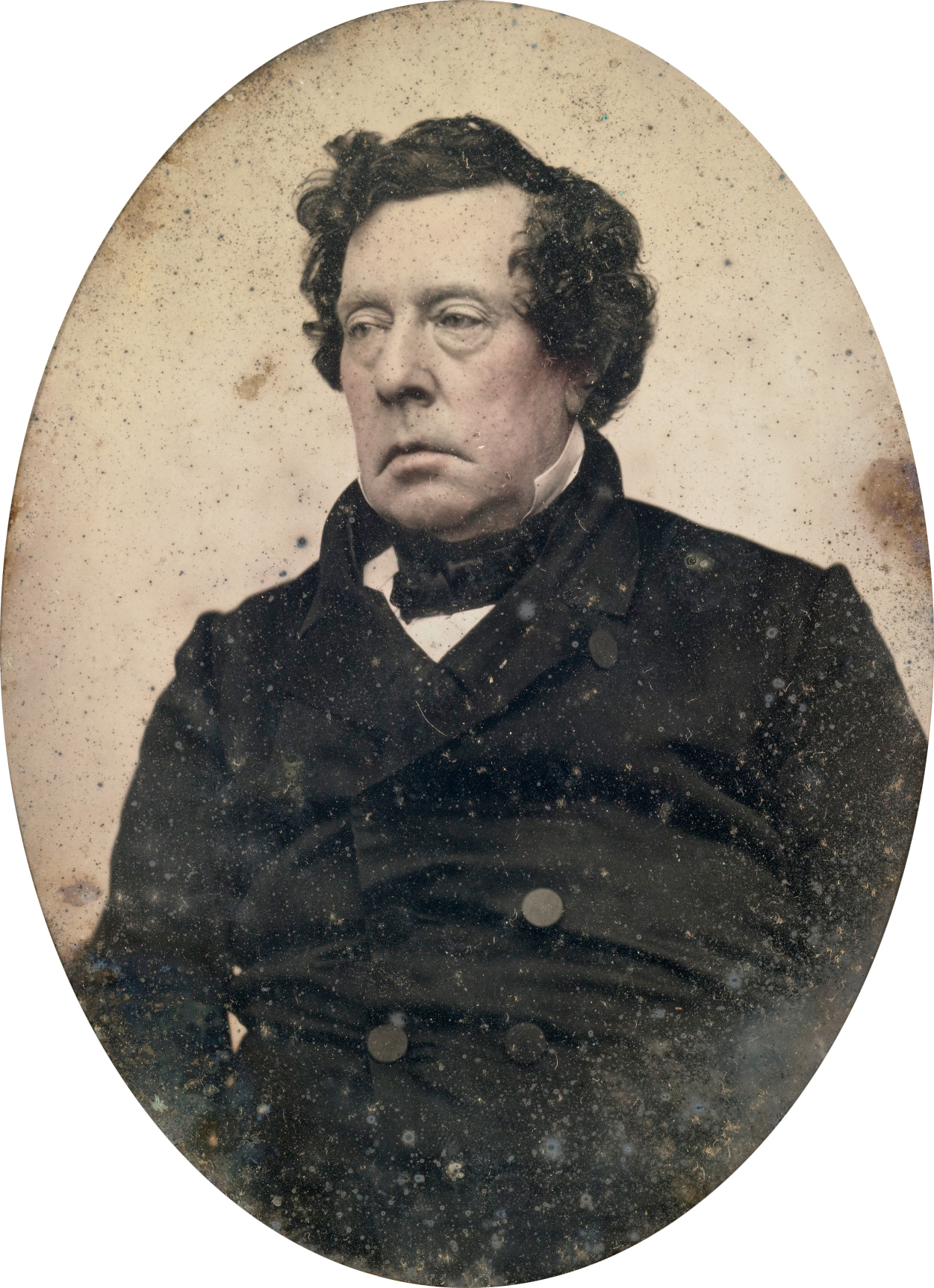
So, given all the inertia against opening trade with Japan, why did Perry succeed -- or even try -- where others did not?
This is obviously a very complex topic, but since this has already dragged on much longer than I wanted, I’ll try to keep it short. Several things were working in Perry’s favor. For one thing, the risk had been lowered.
The crushing defeat in the Opium War of the historical superpower of the region, China, led Japan to frantically reconsider the practicality of keeping the foreigners out by force with their current military power. The Don’t Think Twice edict to fire on foreign ships was repealed in 1842, the same year that the First Opium War ended.
For another thing, America had more incentive to want to open relations with Japan. Unclaimed locations for coaling stations were becoming more rare in the Pacific, and America’s whaling fleet needed places to coal and safe ports to seek shelter and provisions in.
Perry had also benefited from past failures: he refused to go to Nagasaki and engage through the established trade channels. He came heavily armed in modern warships. He demanded to deal directly with representatives of the “emperor” (though actually the Shogun) rather than fishermen or provincial bureaucrats.
In summary, Perry enjoyed more reasons to come, fewer reasons to leave, and the most information of anyone to date. Other European powers -- especially Britain -- simply didn’t want to take the risks or invest the resources when bigger markets or geopolitics demanded their attention elsewhere in the region. And the Dutch, of course, were more or less successfully trading the entire time.
tl;dr: Other nations knew Japan existed the whole time, but an unfriendly Shogunate made it difficult enough to make contact that large-scale official trade simply didn’t seem worth the effort for major powers busy with other things until Perry had already cracked the door open.
Sources:
HOWELL, DAVID L. “Foreign Encounters and Informal Diplomacy in Early Modern Japan.” The Journal of Japanese Studies, vol. 40, no. 2, 2014, pp. 295–327. JSTOR, www.jstor.org/stable/24242704. Accessed 15 Mar. 2021.
Beasley, W. G. “Japanese Castaways and British Interpreters.” Monumenta Nipponica, vol. 46, no. 1, 1991, pp. 91–103. JSTOR, www.jstor.org/stable/2385148. Accessed 15 Mar. 2021.
Kohl, Stephen W. “Strangers in a Strange Land: Japanese Castaways and the Opening of Japan.” The Pacific Northwest Quarterly, vol. 73, no. 1, 1982, pp. 20–28. JSTOR, www.jstor.org/stable/40490821. Accessed 15 Mar. 2021.
Beasley, W.G. Great Britain and the Opening of Japan: 1834-1858. Luzac & Co., 1951.