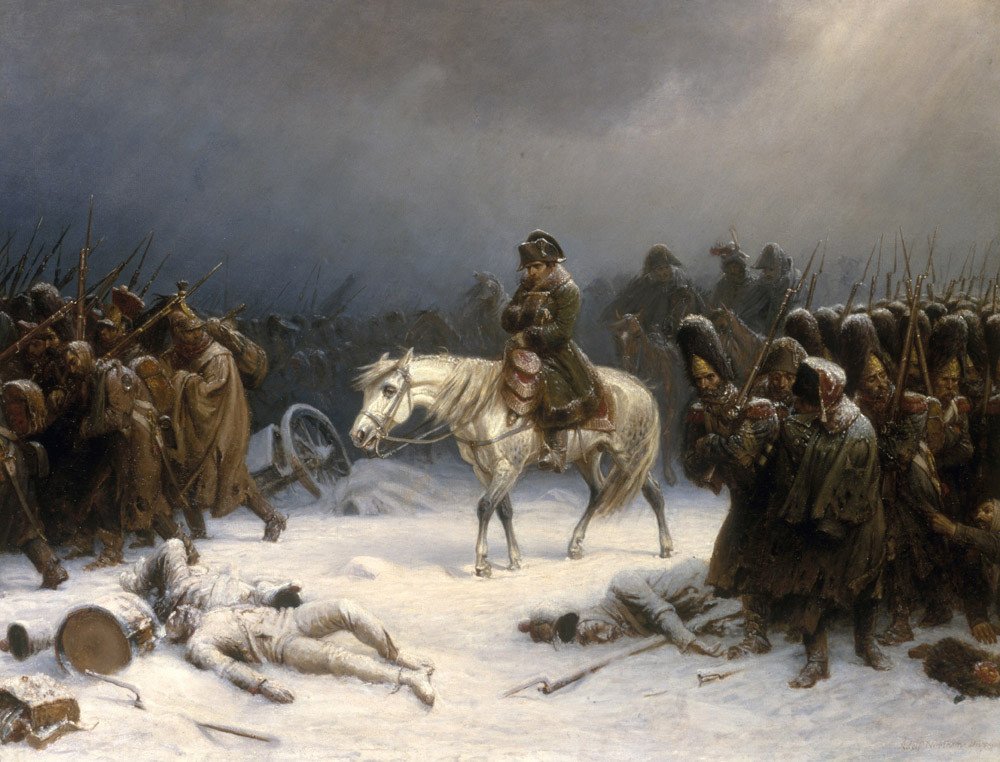
These two people invaded Russia in June. (Hitler on June 22, Napoleon on June 24). Both were stopped by the Russian winter (It may be due to Russian ferocity but history won't remember it that way).
How did so many people believe this? Even some popular sites have posted "nApoLeoN anD HiTlEr fAiLED tO ConQuer RuSSia cuZ thEy iNVAdED In WinTER"
Ah the seemingly perennial myth: that Hitler and Napoleon invaded Russia during winter. OP has already addressed the rather obvious error in this statement, but to tack onto it, I go into more depth on the sheer egregiousness of the errors within that statement on this thread (as, I imagine, have many other AH travelers over the years). It seems that with the rise of "pop" military history and the old "Top 10 (insert ridiculously simplified and at times entirely wrong preposition here)", that myth has gained a new lease of life, much to the annoyance of many students of history who have done even the mildest bit of research on either of the Russian invasions.
As further proof of just how much this myth has permeated into popular media, here is a relatively recent article on Business Insider (red alarms are already blaring in the back) which actually goes further by accepting the "invading Russia in winter" narrative at face value and suggesting that 6 nations managed to invade Russia despite the winter environment. I will likely rant more about how ludicrously wrong many aspects of that article are in a later post, but for now we digress. Let's begin exploring the origins of this infamous myth, which is actually a fairly interesting venture, since research on the matter yields little in the way of secondary or even primary writings which portray either invasion as having started during the winter.
A Misinterpretation?
The first idea we shall explore is a relatively simple one: the idea that the phrase 'do not invade Russia in winter' has simply been misinterpreted (well, grossly misinterpreted if we are being brutally honest). The phrase as popular history narratives often frame it is that one should not start invading Russia during its winter season, whilst in reality the phrase itself is actually rather vague on what "invading" and "during winter" mean. Perhaps the more suitable phrase, as we might put forth from fairly basic knowledge of the experiences of Hitler's Wehrmacht and Napoleon's Grande Armee is the following:
"Do not try to advance in Russia during winter"
Again, such a phrase is entirely reductionist in nature and by no means should we suggest that this become a 'new maxim' so to speak. Yet the point still stands: a plausible theory regarding the origins of the "invading Russia in winter" narrative is that it stemmed from a series of repeated and then widely (though not, and we must stress not, academically or accurately) accepted observations from reductionistic accounts of the 1812 and 1941 invasions.
Myth of Memory?
"The next war on land will be very different from the last one, in that we shall have to fight it in a different way. In reaching a decision on that matter, we must first be clear about certain rules of war. Rule 1, on page I of the book of war, is: "Do not march on Moscow". Various people have tried it, Napoleon and Hitler, and it is no good."
- Lord Bernard Law Montgomery, 1st Viscount Montgomery of Alamein, during the 30th May 1962 debate in the House of Lords on army estimates.
This second theory is slightly more complex, and it gets at the "end-goal" of this response which we shall discuss shortly. If one observes the literature on the Nazi or/and Napoleonic invasions of Russia, the winter conditions are bound to make an appearance to some extent or another. Without considering for even a brief moment the drastic shift in fighting conditions for both armies, any account of the invasions' course and eventual failure is incomplete. Mentions of winter and complaints of the litany of problems caused by it are also fairly common in primary accounts from the troops and officers of both invading armies, which then contribute to the overall portrayal and communication of the campaigns to the wider public.
Then we have the case of the memorialisations of the invasions. News outlets in the Third Reich often gave daily updates on the string of victories, encirclements, and surrender of enemy troops that tumbled quickly into the arms of the Wehrmacht in the Soviet Union, and when this coverage seemingly halted during the winter months of 1941-42, when Unternehmen Taifun (Operation Typhoon, the codename for the push on Moscow) stumbled just kilometers from the Soviet capital. They also halted more alarmingly in the days before and following the encirclement of Sixth Army near Stalingrad, with the onset of winter being on the minds of the German public as well (more details on the Nazi news coverage of Stalingrad discussed here).
Now whilst I am unable to comment too deeply on Napoloeon's invasion of Russia, there is a rather interesting contrast in the early invasion paintings and the retreat paintings. Consider for example, this depiction of the Battle of Borodino by French painter Louis-Francois Lejeune, which depicts the heroic actions of the Grande Armee in its invasion of Russia, set against the tones of the Russian autumn weather. Contrast that with this depiction of the Grande Armee's retreat during the winter (with particular focus given to Napoleon), and the emphasis on the atmosphere of hopelessness, death, and destruction is even more marked. Granted, the motifs of herosim and bravery are still present, most notably in this painting by Adolphe Yvon of Marshal Ney leading the battered rear-guard in the freezing Russian steppe during the retreat. However, the overriding idea of a campaign dashed on the freezing steppes still resonates in that work as well.
Thus whilst it was public knowledge even at the time that the invasions did not take place during the winter, the fixation on winter as a backdrop and setting in which the invasions faltered and ultimately failed in memories and depictions of the military campaigns may have also given rise to the "invasion during winter" narrative which was then further misinterpreted.