I'll admit almost complete ignorance on the subject. I have no in depth knowledge on the topic, i only have a rough roadmap of the history of the area. The question somewhat excludes the reality that they both did originate from the same ancestors roughly 14,000 years ago. That's too obvious an answer for me. I'm more interested in the ties the cultures may have had predating colonization, but not so far back that it leads to the original migration of tribes from North America
I'll begin with a short summary: Inca religion is usually understood differently from Mesoamerican beliefs, and was clearly part of an Andean sphere of belief that was separate from Mesoamerica aside from a few possible but minor connections. Olmec, Maya, Aztec, and other Mesoamerican religions were in regular contact with each other and had many similarities, but shared sources for certain religious aspects do not prove a single, unified progenitor religion.
Now, the longer version:
Inca religion was not related to Olmec/Mayan/Aztec (I'll call those Mesoamerican) beliefs. Although there does seem to have been sporadic contact between the Northern Andes and West Mexico during pre-Hispanic times, there probably wasn't much religious diffusion aside from some possible mortuary connections.^(1) Inca religion is clearly related to other Andean belief systems, from similar sacred bundles^(2) to the complicated nature of wak'as^(3) to 4,500 year-old continuations of specific deities and their images.^(4) The Inca religious world was one which developed from and interacted with Andean societies such as the Wari, Tiwanaku, Moche, and Chavin civilizations, among others. The Andes can be thought of as a sphere of often shared histories and cultures, creating similarities across the region's belief systems.
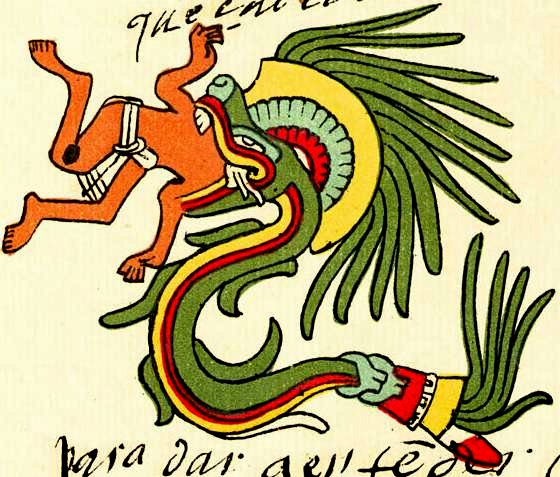
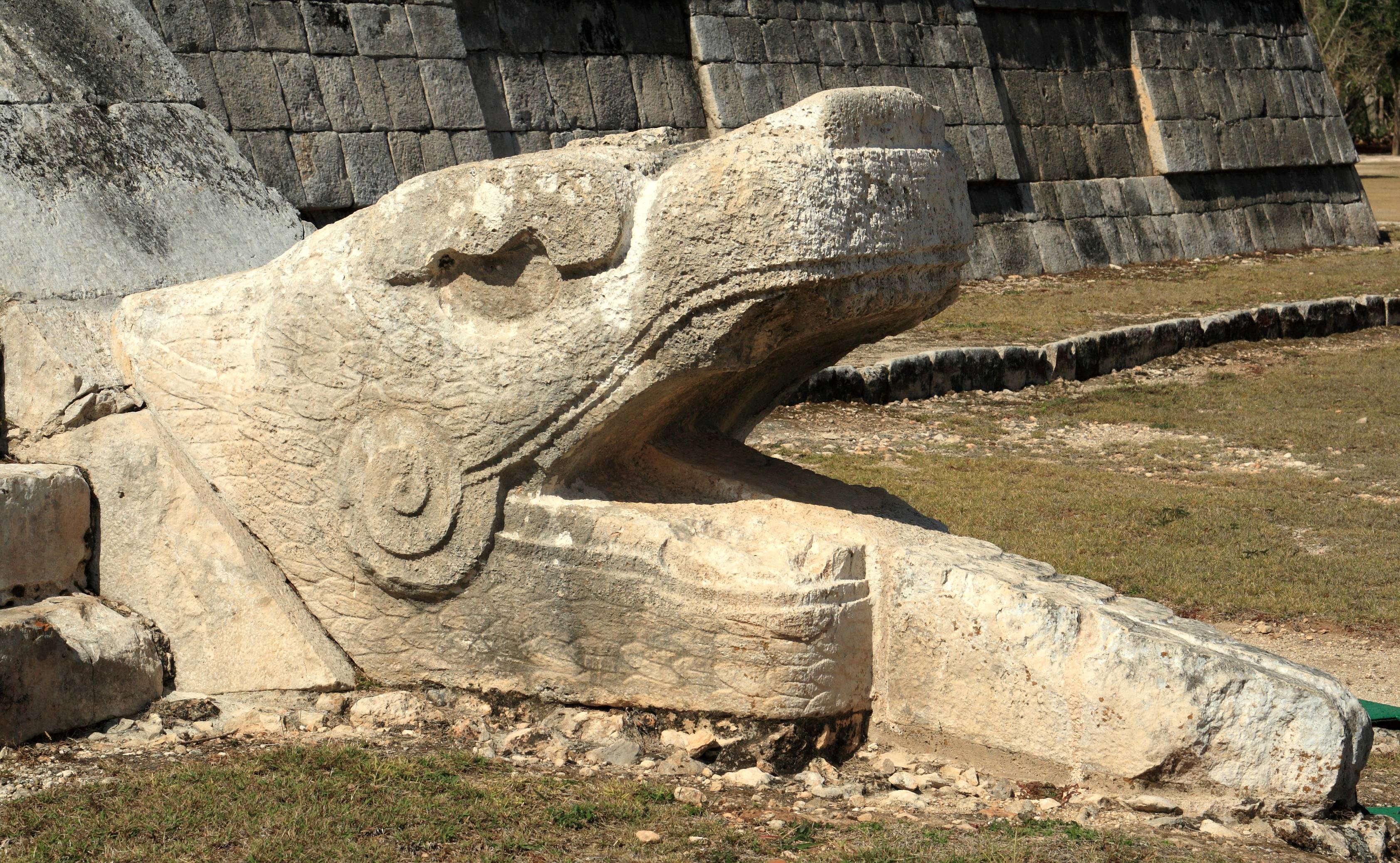
Olmec, Maya, and Aztec religion can be thought of in a separate but analogous way. All of these societies were part of the Mesoamerican cultural sphere; a community of peoples who have been influencing each other for thousands of years. Some features and symbols which were common throughout Mesoamerican religions were cyclical cosmologies, the importance of maize, serpent imagery, and human sacrifice. Many specific characteristics or beings in some Mesoamerican religions have analogues in others. The feathered serpent appears in Aztec religion as Quetzalcoatl and some Mayan beliefs as Kukulkan. Multiple Mesoamerican societies had creation myths that emphasized multiple failed attempts which culminated in our current era.^(5)
But your question asked about religions with a common ancestor, not just shared features. Historically, many Mesoamerican archaeologists have placed Olmec religion and society in a comparable position to what your asking about. This position argues for the Olmec as a Mesoamerican "mother culture" which jumpstarted the region's urbanism, culture, and religion.^(8) It is certainly true that Olmec artifacts represent some of the earliest examples of Mesoamerican themes, such as the Feathered Serpent or ubiquitous maize deity.^(9) However, even as it continues to recognize the importance of the Olmec, modern archaeology is generally pushing back against the Olmec as a totally foundational "mother culture." Thus recent claims that push for relatively high Olmec importance make arguments like this:
"While the impact of Olmec symbols and cosmology varied throughout Mesoamerica and was negotiated on a local level, Karl Taube (2004) has tracked features of Olmec religion and cosmology that resonated in later societies through iconographic elements in depictions of supernatural entities. Understanding Olmec interaction in Oaxaca does not supersede an interest in local sequences (contra Grove 2007) but rather is vital to understanding the nature of early ranked societies in the Valleys of Nochixtlán and Oaxaca as well as comparative Early Formative sociopolitical organization. The relationships between the Olmecs, Zapotecs, and Mixtecs represent a complex episode of "interaction and entanglement" (Dietler 1998:298) that added a distinct patina to early iconography and imagery in the Valleys of Oaxaca and Nochixtlán and provided additional elements to locally emerging religion, cosmology, and ideology."^(10)
Olmec culture and religion clearly influenced many other Mesoamerican societies, but it seems increasingly unlikely that a single Olmec religion made its way across civilizations and then grew into different forms over time. Olmec beliefs were incorporated and transformed to various degrees amongst different societies. And we can see that commonalities across Mesoamerican cultures arose outside of Olmec time and space:
"Deities, concepts, and views developed in the Postclassic Yucatan can be understood as having central Mexican influence from a possible wide number of sources...I have shown here how these concepts were developed and re-centred based on earlier Maya and central Mexican concepts. Postclassic Yucatan Maya thought represented in many ways a kind of syncretistic Mesoamerican system of thought, not altogether different from the kinds of syncretism we see in Mesoamerica after Spanish colonization and the introduction/integration of Christianity."^(11)
So, in the end, it seems like the similarities found throughout Mesoamerican religions result from a hot mess of millennia of interaction between different societies.^(12, 13) The Olmec have often been called a "mother culture" and may have indeed played an outsized role in later Mesoamerican belief systems. But other societies and regions influenced each other enough that it would probably be inaccurate to say that Mesoamerican religions "shared a single common ancestor." I would argue that it would be correct to say they shared and mixed common ancestries, over several thousand years of interaction.
^(1) Anawalt, P. (1992). Ancient Cultural Contacts between Ecuador, West Mexico, and the American Southwest: Clothing Similarities. Latin American Antiquity, 3(2), 114-129.
^(2) Brown Vega M. Ritual practices and wrapped objects: Unpacking prehispanic Andean sacred bundles. Journal of Material Culture. 2016;21(2):223-251.
^(3) Bray, T.L. (2014). The Archaeology of Wak'as: Explorations of the Sacred in the Pre-Columbian Andes. Boulder: University Press of Colorado.
^(4) Isbell W.H., Knobloch P.J. (2006) Missing Links, Imaginary Links: Staff God Imagery in the South Andean Past. In: Isbell W.H., Silverman H. (eds) Andean Archaeology III. Springer, Boston, MA.
^(5) Heyden, Doris, et al. "Mesoamerican Religions: Mythic Themes." Encyclopedia of Religion, edited by Lindsay Jones, 2nd ed., vol. 9, Macmillan Reference USA, 2005, pp. 5933-5939.
^(6) Flannery, K. V., Balkansky, A. K., Feinman, G. M., Grove, D. C., Marcus, J., Redmond, E. M., Reynolds, R. G., Sharer, R. J., Spencer, C. S., & Yaeger, J. (2005). Implications of new petrographic analysis for the Olmec "mother culture" model. Proceedings of the National Academy of Sciences of the United States of America, 102(32), 11219–11223. https://doi.org/10.1073/pnas.0505116102
^(7)Flannery, K.V., Marcus, J. (2000). Formative Mexican Chiefdoms and the Myth of the “Mother Culture.” Journal of Anthropological Archaeology, 19(1), 1-37.
^(8) Ochoa, L. (2005). The olmec. america's first civilization. Anales De Antropología, 39(1), 265-270.
^(9) Hammond, Norman, and Karl Taube. "The Aberdeen Celt: an early twentieth-century Olmec find." Antiquity, vol. 93, no. 368, 2019, p. 488+.
^(10) Blomster, J. (2010). COMPLEXITY, INTERACTION, AND EPISTEMOLOGY: MIXTECS, ZAPOTECS, AND OLMECS IN EARLY FORMATIVE MESOAMERICA. Ancient Mesoamerica, 21(1), 135-149.
^(11) McLeod, Alexus. "Itz and the Descent of Kukulkan: Central Mexican Influence on Postclassic Maya Thought." Parergon, vol. 35, no. 2, 2018, p. 147+.
^(12) Folan, W. J., Bolles, D. D., & Ek, J. D. (2016). ON THE TRAIL OF QUETZALCOATL/KUKULCAN: TRACING MYTHIC INTERACTION ROUTES AND NETWORKS IN THE MAYA LOWLANDS. Ancient Mesoamerica, 27(2), 293-318.
^(13) Ringle, W., Negrón, T., & Bey, G. (1998). THE RETURN OF QUETZALCOATL: Evidence for the spread of a world religion during the Epiclassic period. Ancient Mesoamerica, 9(2), 183-232.