Since the question is asking specifically about the major third, we have to go back a bit farther than you might expect, to April 13, 1742: Easter.
An audience of 700 has gathered at the New Music Hall in Dublin; in prior advertisement, men were asked to "come without their swords" and women were asked to wear dresses without hoops in order that more people would fit. The performance was quite a draw, as a new work was to be performed. As described in the word-book:
Messiah
an
Oratorio
Compos'd by Mr. Handel.
The music was a sensation then ("The sublime, the grand, and the tender, adapted to the most elevated, majestick, and moving words, conspired to transport and charm the ravished heart and ear.") and it is still a sensation now, but the most important part for our story comes near the end, during PART THREE (A Hymn of Thanksgiving for the final overthrow of Death) as the soprano sings a verse from Job:
I know that my Redeemer liveth, and that he shall stand at the latter day upon the earth. And though worms destroy this body, yet in my flesh shall I see God.
A part in the very start -- ten seconds in in this performance -- there are four specific notes, key of E major, the second note with a trill: G# F# E B.
Fast forward a little, to 1793: a new clock was built at the University Church in Cambridge, with the commission of a set of "quarters", musical chimes to be played at the quarter hours. There is some fuzziness as to the exact composer (probably either Dr. John Randall or Dr. William Crotch) but either way, the composer supposedly expanded those four notes into the Cambridge Quarters (sheet music here) used to mark the hours. Handel's notes were transposed into the key of D and varied upon. Taking just the first two parts:
First quarter (corresponding to bells intended to be sounded at 0:15 mark) F# E D A
Second quarter (corresponding to bells intended to be sounded at 0:30 mark) D F# E A / D E F# D
Notice that the same notes are first permuted, and then F# E D is reversed to D E F# where the falling note goes to D (a major third) instead of from D to A (a fourth).
The quarters would eventually be the basis of the Westminster Quarters, which are famous enough you have likely heard the tune elsewhere.
...
Now, I haven't said a word yet about doorbell chimes. When they were first invented in the 19th century they weren't generally multi-note affairs, you had a buzzer sound or a bell rather like this one.
Music door chimes first started reaching the market in 1930. This is immediately after the Depression started, which is not a coincidence; the fall of financial fortunes had a knock-on effect on the building industry, and it led to doorbell makers hitting the notion of modifying existing buzzer sounds to something far more pleasant (hence represented a house improvement at a relatively low cost).
Mello-Chime is the dignified way to announce the arrival of your guests, with a soothing appealing musical note instead of a harsh fire-alarm doorbell. In no other way can you add so much charm to your home with so little cost.
-- from House & Garden Volume 74, 1938
Nutone, Mello-Tone, Sears, and Rittenhouse would all get in on the market.
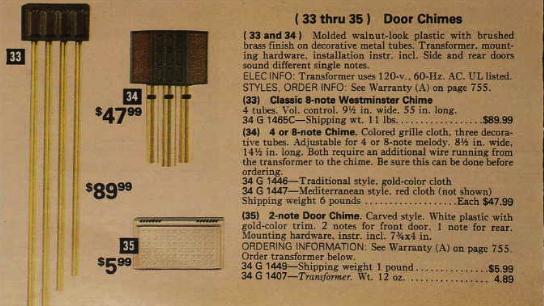
On the more complicated 8-tone models the most popular tune was the Westminster Chimes; you can hear an actual model from the late 1930s here. However, those were more elaborate and expensive, so there were simpler models, including ones that played the three note "NBC tune" (it was used in outdoor clocks; NBC set up a deal with Nutone to make chime sets that matched) and there were even simpler (and more compact) 2-tone models; here's one from the 1950s.
Note if you listen the 2-tone model does not play the classic falling-third sound. You could even have both tones at the same time, as a chord. The falling-third classic sound did start to emerge in the 1950s as you can hear in this alternate Nutone 1950s model or in this 1960s model. Even then, the two-tone wasn't necessarily standard while fancy chime sets were still being available; this clip from a 1970s Sears catalog shows 8-chime "Westminster" chimes still being sold.
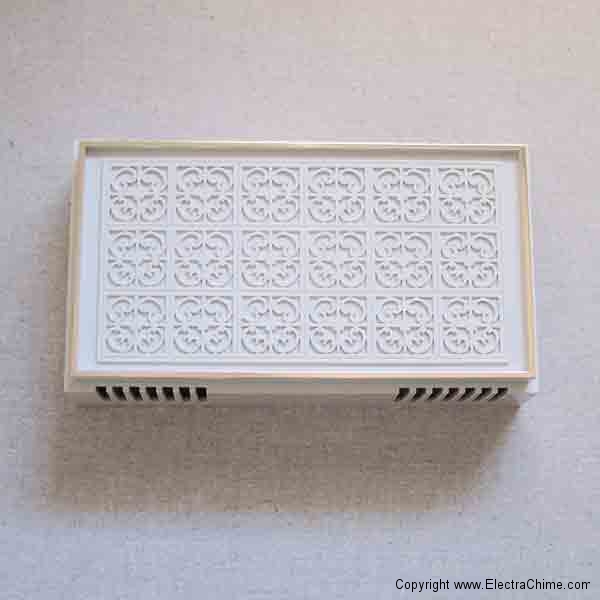
However, buying fancy chimes in the 1970s started to be a quaint hold-over, as more practical boxes like this one from Sears started to be sold. Due to this, the simplicity of the two-tone model, the pleasant sound of the falling third, and the strong resemblance to the still-ever-popular Westminster sound made the "classic" major third eventually win out.
...
Keates, J. (2017). Messiah: The Composition and Afterlife of Handel's Masterpiece. Basic Books.
McKay, C. (2010). Big Ben: the Great Clock and the Bells at the Palace of Westminster. OUP Oxford.
Several primary sources are from The Doorbell Museum.