Ill take a stab at this.
So I will list multiple sources a few of which are specifically Census data from the multiple All Union Census which were conducted between 1926 and 1941. This is even though there is a significant gap between the late 30's until 1959.
The Census of 1926 specifically states that the nascent Soviet Union had a hair over 147 million people. When you jump forward to some of the more recent census data moving towards the 40's you start getting into 180 million and change. This is partially disputed since no true "Official" data exists in this context that can be considered undeniable proof rather than educated speculation based on available data.
The Soviet Union suffered absolutely obscene levels of casualties in WW2. Given the goals of the war from the German perspective, The Soviet Union and its constituent soviet republics didnt exactly have a choice. This wasnt just a war for the survival of their state, but a war for the survival of multiple large far reaching Ethnic Groups. Many direct and ridiculously horrific plans were laid out on what to do with the peoples that were to live in the Post-war Lebensraum. Given what was known to be happening to prisoners, civilians, and just everyone behind enemy lines, options narrowed down to fight or die. This war for survival as it can be described, was essentially the only thing that allowed for many traditional situations revolving conscription, volunteering, and even Women, to be completely disregarded in the face of trying to stop an unstoppable enemy surging from the West.
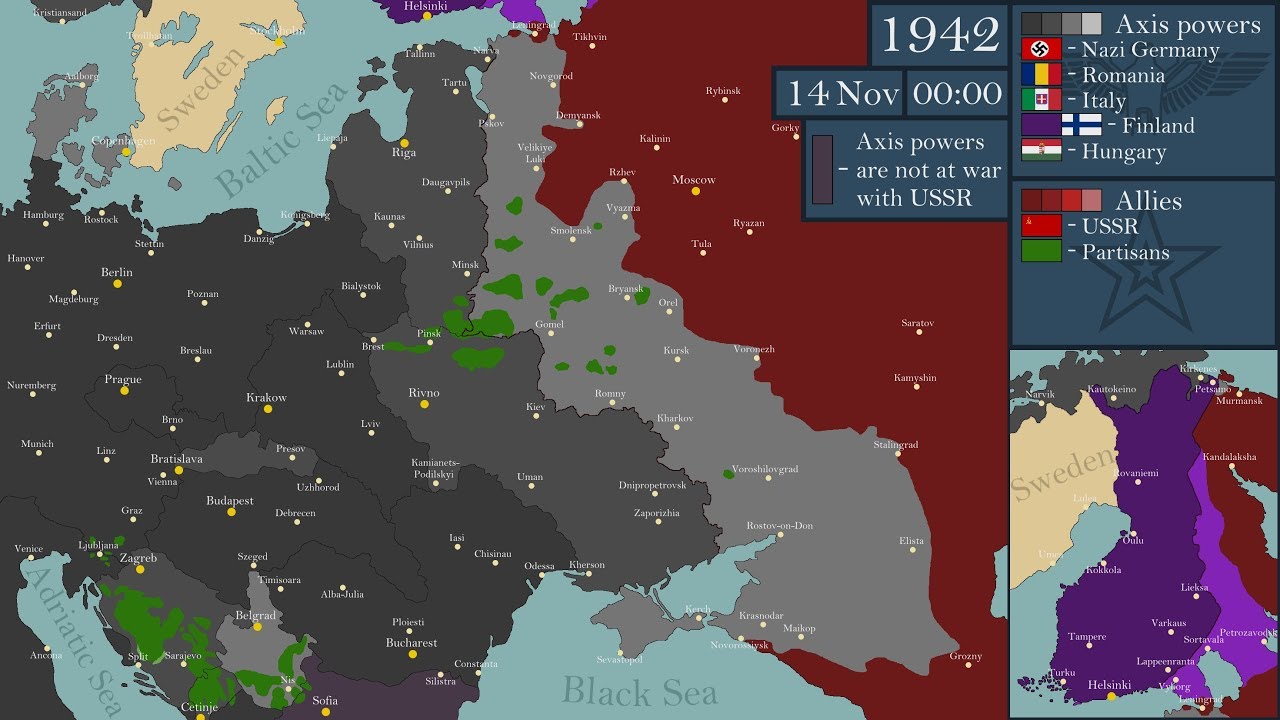
As we start getting into the territories occupied by the Germans and their Romanian/Hungarian Allies it starts to paint a picture of how insanely large the Soviet Union (and by extension modern Russia) actually are. To list major cities occupied entirely by Germany, you have Kiev, Minsk, Smolensk, Rovno, Riga, Pskov the list goes on. When you center in on Moscow in this context, it really seems like many of the most important cities have been occupied. This is where the vastness of Russia in general comes into play. The Germans had reached in one very awkward staggered front across all of European Russia, and were maybe 1/4-1/3 through the Russian territory. The Germans also failed in three key strategic objectives which included the seizure of 3 key cities and their surrounding populous countryside. Leningrad, Stalingrad, and Moscow all held, and even if they had fallen you have a line of massive cities lying across the entire Volga river. Stalingrad, Nizny Novgorod, Kazan, Saratov, as well as some stand alones and cities by the Urals which includes Perm, Ufa, Yekatarinburg the list also goes on. Just by the sheer amount of settled land in the USSR, a large majority of the Soviet population remained within control of the Central government in Moscow.
The next step is looking at the Standing Soviet Army at the start of the war, as well as its insanely large pool of reservists. The Soviet union in general had somewhere between 2.6 and 2.9 million men on the Eastern front, and further forces located in the The Urals Military District. The Siberia Military District. The Central Asia Military District. The Transbailkal Military District. The Far Eastern Front.
From these districts an outflow of veteran, well armed, and well trained divisions flooded west in defense of Moscow. While only a moderate influence on the battle, the Soviet model for mobilizing its population for war, was surprisingly efficient. The Soviet land model shows that 182 rifle divisions, 43 militia rifle divisions, eight tank divisions, three mechanised divisions, 62 tank brigades, 50 cavalry divisions, 55 rifle brigades, 21 naval rifle brigades, 11 naval infantry brigades, 41 armies, 11 fronts and a multitude of other units were newly Mobilised and Deployed (MD) in the second half of 1941. While mobilization structure and timetables isnt exactly my Forte, its very clear the Soviets had an extremely sophisticated model, and they simply had much more populated territory that was unoccupied vs occupied. When you make rough considerations to the populations occupied, its still roughly 1/4-1/3rd. If just by taking rough approximations here, we can deduce of the estimated 175-180 million strong Soviet Union, somewhere between 45-55 million people were in occupied territory (give or take because i cant find concrete city population data from that time period.) If we take the worst case estimate of occupied population, that leaves 120-125 million people still under the direct control of the Moscow government. Even with all the occupied territory, this still leaves the Soviets in a commanding lead on population compared to the roughly 80 someodd Million Germany could reliably draw on during the war.
So to summarize here, As titanic as the war was and how much important territory was occupied, The Soviet union was a vast and populous country and many more of its most important cities never saw a German outside of a propaganda film. On top of this a combination of having a massive reservist pool, a large standing army, extremely effective mobilization structure, and the was essentially being a literal war of survival for the Russians and by extension the rest of the East Slavic Ethogroup. There is also the discrepancy in how much manpower was available with Germany Mobilizing 18 million to the Soviets 34 million. Alot of the stopgaps for usual mobilization structures were also removed in the case of the Soviets given how desperate the situation was. So by and large the Soviets had many more women, older people, even younger people serving. My favorite of these that i recommend you research on your own time would be the 588th bomber regiment, affectionately these women are known as the Night Witches.
I hope I managed to answer your question here. Im a little sick so if it seems like im droning on thats was probably it.
Sources:
Google maps (Literally just to get cities and an attempt at distance)
Glantz, David M (1998), Stumbling Colossus: The Red Army on the Eve of World War, University Press of Kansas
Empire of Nations: Ethnographic Knowledge and the Making of the Soviet Union by Francine Hirsch, Cornell University Press, 2005.
Stalin's Folly: The Tragic First Ten Days of WWII on the Eastern Front – December 12, 2006 by Constantine Pleshakov
German occupation map, Unknown author, (its from a youtube video figured this would be a big deal since i was just hoping to showcase territorial extent in some rough context here) https://i.ytimg.com/vi/EJcByHRQl24/maxresdefault.jpg