As in, was there an instrument of a similar role/sound before, which saxophone improved upon, or Adolphe Sax just created a new cool sounding thing and everyone started using it?
The saxophone was a part of a sustained period of development and improvement in wind instruments in the late 18th and first half of the 19th century. Adolphe Sax wasn't so much creating a new sound as combining some older ones and adding some modifications that were being tested on a variety of instruments. The result was an instrument that had certain properties, namely ease of chromatic playing and a very loud sound, that has made it popular in certain settings.
Wind instruments are funny things. They're actually quite hard to play in tune. Or, more, specifically, they're quite hard to play in tune while still having all the notes sound roughly the same in terms of timbre and volume. This is especially true once you get outside of a single scale and try to make a fully chromatic instrument. You don't want to have a blasting F, a quiet F#, a moderate G, and then a foghorn G# all in a row. It just doesn't sound good! So, the pursuit of perfection and balance in tuning, volume, and timbre has driven the development of wind instruments.
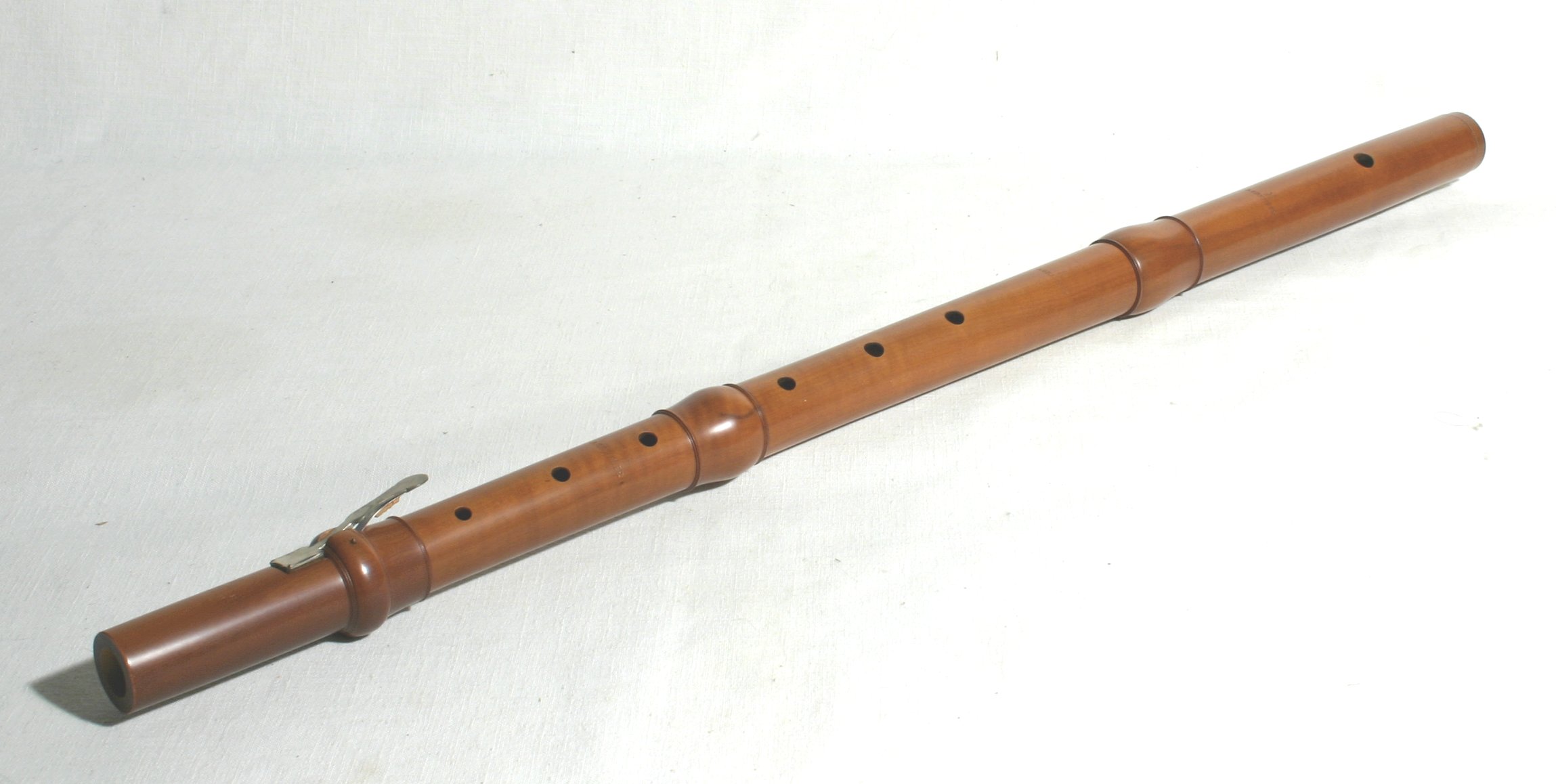
In the 17th and early 18th centuries, most wind instruments were mainly tubes with holes you covered with your fingers. You can see this in instruments of the time like recorders, chalumeaux (ancestor of the clarinet), hautbois (ancestor of the oboe), and baroque flutes. If you uncover each hole in succession, you go up a scale. To play notes outside that scale, you have to use so-called "forked fingerings," combinations of non-successive uncovered holes that get you close to the pitch you're looking for. For example, four fingers down on many baroque flutes gives you an F#. Putting your sixth finger down while keeping your fifth finger up shades that F# down to an F natural.
This works, but it's awkward. The note often comes out fuzzy, it's usually not directly on the pitch you want, and moving quickly between different forked fingerings is not easy. Even a split second of a finger being slow to move can make an unwanted noise, and can make certain notes hard to play. The player constantly has to correct their embouchure and breathing to compensate for the slight variations in tuning and tone. And some problems, like notes coming out at different volumes, are ultimately very hard to fully compensate for.
The biggest issue you run into as an instrument maker is a simple matter of physics and human anatomy. Each hole that you drill into the instrument affects the sound in a different way. Often, the optimal place to put a hole is not an optimal place for a person's finger to be able to cover it. So, you make compromises. If only there was a way to somehow artificially elongate or compress fingers to adequately reach the holes they're supposed to!
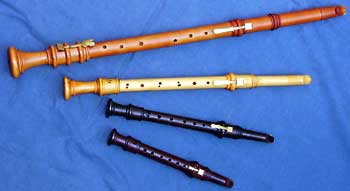
Enter keys. You can see a few early examples in the pictures above. You have a little pouch or pad, usually leather, on the end of a lever. The pouch acts like a fingertip, covering the hole. The lever makes it so that you can press it from a more easily reached position, while still putting the hole in the optimal spot. At first, keys were only used when absolutely necessary. There isn't a good forked fingering for Eb on a Baroque flute, so a hole and key was added to adequately play that note.
In the mid-to-late 18th century, keys started proliferating as instrument makers looked to improve the tone, tuning, and playability of wind instruments. Johann Denner (or sometimes his son Jacob) is usually credited with inventing the clarinet around the turn of the 18th century as an improvement on the chalumeau. However, his invention/innovation only included two keys. By the 1770s, clarinets had many more, added by makers and designers that were looking for better tuning, tone, and volume at various points in their range.
I should take a minute to note that keys are far from the only aspect of wind instrument design that changed significantly during this period. The bore, for example, has a huge affect on tuning, tone, and volume. However, I don't want to turn this into an acoustic science treatise on the benefits of a conical vs cylindrical bore, or discuss the somewhat complicated overblowing system that allows wind instruments to play higher octaves. Keys are the most easily understood and visible aspect of this design, and also arguably the most important and intricate, hence my focus on them.
All of these improvements led to, among other things, a hell of a lot more music being written for wind instruments. Winds had often been part of popular and folk musics, but their inherent limitations had made them somewhat less popular among classical composers. However, by the early 19th century we not only see an explosion of innovation in wind instruments, we also see a lot more classical pieces, especially virtuoso pieces for famous soloists like Charles Nicholson and Joseph Beer. It's funny for a contemporary audience to realize that a composer writing a clarinet concerto in 1805 would be in many ways analogous to a composer writing for computers/electronic instruments today, leveraging newly-developed technology in their music.
One of the biggest and possibly the last "major" development in wind instrument design was the creation of a new system for the flute by a maker named Theodore Boehm. Up until he began seriously working on his designs in the 1830s and 40s, flute makers had consistently added keys and enlarged holes on their flutes, again in search of better tone, volume, and tuning. Boehm took that to its logical conclusion, developing a system that included holes too large and awkwardly placed for a player to cover them with their fingers. Instead, pads covered most holes, with a series of levers and mechanics making it so that the player's fingers could stay in their most comfortable natural position. It was complex, but it created a loud, powerful, consistent, and in-tune sound across multiple octaves. The Boehm system flute is the familiar silver/metal instrument used in classical and other musics to this day (with some tweaks/improvements since his day, of course).
Boehm-inspired systems made their way into other woodwind instruments, including the oboe and clarinet. The saxophone as designed by Aldolphe Sax was based on an amalgamation of those fingering systems. Mainly, Sax was looking for the same thing that drove other woodwind designers: a loud, easily played wind instrument with good tuning and solid tuning across a wide chromatic range. His saxophone was certainly loud, had a distinctive tone, and immediately attracted both proponents (most famously the composer Hector Berlioz) and detractors. It was particularly well-suited to marching bands and groups that primarily played outside and/or along brass instruments, which can easily drown out other wind instruments. While it was never fully assimilated into the classical orchestra, it has found its way into many classical settings, and has found a lasting home in jazz, where its brash, distinctive tone and ease of chromatic playing made it perfect for bebop soloing.
So, to conclude, the saxophone was certainly novel but was mainly an outgrowth of a longer-standing musical trend towards louder, more chromatic, and stronger-toned wind instruments. As such, it's just one of the most famous branches of a tree that also includes lesser-known instruments like the basset horn, Sarrusophone, and Rothophone. All of those instruments, whether famous or obscure, were after the same thing.
What a remarkable response. Thanks!