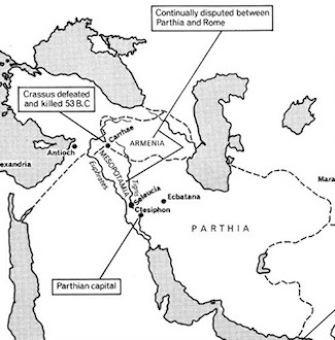
Alexander the Great's path of expansion, I don't have a proper pic of the path Crassus took, but this general map of location of Carrhae seems to get the point across. It seems a bit odd to point fingers at Crassus so much for his choice of path when it had actually worked for the greatest military expedition in history a few centuries back.
Yes, things had changed and all that, but it wasn't like he was crossing the Alps with giraffes or sth...
Crassus's army was not Alexander's. If he had an army like Alexander had, he would probably have fared rather better than he did in real life. The army he did have was not much smaller than Alexander's, but was weaker in cavalry, while his opposing commander, Suren (Surena) had a much smaller army than Darayaus (Darius) had at Gaugamela, but possibly stronger in cavalry (notably, Suren's army was all-cavalry).
The Macedonian army at Gaugamela is reasonably well-known: about 9,000 in his pike phalanx, about 22,000 other heavy infantry, about 9,000 light infantry (including archers), about 2,500 companion cavalry, and about 4,500 other cavalry.
The Persian army at Gaugamela is not reliably known, and modern estimates vary greatly. Arrian reports 1,000,000 infantry, and 40,000 cavalry. This number of infantry is about 10 to 30 times too large. The mystery is whether the number of Persian cavalry is similarly too large. Some modern estimates assume that it is accurate, and that therefore Alexander's cavalry was outnumbered by more than 5 to 1. This seems to be an overestimate from the course of the battle. At Gaugamela, as was common practice, the infantry was deployed in the centre, and the cavalry on the wings. The Persian army was larger than Alexander's, and Darayaus's cavalry attacked the flanks of the Macedonian army. The Macedonian cavalry on the wings were supported by archers and other infantry, and fought a largely defensive battle, eventurally defeating the Persians on the Macedonian right wing after a long hard cavalry battle, while the Macedonian left wing held its own but was being surrounded at the end of the battle. Alexander's companion cavalry - his elite best-armoured cavalry - was kept in reserve to the right of the centre, and the left of the cavalry battle on the right wing. Thus, Alexander's 4,500 non-companion cavalry, with some infantry support, were able to hold their own on one flank, and win on the other. This suggests that the Persian cavalry strength was rather weaker than 40,000. While the Persian cavalry was engaged on the flanks, the Macedonian centre and the companion cavalry attacked and broke the Persian infantry in the centre. Darayaus and those of his infantry who could flee fled. The danger to his left wing stopped Alexander from pursuing - his companion cavalry, and also the cavalry from his right wing, went to help his left, and handily defeated the Persian cavalry there.
It is likely that if Alexander's companion cavalry had been committed to the left wing early (rather than being held in reserve to break the Persian centre), the Macedonians would have won the cavalry battle on both wings. Whatever the numbers of the Persian cavalry, Alexander's cavalry was stronger (in effectiveness, if not in number). The cavalry battle was not a walkover for the Macedonians; they lost about 1,000 horses, and fewer but still many men.
At Carrhae, Suren had a mere 11,000 men to slow down Crassus. The main Parthian army headed to Armenia, while a small force - commanded by Suren - was sent to delay Crassus. Crassus had approximately 30,000 heavy infantry (his legionaries), about 4,000 auxliary infantry, and about 4,000 light cavalry. Suren's army was all cavalry - about 1,000 cataphracts (fully-armoured cavalry on armoured horses, equipped with long lances and bows) and 10,000 light cavalry (all archers, too).
The problem with Crassus's march was not that it was across hot desert, but that it meant that he met Suren in open cavalry-friendly terrain. Had he followed the advice of the Armenian king, he would passed through Armenia and marched into Mesopotamia in rough terrain, with one flank protected by the Tigris. (This would also have led to him meeting the main Parthian army, so it might not have turned out much better for him.)
In the open, he could not force contact with Suren's army with his infantry - Suren had no infantry he needed to slow down to cover, and could freely fall back before the Roman infantry. If the Roman cavalry attempted to attack his cavalry, it would end badly for this - Suren's cavalry was more than double in number, and also better. Crassus's light cavalry was vulnerable to Suren's archers. If the Roman infantry tried to turtle up (i.e. use the testudo formation) for protection against the Parthian archery, they could be (and were) attacked by the Parthian cataphracts, which forced them into a more open formation, making them more vulnerable to archery.
Whether Alexander's cavalry would have fared well against Suren's must remain unknown, but we can guess that 1,000 cataphracts might prove more than a match for Alexander's 2,500 companions (with unarmoured horses, and less armour for the riders), and Suren's 10,000 light cavalry would prove almost as effective against Alexander's 4,500 light cavalry as they did against Crassus's 4,000.
In summary, it much safer to march across open cavalry-friendly terrain when your cavalry is stronger than the enemy cavalry. As Crassus demonstrated, it is potentially fatal to march across such terrain with a slower force with inferior cavalry. (This was something that the Chinese discovered and re-discovered in their wars against their northern neighbours.)