Before the arrival of Europeans there were some pretty advanced civilizations in South and Central America. Were the natives in North America aware of them? I recently read an article that stated there is evidence that the native peoples in the Caribbean were not only aware of the civilizations in Southern America but traded with them, and that they had more interactions than previously thought. This made me wonder if the people from North America also interacted with these civilizations, for example did they know about the Aztecs?
It's important to keep in mind that we're talking about very large and varied groups of people here. There were millions of people in both North and South America, split into hundreds of different confederations, empires, tribes, city-states, and everything in between. So when I say that the answer to your question is "yes," I mean that some North American peoples were aware of some South American ones, and vice versa. I'll talk specifically about three examples: Caribbean - South American contact, Mesoamerican - Southwestern U.S. contact, and Northern Andean - West Mexican contact. This is not meant to be a complete record of all interactions across those regions, but instead just a selection of examples I find particularly interesting.
So, let's begin with the Caribbean. Evidence suggests that this region was influenced by multiple migrations from northern South America. For example, the Taino who inhabited Puerto Rico at the time of Columbus' arrival seem to be descended from South Americans, and genetic studies (along with linguistic ones) show close links between historical Caribbean Taino people and modern Arawakan-speaking groups in northern South America.^(1) The same article also notes:
archaeological evidence...suggests that indigenous Caribbean communities were highly mobile and maintained complex regional networks of interaction and exchange that extended far beyond the local scale.
These mobile and complicated regional networks extended to mainland areas around the Caribbean. For example,
Current archaeological evidence suggests that connections between the Antilles and mainland areas were taking place across time and space, but at which points in time, and how these were spatially structured, are in many ways unknown and still under investigation.^(2)
This article also highlights the need for further study on contact between Caribbean Islands and mainland Mesoamerica. I'll quote one final part, which highlights potential lines of evidence for Caribbean - Gulf Coast/Floridian contact even though there is no unequivocal archaeological evidence for that yet:
Many scholars (e.g. Helms 1988; Marquardt 1990; Rouse 1986) have suggested that it may have occurred based on various lines of evidence, including geographical proximity and similarities in agricultural practices, language, burial customs, general cultural behaviors, and artifacts such as ceramics and shell gouges (see Siedemann 2001: 4–5 for a list of more complete references). Purdy (1988) argued that shortly after post-contact in 1492, Caribbean Amerindians retreated to Florida in the wake of incursion, suggesting they knew of land and people to the north.
Ok, now let's move onto regions with decidedly more evidence for contact: the extensive history between Mesoamerican societies and northwest Mexico/the Southern U.S., which is sometimes referred to as "Oasisamerica." There seems to have been long periods of often intensive contact between these two areas, and this contact involved significant exchange. One especially telling marker of Mesoamerican influence is the presence of ball courts. Many of these distinctive structures have been documented across the Southwest - here are two built by the Hohokam people during the 1st millennium A.D.
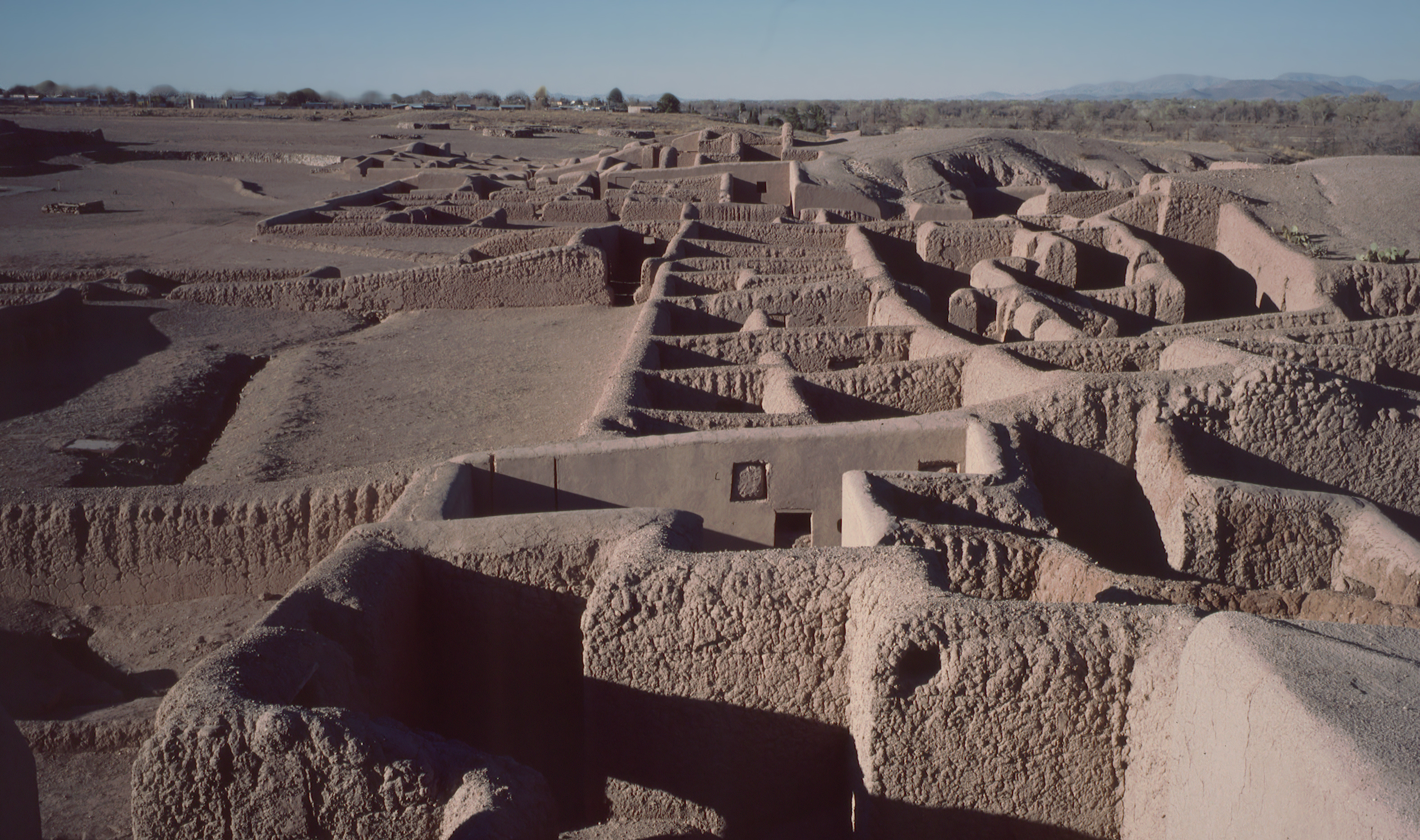
But my personal favorite example of Mesoamerican - Oasisamerican contact has to come from Paquime, a Mogollon culture site in Chihuahua, Mexico near the border with the United States. Sometime between 1150 and 1450 AD, Paquime's residents were raising and breeding scarlet macaws. The kicker is that scarlet macaws' northernmost native range is 1000km south of Paquime. The Mogollon must have been interacting with Mexican societies further south in order to obtain these birds. Isotope analyses even suggest that
Paquime's inhabitants also acquired scarlet macaws from...extra-regional locales that may have been as far away as their endemic homeland in Veracruz in eastern Mexico.
Finally, let's turn to what is perhaps the most remarkable direct intercontinental interaction known between Amerindian peoples prior to contact with Europe: trips between the Northern Andean coast (Ecuador/Colombia) and West Mexico. Amazingly, it seems that metallurgy in Mesoamerica was introduced through maritime trade routes from the Andes. The earliest examples of metallurgy in Mesoamerica seem to be directly learned from Ecuadorian techniques. Let me take a long quote from someone more knowledgeable on the subject:
The data strongly support the idea that knowledge of metallurgy was introduced by Ecuadorian voyagers to peoples living in west Mexican ports. This argument derives from my comparative anal yses of lower Central American and South American artifact chemistries, fabrication techniques, and design characteristics, with those of artifacts from west Mexico (1986, 1988b, 1994, 1996) and from recent engineering studies of the design and performance of Ecuadorian balsawood sailing rafts (Dewan and Hosier 2008). Both lines of evidence strongly suggest that knowledge of metalworking techniques, and a few prototype artifacts, were carried to the shores of western Mexico by the sea-going peoples of coastal Ecuador, whose balsawood trading rafts were still in evidence at the time of the European invasion
long layovers were essential to the process of introducing this complex technology, metallurgy, to peoples who were unfamiliar with it...The argument that west Mexican metallurgy was introduced from the south becomes particularly convincing when we assess the laboratory and archaeological data comparing lower Central American and South American metallurgy to the metal objects excavated in the west Mexican metalworking zone. Those data show that copper objects recovered at the west Mexican metalworking zone sites mentioned previously - lost-wax cast bells and cold worked needles, tweezers, and rings - are virtually identical in design parameters and fabrication techniques to Colombian, and to Ecuadorian/northern Peruvian artifacts^(3)
Other analyses make it clear that Ecuadorian sailing craft were
fully functional sailing vessels and could have been sailed between Ecuador and Mexico.^(4)
Ecuadorian sailors, traveling up South and Central America to share their knowledge of metallurgy in West Mexico? That's pretty cool, to put it lightly.
As an endnote, I want to repeat that these are only three examples. There are many more. Even just the history of plant domestication in the Americas suggests contact across both continents; plants like maize, cassava, cherimoya, tomatoes, and many more were all transferred thousands of miles across the two continents through indigenous networks.
So, TLDR; a resounding yes.
^(1) https://www.pnas.org/content/115/10/2341
^(2)Fitzpatrick, S. M. (2013). Seafaring capabilities in the pre-columbian caribbean. Journal of Maritime Archaeology, 8(1), 101-138.
^(3)Hosler, D. (2009). West Mexican Metallurgy: Revisited and Revised. Journal of World Prehistory, 22(3), 185-212.