Side question; my grandfather served in the Tank Depot in both WW2 and the Korean War. Unfortunately he passed away, would he also have seen much Klan regalia and Confederate flags in Korea?
This is an area that requires more research. You have perhaps serendipitously walked into what we would usually refer to a "gap in the literature", something that any student in history planning to write a thesis actively looks for. The research about the presence of the Klu Klux Klan among white American service members in South Vietnam is very small, if not non-existent. The heavy bulk of research of the Klu Klux Klan and the Vietnam War centers around the influence that the war and its aftermath had on the growth of the Klu Klux Klan and the radicalization of a small portion of its white veterans. /u/Georgy_K_Zhukov recently wrote an excellent post about the Klan and the Vietnamese diaspora in Texas, showcasing how attitudes and training gained from the Vietnam War came to serve present or future Klan members in the war's aftermath. The Vietnam War became a rallying point for these white nationalist extremists.
But none of that actually answers your question and I am afraid to say that there is no answer to your question at the present. It is not an easy task to determine how widespread the Klan presence was in South Vietnam during the Vietnam War and it is an area that requires further research. But there is little doubt that there was a visible Klan presence. The question of whether or not personal racism aimed towards African Americans was widespread among active combat units is still up for debate, but both white and African American veterans agree that racism was not as much a problem on patrols as they would have been in bases or installations. The primary reason for this was the stress of combat and the ever present threat of imminent death which seemed to make some men overlook racist thinking, or as a 9th Infantry Division soldier put it, "You know when I am out in the bush carrying a grenade launcher, no white man is going to call me n----r." Making yourself known as an active racist or Klan member would not have made you any friends among your fellow soldiers, as Harold "Light Bulb" Bryant explained:
There was another guy in our unit who made it known that he was a card-carrying Klu Klux Klan member. That pissed a lot of us off, 'cause we had gotten real tight. We didn't have racial incidents like what was happening in the rear area, 'cause we had to depend on each other. We were always in the bush.
Yet away from the bush, racial incidents did happen. African American soldiers reported finding racist literature, some of it Klan material, in guardhouses. In the aftermath of the assassination of Dr. Martin Luther King Jr., a Confederate flag was hoisted in celebration and white men donned improvised Klu Klux Klan robes, burned a cross, and paraded around the base in Cam Ranh Bay. A year later in 1969, another cross was burned in Cam Ranh Bay, aimed towards a barrack that was predominantly African American. In 1970, yet another cross was burned, this time outside the tent of Clyde Brown, an African American soldier who had appeared on the cover of Time magazine. It is impossible to ignore a 12-foot-high burning cross, but these incidents all seemed happened with "the tacit approval of those in command" in the words of James E. Westheider.
While just how widespread the presence of the Klan and Klan regalia really was is not entirely certain (although it was made very visible at certain times), the presence of the Confederate flag is far more easier to determine. In the words of Reginald Edwards: "It was clearly [a white man's] war. If it wasn't, you wouldn't have seen as many Confederate flags as you saw. And the Confederate flags was an insult to any person that's of color on this planet." For many African American soldiers, the open display of the Confederate flag was something that they rightly despised. It was everywhere. Whether it was flown over a firebase, displayed in a barrack, used to drape a tank, or was posed with by white soldiers, it was something that black soldiers simply could not ignore. African American soldiers and the NAACP began to complain about the presence of Confederate flags as early as 1966. Only in May 1969 was a new regulation introduced that banned Confederate symbols (unless if it was shown on a state flag). However, this was very rarely enforced. Quite the opposite, in fact, as more time and effort was put in to forcibly ban expressions of black cultural solidarity, such as dapping, Black Power flags, and the "Black is Beautiful" poster.
Sources:
Bloods: Black Veterans of the Vietnam War: An Oral History by Wallace Terry.
Fighting on Two Fronts: African Americans and the Vietnam War by James E. Westheider.
For post-war Klan members, see Bring the War Home: The White Power Movement and Paramilitary America by Kathleen Belew.
I can only give a partial answer to this. I am a little reluctant to get into the 'Why" part of the answer, but the "what" is pretty objective, at least insofar as confederate imagery stands. I am not going to address Klan display issues, since I know little on the subject.
He would certainly have seen confederate imagery, it has been a constant in the US military for the last century. With respect to Vietnam in particular, see for example
https://hernandoheckler.files.wordpress.com/2012/11/confederate-flag-vietnam.jpg
or https://hernandoheckler.files.wordpress.com/2012/11/namrebs.jpg
It's worth noting, though, that the Confederate Flag itself was always pretty much consigned to history, but the Confederate battle flag (CBF) (Flag of the Army of Northern Virginia, later adopted by other confederate armies) has been common enough throughout the century and a half since the civil war.
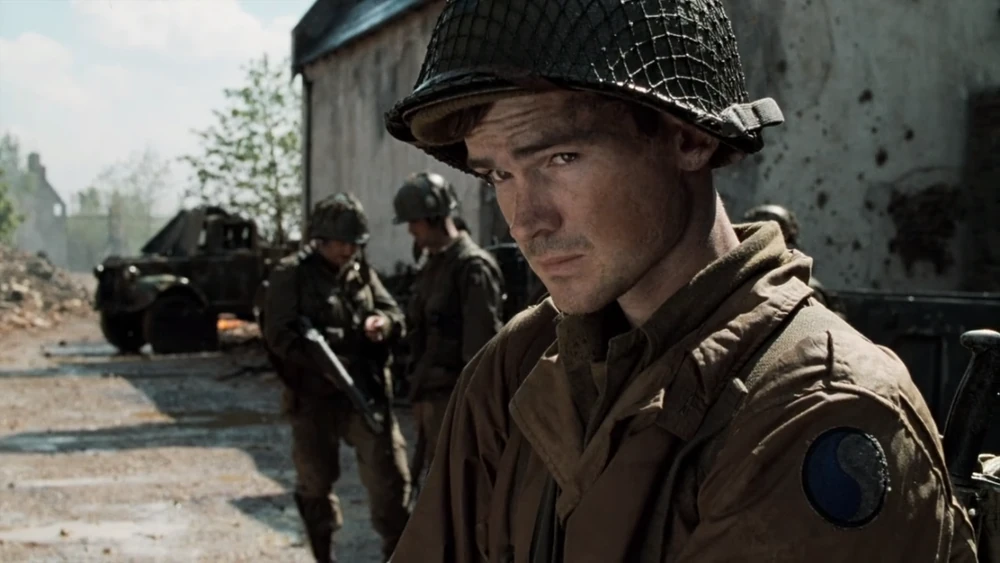
The policy of the US Army in the post-bellum period was "reconciliation", not "suppression". It deliberately integrated confederate military history and heritage. The US named a number of its bases in former confederate territory after confederate locals, much to the angst of some. (It's worth noting, perhaps, that these bases have recently been declared to be subject to renaming). If you will recall when watching Saving Private Ryan, the outfit that Hanks and his crew hit the beach with was the 29th Infantry Division, also known as the Blue and Grey Division from their shoulder patch: When the Division was constituted in 1917, since the men came from States which fought on both sides of the Civil War, the unit patch proudly proclaimed it: The blue uniforms from the Union and the grey uniforms from the Confederacy swirl together to make the one insignia. https://static.wikia.nocookie.net/ww2-movie-characters/images/4/49/Timothy_Upham.png/revision/latest/scale-to-width-down/1000?cb=20210522105439 ; https://history.army.mil/documents/eto-ob/29ID-eto.htm
The 31st Infantry Division, also raised in 1917, nicknamed the Dixie Division, was formed pretty much entirely from divisions from the South. The Confederate Battle Flag was displayed prominently in its imagery. http://www.indianamilitary.org/31STINFDIV/images/Tentmates2.jpg
In 1943, former US Army Lt Col and WW1 combat veteran Senator Millard Tydings from Maryland, submitted a bill to officially authorise US troops to fly confederate battle regalia, this was signed in by President Truman in 1948. Many troops, of course, did not wait for this signature, there are plenty of photos of such display during WW2, either as a personal token or as something more official eg (Virginia/NC sourced Eighth Evacuation Hospital CO addressing the troops on the occasion of Thomas Jefferson's (Also a Virginian) birthday): http://www.ww2incolor.com/d/591177-4/blackFord Tyndings' official reasoning was "The sons of those who fought on the southern side in the Civil War ... at least should have the right to carry these streamers as a matter of maintaining military morale"
Of course, it would be not wrong to observe that these displays were not universally approved of. The seizure of Iwo Jima was symbolised by the famous raising of the US flag, but the seizure of Okinawa (More specifically, Shuri Castle, the Japanese HQ and last major point of resistance) was marked by a CBF. It had been worn inside the helmet of a Captain Julian Dusenbury from South Carolina whose actions during the battle earned him a nomination for a Medal of Honor (Downgraded to Navy Cross). After he was shot and evacuated, his troops found the flag in the helmet and raised it partially because it turned out nobody had thought to bring a US flag, and partially out of respect for their CO. However, after being displayed for three days, it was ordered down, which started a bit of controversy. According to Dusenbury's XO, it was the battalion commander who ordered it be replaced by a US flag, but the division commander stated that the Marines who stormed the castle could fly any flag they wanted. Of note, Army Lt Gen Buckner, son of Confederate General Buckner, was displeased with this CBF display, saying the battle belonged to all Americans. There were other incidents of CBF display being ordered down by commanders after display such as by a group of US destroyers all of whom had Southern COs being nixed in 1952, but this became very much a matter of the personal inclinations of those commanders and no official military-wide policy seems to have existed.
Indeed, until the very recent past (2020), no military wide policy existed post-Vietnam either. The CBF not uncommonly showed up as late as the Afghanistan and Iraq campaigns.
That's the what. The "why", and any connection to the Klan, is another kettle of fish. The bottom line is that though it may not have been massively common to see confederate imagery in Korea or Vietnam, it would not have been surprising either.