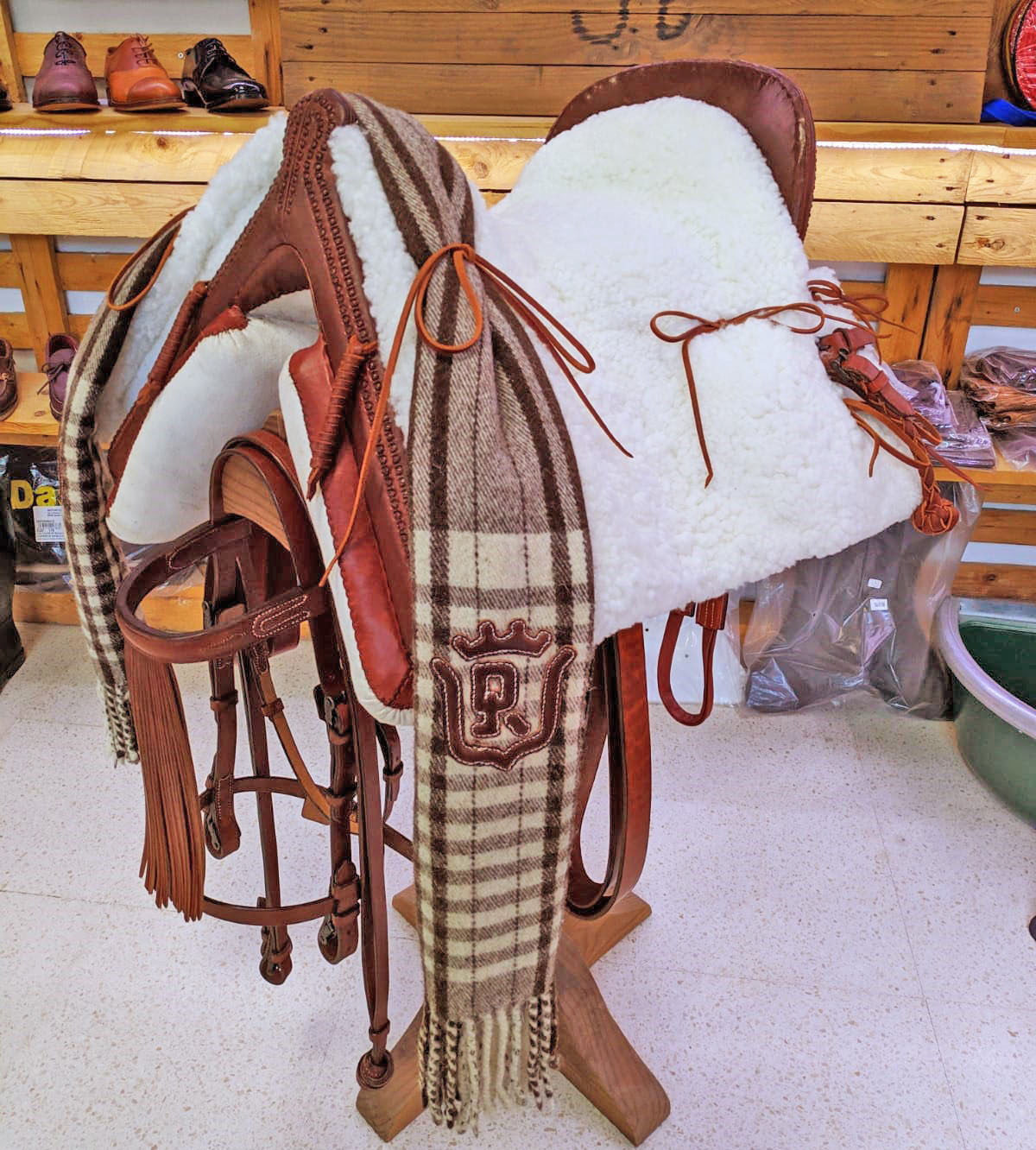
The very short answer is yes. You can attribute some of this to the basic physiology of the horse, which has remained largely unchanged since domestication. There are only so many ways one can design tack to be safe, comfortable, and effective for both horse and rider. The physiology of the horse, however, only tells part of the story. The demands of Medieval horsemanship, as well as the invention and introduction of new equine technologies, pushed the design of tack in a direction that still shapes it today.
Before I jump into my full explanation, I’d like to note that when I use the terms “modern equitation,” “modern horsemanship,” or “modern tack,” I’m taking a deliberately broad view of what constitutes “modern.” The foundations of modern horsemanship -- ways of riding that would be immediately recognizable to a 21st century equestrian -- were cemented in the 16th century and had developed into their distinct forms by the mid to late 19th century. In short, my use of “modern” encompasses a rider from 1880 as much as it would a rider from 2020.
We can break tack down into three major categories: saddle, harness and bridle. A recognizably modern saddle can be defined by the presence of stirrups and a tree, which consists of two bars on either side of the horse’s spine that are often contoured. These bars connect a continuous arch or fork at the pommel and cantle of the saddle. Both stirrups and the saddle tree were in widespread use by the 11th century.
The adoption of the stirrup across western Europe was slow, and driven by developments in arms and armament. The Avars first brought the stirrup into Europe, where it influenced the Byzantine cavalry by the late 6th century. The Franks likely adopted the stirrup directly from the Avars, perhaps in the late 7th century. But the stirrup was not omnipresent during Carolingian expansion and empire during the 7th to 9th centuries. Contrary to older historical interpretations, stirrups don’t make stereotypically medieval cavalry tactics possible. Mounted shock troops, for instance, had been deployed since antiquity. Heavy cavalry first truly emerged during the Roman-Seleucid War in 2nd Century BC, although horses had been armored to some degree for one or two centuries before that. Horse soldiers were also perfectly able to wield lances, though they would not have couched the lance under their arm.
This isn’t to say that stirrups have no benefit, and in Medieval cavalry usage their benefits are easy to understand. Stirrups make it easier for the rider to shift weight and correct balance in the saddle. They further facilitated the development of heavier armor by offsetting its topheaviness. Stirrups make mounted combat safer and more comfortable for the horse soldier; they also make mounting easier, especially in armor. As knights adopted the technique of couching their lance under their arm, the stirrup played an additional role in increasing the effectiveness of the weapon. A knight could push his feet forward in his stirrups, thus bracing himself against the cantle of the saddle, which imparts more force to the blow of the lance.
A stirrup, however, needs a solid platform to be affixed to. That platform is the tree of a saddle. The treed riding saddle may have its origins in the Roman four-horned saddle that soldiers adopted from the Celts. Unfortunately, no complete Roman saddle survives, so our practical understanding of their construction comes primarily from written and visual descriptions, alongside the incomplete archaeological remains. Scholars have debated about whether or not the four-horned saddle had a true tree, and reenactors who have tested treed and treeless reconstructions have provided positive and negative feedback about both designs.
Regardless of the origins of the treed saddle, the increased bulk of arms and armor as the Middle Ages progressed rendered a tree vital. The primary purpose of a saddle tree is to distribute weight across the horse’s back. Horses didn’t evolve to be ridden, and pressures exceeding 11 kPa (or about 1.6 PSI) can cause pain and injury. A well designed, continuous, solid tree that is fitted to the back of the individual horse spreads the weight of the rider over a surface area large enough to bring the pressure on the horse’s back to a safe and manageable level. Additionally, a saddle tree provides the strength and rigidity necessary to increase the size of the pommel and cantle. As I mentioned before, the efficacy of the couched-lance technique that knights employed was increased by the knight’s ability to brace himself against the saddle’s cantle. By the 14th century, the pommel and cantle had grown tall enough, and in some instances curved enough, to essentially lock the rider in place. Of course, mounting a horse with such a bulky saddle was made trivial by the stirrup.
While a Medieval saddle may look rather over the top in comparison to the sleek saddles one sees on racehorses, jumpers, and some show horses, the basic principles are identical. The shape of the superstructure is guided by the rider’s purposes, but underneath are two stirrups, a pommel, a cantle, and a solid tree. Indeed, the traditional saddles still used by Iberian equestrians, as well as their western saddle descendents in North and South America, have a medieval influence in their high cantles, deep seats, and pommel swells that help ease the shocks of working with livestock. One could even argue that recent trends in the design of dressage saddles show a return to more of a Medieval pattern, as riders find that additional support is necessary to sit the extravagant gaits favored by judges in the arena.
When it comes to bridlery, we’ll need to look primarily at bits, since bridles, typically made of natural materials, don’t preserve well in the archaeological record. Bits can be broken down into two broad categories: leverage action and direct action. Bits that work off of direct action are called snaffles. The only force that they transmit to the horse is the force that the rider can apply to the reins, though the mouthpiece of the bit can have secondary effects. Leverage action bits, as their name suggests, increase the amount of force applied to the horse’s head and mouth. While there are many different types of leverage bits with slightly different forms and functions, for the sake of simplicity I’m going to collapse these types into just a generic “curb bit.”
Snaffle bit design has remained remarkably stable for thousands of years. Snaffles that are essentially identical to modern single-joint, full cheek, twisted wire snaffles have been uncovered in Greek tombs dating to the 8th and 7th centuries BC. Medieval bits likewise are immediately recognizable as snaffles and curbs. Medieval snaffles are more common archaeologically than Medieval curbs, though curb bits are more commonly depicted in art. This perhaps reflects the turnout of the fine riding animals that would have been recorded by artists, versus the turnout of draught animals that would have been more common in daily life.
(Continued below)