Hello
I'm a German History Lover and it has been a year since I have some problems answering to this question .
We Iranians are very good in Translation , so I have read many books about ww1 ,But none of these ever pointed out a logical reason for Germany's defeat in 1918 .
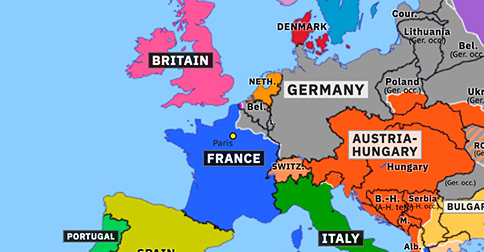
I mean Look at this picture : Germany map 1918
You see that everything goes fine with German empire , Eastern front is out of sight and Paris is near to fall and Britain being bombed heavily with Zeplins , in short Germany was winning !
So why people just Rebelled against the Regime when the victory was near ?
Please give me a detailed answer , I'm tired of nonsense stereotypes .
Thank you
I've covered this before in depth but I can't for the life of me find the post so here we go again.
TL;DR - By 1918 the German Empire was finished.
It was finished politically, industrially, militarily and economically. You can't just look at a map and say "this looks good" because a map tells you nothing about the situation in Germany, on the front or in the rest of the world so let us summarize.
By 1918 Germany was essentially alone, starving, bakrupt and losing. Yes, the treaty of Brest-Litowsk allowed the Germans to transfer fresh troops to the western front and for a brief period in the spring of 1918 resume the offensive but none of that mattered because:
Germany was starving.
And they had been for years. People were dying of starvation in Germany. Rationing in 1918 was so harsh that hundreds of thousands of people died of malnutrition or related causes. The situation was particularly bad in major cities. Germany was always dependent on international imports and could not sustain itself without them. Britain and France kept the Atlantic and Mediterranean route closed. Initially Germany was able to get some imports from the middle east through the Austro-Hungarian empire but by 1918 this route too was about to close since the Austro-Hungarian empire was collapsing. This in turn leads us to point 2.
Political instability.
People really don't like starving and they don't particularly like dying in their millions for a lost cause either. So, as the war progressed and the situation in Germany worsened, so did political discontent. Calls for bread and peace were growing increasingly loud in Germany and it all came to a head when the German Navy wanted to try for one last engagement with the British. The sailors said no. Initially the revolt was small, limited to only 3 ships and the mutineers surrendered peacefully but it grew. Quickly. The sailors joined up with dock workers, union men and even soldiers, forming revolutionary councils and quite simply refused to obey orders. The initial mutineers were freed from prison. This spark ignited a powder keg all over Germany but primarily in the north west where strikes, marches and protests grew into a full fledged revolution. This in turn led to point 3.
The collapse of the army.
Knowing the things at home were quickly falling apart, the army was close to full blown mutiny and collapse. Desertions were rampant, food, supplies, ammo and shells were in short supply. Added to this, they were out-numbered by at least 2 to 1 along the entire western front and the allies had done their homework. Gone were the costly large scale offensives of the early war. The allies now concentrated forces on more limited objectives, took them and then shifted elsewhere forcing the Germans to constantly redeploy their troops to counter a new threat. The numerical superiority of the allies allowed them to do this nearly constantly, always focusing on a new area of the front all the while the Germans were scrabbling desperately to prepare new defenses and counter new threats.
When you put all of this together it's a miracle Germany held out as long as it did. By the summer of 1918 Germany stood virtually alone, starved, outnumbered and falling apart from within. Who care what the map looked like, there was absolutely no way Germany was ever going to recover or stabilize. You say "victory was near" but it really wasn't. The only thing that was near was the total collapse of Germany.
EDIT: Fixed formatting