I was watching one of these YouTube videos where a historian reviews films and television shows that take place in historical settings. I think the guy was reviewing Vikings, and he mentioned that it was inaccurate the extent to which leather was being used as shirt or over-shirt material. He went on to briefly say leather was actually not that widely used for such purposes at the time. Is this accurate? Hoping some medievalists can way in. Thanks
Leather is a very fragile material regardings its chances to survive through the centuries. What suriving leather items we have found in archaeological digs were preserved in rather favorable environments such as bog pits or clay deposits. Thus, hard evidence is scant.
However, most historians share the conjecture that leather would not have been widely used in everyday garments given its relative cost, higher than textiles such as linen or wool, but also its properties which plausibly do not fit well within what everyday clothing is supposed to do if compared to the aforementioned materials.
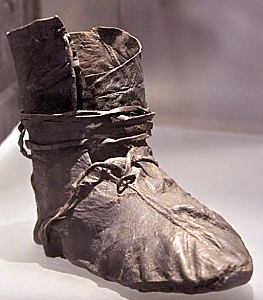
Leather was used to manufacture footwear as this finding from Hedeby, Denmark, dating around the IX-X century tells us. Accessories like belts and sheaths would have been made of leather (although the latter could be made of wood as well), and a speculated usage could have been covering the edge of round shields commonly used by Germanic Northern European people until the mid-XI century.
Pieces of attire like aprons could very well have been leather, given the rigidity of the material and it being fireproof in some capacity. A blacksmith for example might very well have worn such apron while working in his forge. But producing and entire tunic or trousers in leather I reckon would have been a huge commitment in time and resources for a return which I believe would not have justified such investment. Leather production would have meant slaughtering livestock, thus eliminating very precious and expensive means of sustenance for even the wealthiest of families. Of course this was done, but only in given circumstances and even in such occasion I strongly believe that leather would have been employed chiefly in the contexts we have discussed above, since dresses and tunics and cloaks made of fibers, both natural and animal, would have been cheaper.
Another speculated (and I need to stress "speculated" in this peculiar case) usage for leather could have been the production of armour. But such armour has been exceedingly rare to find, both in archaeology and iconographies. Returing to the Vikings TV series, what fantasy-esque armour and clothing is shown wildy steers away to what is hypothesized leather amour could have looked like, which is possibly something like this.
During the rest of the Middle Ages, as far as we can tell, leather usage for clothes never appears to spill within everyday dressing customs. Fabrics managed to be virtually the only type of material used, although one exception could be a type of riding breeches, a sort of very skin-tight boot reaching almost the groin area, which is sometimes described in written sources but it is not as understood as we'd like.
I hope this helps you.