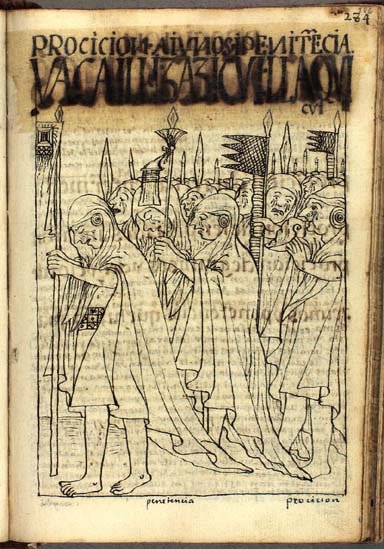
It is unthinkable to many people that the Incas could have had a form of political organization as advanced as a modern nation-state without also having that critical symbol of the nation-state, the flag.
Orlove, 1982
In the European sense of a flag as a national symbol, there was never an Inca flag.
There were definitely Inca war banners, standards, and, for lack of a better term, coats of arms. The indigenous author Guaman Poma de Alaya rarely depicts a large gathering of Inca, military or not, without some number of banners and "flags" of various shapes and sizes. His text suggests these played the roles we might expect from them: gathering points for battalions of soldiers, emblems for regions or family lines, or as props in religious rites. Inca royals and soldiers depicted in colonial era kero goblets also frequently carry banners. That this association continued well into the 1700s suggests it was a particularly significant practice.
We might also reference the "tocapu" here. "Tocapu" is the term for square geometric "icons" that were used to decorate textiles and other goods. This unku tunic has a selection of them in a band around the waist, and a single one is repeated along the middle of this kero and the top of this one. This unku is entirely tocapu! We know that tocapu were defined symbols because the same ones appear across mediums. Take a look at the first person in the Guaman Poma illustration above, or at all of them in this one. Guaman Poma has made sure to include the tocapu on their tunics. The squares are tiny and kind of "shorthand", but they're not random squiggles. The illustrator took the time to make sure they were accurately representing both the tocapu themselves and their arrangement on garments. Squiggly though they be, you can see that the tocapu are laid out in repeating, diagonal patterns, much like is done on those two real tunics.
The same tocapu also appear in different contexts. This kero has both a band of tocapu and a seated noble with a banner (in the middle of the top scene, with a white edge). That pattern on the banner? You can see it as a tocapu in other places. This Inca warrior also carries a banner, and the tocapu on that banner is an uncu tunic- just like the one he wears. And if you zoom in on the All Tocapu unku from before, you can see the unku-tocapu again; it looks exactly like this tunic, but shrunk into a square.
This is all to say that if there was a singular "Inca flag," we would most definitely know.
Now, the rainbow motif comes to us from a single passage in the writings of Bernabe Cobo. This passage can be found reproduced almost anywhere either the Inca flag or the related Wiphala is discussed, be it Wikipedia or the official website of the Bolivian Army. A recreation of the described insignia can even be found as the header to the Wiki on the Inca Empire. You can read the whole passsage at either of those links, but I want to point out two important lines in the Cobo text. First, he says that on the royal banner "pintaba cada rey sus armas y divisas:" each king painted his own arms and colors. Second, he says that the rainbow emblem was "las generales de los Incas:" the usual/typical one of the Inca kings.
This is often used to claim that the rainbow does not represent the Inca empire in the way the Stars and Stripes represent the USA, but that it was a symbol of the Inca royalty alone. This is not wrong. The snake and rainbow might be better compared to the Tudor rose than to the Union Jack. At the same time, this is not why it's inaccurate to consider the Cuzco rainbow flag the "Inca flag." As stated in my opening quote, the national flag is a concept directly linked to the modern nation-state, an entitiy distinct from a ruling dynasty or house. The modern nation-state simply did not exist in 1500, anywhere in the world. You'd be hard pressed to find anything at that time that could really be called a national flag. The banners of Castille and Leon under which the Spanish first landed in Peru weren't really "Spanish" in the sense of the modern nation-state "Spain;" they were the emblems of royal dynasties. Many of these emblems do occur in modern European flags. The Castle and Lion are still on the Spanish flag. It would, however, be no more appropriate to say that those emblems placed on a banner represented a "Spanish flag" in 1500 than did the royal Inca emblems placed on a banner. Using a royal Inca emblem in a modern flag is very much in line with how modern European flags were created. "Inca flag" is anachronistic because any nation-state flag from that time is anachronistic.
In any case, the rainbow flag was not officially adopted by Cuzco until 1978; the resolution which established this cites a popular radio host, Raúl Montesinos Espejo, who used the flag to promote shows with Andean folk music beginning in 1973. This, together with the Cobo quote, form the popular narrative for its origin. Did Espejo actually create it? Probably not. But that's as far back as any publication I can find goes. Again, it's not that the rainbow was conjured out of nowhere as an Inca symbol. We even see Inca noblesstanding beneath rainbows in Colonial Quechua art. But the exact striped flag of Cuzco? That's a lot harder to pin down.
The similarity to the Pride flag is coincidental, but not unnoticed. As quoted by Silverman:
on July 9, 2000, Cusco's [then] current mayor, Carlos Valencia Miranda, complained that the Inca flag had been "usurped by the gay community" and needed to be replaced. Infantas, the lieutenant mayor, stated that replacement was imperative so as "to avoid the moral deterioration of Cusco society."
Local LBGT advocacy groups clearly took offense at the implication that association with them was "moral deterioration."
Orlove, Benjamin S. 1982. “Tomar La Bandera: Politics and Punch in Southern Peru.” Ethnos 47 (3–4): 249–61.
Silverman, Helaine. 2002. “Touring Ancient Times: The Present and Presented Past in Contemporary Peru.” American Anthropologist 104 (3): 881–902.
Ziólkowski, Mariusz. 2009. “Lo Realista y Lo Abstracto: Observaciones Acerca Del Posible Significado de Algunos Tocapus (t’uqapu)‘Figurativos.’” Estudios Latinoamericanos 29: 307–34.