I was listening to the podcast of the BBC In Our Time's episode on Strabo's Geographica, and the guest classical historians seemed pretty agreed on this point: whilst in movies, scrolls in Ancient Greece and Ancient Rome (and its empire) are mostly shown to be held in the up-down position, in fact scrolls were meant to be held in the left-right position, with the reader scrolling the text laid out in columns.
As the host Melvyn Bragg comments, this does seem on reflection to be the sensible thing to do - scrolls could get pretty long (the 22 feet long scroll of Plato's Timaeus was mentioned), and the left-right position would seem the tidier option: the left hand rolling up and the right hand unrolling to show one column at a time.
This got me wondering a few things:
Is there enough evidence to support this assumption that left-right scroll-holding was the norm?
If so, what accounts for the emergence of the trope of up-down scroll-holding - as featured in movies and TV shows based in the Classical era - if it's historically inaccurate?
[Important note: I am aware of my assumption that the up-down scroll-holding trope is a lot more common in Western media than the left-right one. My familiarity with the trope suggests to me that this is so - and I don't want to carry out a large-scale statistical breakdown of movies set in the era which features scrolls. So, my assumption could be entirely wrong.]
The points are raised at the 44:40 mark of the In Our Time episode [Note: This is in the 'bonus material' podcast-only extended edition of the episode, where the guests relax and talk over one another a little]
For one example of up-down scroll-holding, see the Monty Python's Life of Brian stoning scene.
I can answer question 1. It's as well to do so: some readers here may regard this as common knowledge, but most people don't get to see ancient documents very often.
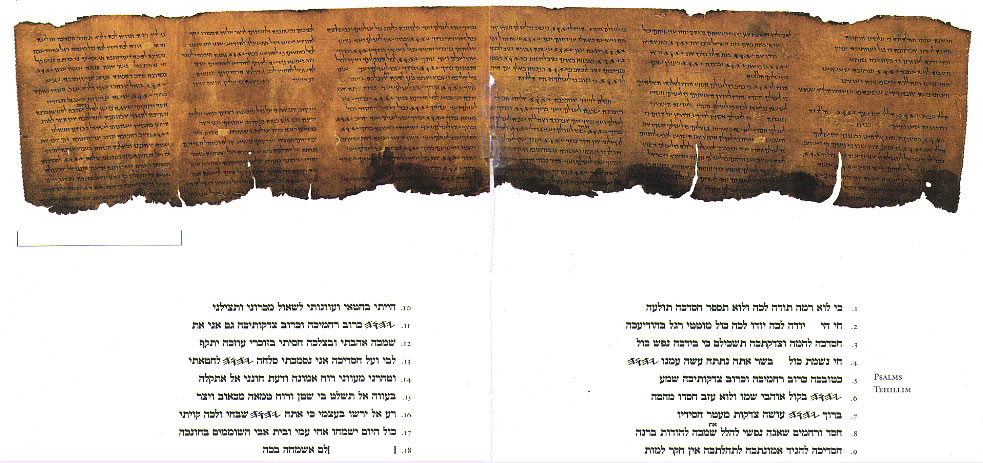
Yes, the guests on In Our Time were absolutely correct. Scrolls in the ancient Mediterranean world invariably unrolled horizontally, and the text was invariably written in columns, often fairly narrow columns, placed side by side. Paul Cartledge, Maria Pretzler, and Benet Salway are all capable scholars, and they definitely know what they're talking about. This applies to both Greek and Latin documents (left-to-right) and Hebrew/Aramaic (right-to-left).
The evidence is copious. We have thousands of literary papyri from antiquity (where 'literary' = published texts, as opposed to private, legal, etc documentary papyri), and all of the ones that are in scroll format are designed to unroll horizontally. The only exceptions are ones where there's no rolling at all: codices, that is pages bound at the spine (like a modern hardcopy book), which begin to appear in significant numbers from the 2nd century onwards; and documentary papyri, which are often just a single smallish sheet.
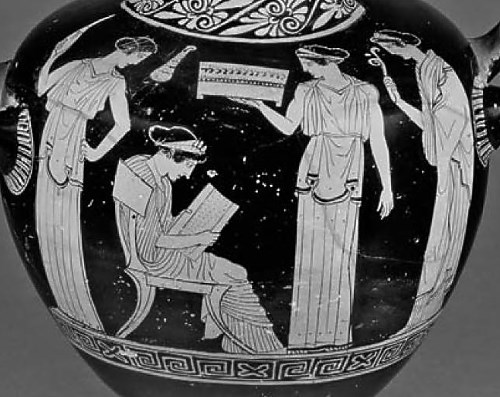
As illustrations, here's a fragment of a 3rd century Torah scroll from Ein Gedi; one of the Dead Sea scrolls; the copy of Aristotle's Constitution of the Athenians from Hermopolis; the 4th century BCE Derveni papyrus; a couple of images from 5th century BCE Greek vases, 1 and 2; and a fresco from Pompeii. I'd be happy to double or triple the examples if anyone really wants.
I can't answer your second question but I agreee it's an intriguing one. I've seen the vertical-unrolling trope too, just like you have, even on things like Hanukkah cards where you'd think the designer would know better. But I can only speculate on possible origins of the trope.