After all, despite occupying a prominent place in American history books talking about the 1920s, flappers were not a majority. Was this the case with hippies as well? Were most Baby Boomers who voted for Reagan in 1980, already socially conservative to begin with? How much did this differ by race and income?
The Hippie Trip from 1968 estimated 200,000 hippies, that is, less than 0.2% of the population. So you are right that the situation amplifies a minority. Even more seriously (and being more expansive than just "hippies"): a great deal of the counterculture was not Baby Boomers at all.
Let's suppose the most common definition of Baby Boomers: as being born from 1946 to 1964.
Let's also, for the sake of argument, consider the height-of-counterculture year to be 1969, the year of Woodstock, the year of the Stonewall riots, the year of the trial of the Chicago 8 (later 7 when Bobby Seale's case was severed).
How old would your Baby Boomers be?
For them to even be 18, their cutoff birth year would be 1951, only a quarter into the supposed span of the entire generation of Baby Boomers.
Now, there were certainly young people involved -- and part of the push for the 26th Amendment lowering the voting age from 21 to 18 was involving them -- but centering sole responsibility for the Counterculture Movement on Baby Boomers is very strange.
What about individual influential figures? There's no "scientific" way to make a "most influential" list, so I just grabbed a clickbait article which I figured would be a good approximation, just to check how many were Baby Boomers:
Hunter S. Thompson, gonzo journalist
The Beatles, musicians
Bob Dylan, musician
Muhammad Ali, boxer and noted pacifist
Timothy Leary, LSD advocate
Lenny Bruce, comedian
Gloria Steinem, feminist
Andy Warhol, artist
Jimi Hendrix, musician
Jack Kerouac, writer
We'll keep the Beatles even though they aren't from the US. The birth years of all the people listed? 1937, (1940, 1942, 1943, 1940), 1941, 1942, 1920, 1925, 1934, 1928, 1942, and 1922.
In other words, none of them are Baby Boomers. I can assure you it is equally hard to find Baby Boomers from larger and more expansive lists. The most prominent activist I can think of that falls in that zone, Fred Hampton (famous for dying young) just squeaks into the "Baby Boomer" window at 1948.
The Chicago 8, the ones charged with "conspiring to use interstate commerce with intent to incite a riot" and "teaching demonstrators how to construct incendiary devices that would be used in civil disturbances"? None of them were Baby Boomers either. (The oldest, David Dellinger, was born in 1915: not even of the Silent Generation, but the Greatest Generation.)
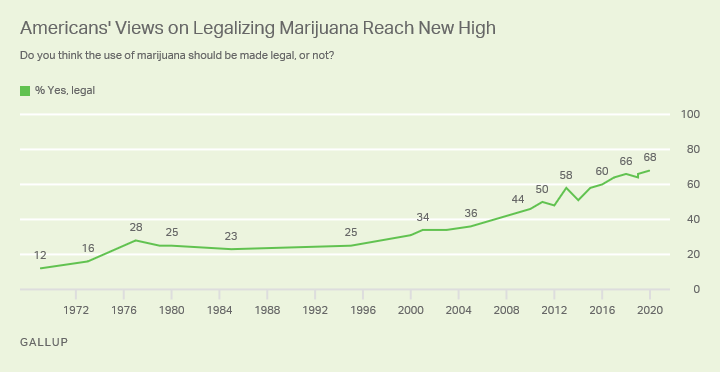
Social change is progressive and not always defined by a "generational" boundary line except in an incidental sense. To take a small example, consider the use of marijuana (a reasonable "hippie-ness" proxy, since the two were considered inseparable in the 60s). Gallup has been asking since 1969 if marijuana should be legalized.
Note a very small initial support (12%) and near-steady increase then. In the supposedly-more-considervative-80s there was a slight slowdown and drop, but hardly a reversal. Support at 2020 is now at 68%. There wasn't a reversal of social norms; things steadily increased, until, in a sense, everyone became hippies.
...
Issitt, M. (2009). Hippies: A Guide to an American Subculture. ABC-CLIO.
Colby, S., & Ortman, J. M. (2014). The baby boom cohort in the United States: 2012 to 2060. US Department of Commerce, Economics and Statistics Administration, US Census Bureau.