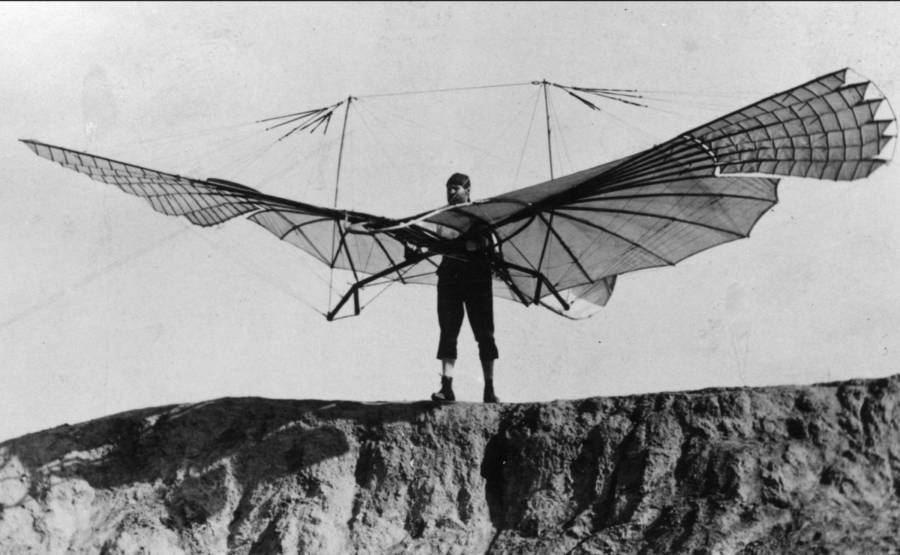
I'm really interested in the early history of heavier than air flight. There was a period that I would call "copy cat" when we tried to make bird suits, etc... Essentially slavishly followed how nature had done it without working out or really thinking about what it would take for humans to *actually* do it.
Think this: https://allthatsinteresting.com/wordpress/wp-content/uploads/2017/03/otto-glider-flying-machines.jpg
At some point the Wright brothers sat down and started from basic physics and worked out how to actually do it.
What I am particularly interested in is this sort of transition. From technology we pursue because "That is how we have always done it", or "that is how nature does it", to actual functioning technology. Any sources that cover this kind of historical thought transition?
Up to about 1500, there were indeed various attempts to create flying machines based on somewhat fanciful ideas, quite a few guys with too much free time and imagination making wings from wood and feathers, strapping them on and heading for the nearest castle. Historian Charles Gibbs-Smith called them "tower-jumpers", which is a great term.
However, it was noticed that they did not succeed. People therefore started thinking systematically about the atmosphere and air much sooner than you'd think. Galileo and his protégé Evangelista Torricelli, and also Blaise Pascal, in the earlier 17th c. had begun to think about atmosphere as a fluid, and about atmospheric pressure. In 1673 Edme Mariotte discovered the Velocity-Squared Law, that the force on an object goes up by a factor of 4 as the flow doubles- so a 20 mph wind has 4 times the force of a 10 mph wind. Isaac Newton's advances in physics would be used by Daniel Bernoulli for his work on fluid dynamics in the 18th c. The philosophe Jean D'Alembert would come up with differential equations for fluid dynamics, and military engineer Benjamin Robins did experiments with bodies flying through the air and discovered that shape of the body was critical in determining drag, not just the frontal area, and predicted that objects approaching the speed of sound would experience a huge rise in drag.
So, by the end of the 18th c., though there were still tower-jumpers to be found some very bright minds had discovered a lot. In the 19th c., real experimental work was done by George Cayley. His gliders might seem to us rather comical machines and he was not a mathematician, but his experiments were real and careful, and he discovered a great deal about how wings lift, and the effects of camber and attack angle by 1810.
Your linked photo shows Otto Lilienthal. Those might look like bird wings, but he was not a tower-jumper, was quite systematic in his glider research. He did get into a dead-end, when he decided to build powered "ornithopters" that would imitate the flight of birds. And he was killed in a glider flight right in the middle of his career, hitting a thermal, before he'd built more than one of his flapping planes. But he wrote extensively about his experiments, and was quite close to discovering the key principle of the warpable-wing before he died. There would be other 19th c. aeronautical researchers- Samuel Langley, in the US, and Gustave Eiffel and Octave Chanute in France. And they passed information around: the Wrights did indeed achieve a lot, but did not work in ignorance of these people, didn't "sit down and work from basic physics". They had Lilienthal's book, and Octave Chanute got them up to date on current research. And by the time of the Wrights, others had figured out how to make wings lift, get something into the air. What they had not figured out was how to keep something in the air for very long.
Anderson, J. D., Jr, Rycroft, M. J., & Shyy, W. (1999). A History of Aerodynamics: And Its Impact on Flying Machines (New Ed). Cambridge University Press.