The USSR had notoriously drab architecture and a dull color palate. Did they actually enjoy this style or were they using it to psychologically manipulate thier citizens?
Did the citizens' and the government's aesthetic tastes differ? Was all of the USSR's architecture bland or was it just government buildings?
First off, I want to challenge your assertion that the architecture of the USSR was drab and dull. Yes, there are plenty of images out there of unadorned, repetitive Soviet apartment blocks in need of rehabilitation. But examples like these are hardly unique to the former USSR specifically or to the Communist Bloc in general. We need to be acutely aware of how the selective circulation of images is used to promote certain political arguments. Also, we must be careful with how much we generalize about the architecture of a country that covered one-sixth of the earth’s surface and endured for over 70 years from a few contemporary photographs. We are unlikely to look at images of Levittown, New York, or the Pruitt-Igoe housing development in St. Louis and take it as completely representative of the architecture of the United States throughout the entire twentieth century.
No, the architecture of the USSR was not uniformly bland or uninspiring. It is generally understood as evolving over three periods, each with their own distinctive style: Constructivism (1918-32), Social Realism (1933-53), and the Post-Stalin era (1954-91).
Constructivism was considered by architects within and outside the USSR as the most daring and experimental architecture of its time. Buildings by designers like Vladimir Tatlin and Konstantin Melnikov challenged existing notions of program and type through the use of innovative form and advanced construction technology. It was an architecture as revolutionary as the government that commissioned it. Though many of these projects went unbuilt or were later destroyed, their images would persist and prove to be a major influence on architects like Frank Gehry and Zaha Hadid at the end of the twentieth century.
The following period of Stalinist Social Realism has been described as a reactionary interlude in the pursuit of an architectural avant-garde. The monumental historicist designs of the 1930s represent a rejection of the technological and formal experimentation of modernism and the embrace of neo-Classicism, which was believed to be more relatable for the proletariat. Projects from this period include the Seven Sisters towers, stations of the Moscow subway system, and the unbuilt plan for the Palace of the Soviets by Boris Iofan. Only with the death of Stalin in 1953 would Soviet architects again be free to pursue formal innovation in design and the standardization of construction methods.
The post-Stalin era represents the reemergence of Soviet experimentation in architecture. With the post-World War II housing crisis still unresolved, architects were set to work on devising a solution through the development of industrialized construction methods and the design of easily reproducible dwelling unit and building types. Architects were also freed from restrictions on exchanging technical information across borders, leading to the development of concrete—or “heavy”—prefabrication in the Soviet Union based upon already existing methods in France and Germany. Heavy prefabrication required the development of a building system based around the design and installation of modular concrete panels to create the interior and exterior walls of standardized dwelling units.
The application of heavy prefabrication on a wide scale within the USSR led to the construction of thousands of mass housing estates like Block 9 of Moscow’s Novye Cheremushki district, an assemblage of low-rise apartment blocks and community facilities that served as the model in the following decades. The lack of extraneous decoration, simplified massing, and repetition of forms—which may be seen as “drab”—that characterize such housing estates in this period is due to the influence of functionalism. This style dominated Soviet architecture from the mid-1950s until the late 1960s.
Functionalism was a product of the trend toward rationalization and standardization of building elements that had developed within architecture since the Renaissance. It had its most complete manifestation in the Neue Sachlichkeit (New Objectivity) of Germany and Central Europe in the 1920s and 1930s. In this period, Siedlungen (social housing estates) were constructed based upon the notion of Existenzminimum (subsistence dwelling). The Existenzminimum defined a minimum floor area for a housing unit and provided for increased access to sunlight, fresh air and open green space. This concept was crucial for the creation of housing estates in the 1950s and 1960s not just in the Soviet Union but throughout the world, as recent scholarship has shown.
Those employing the concept of Existenzminimum sought to further social development through the creation of low-cost dwellings. Freed from crowded, dark and disease-ridden slums, the inhabitants were expected to thrive and flourish within these new communities. This type of architecture was intended as a positive expression of social ideals, not as a torture chamber or prison. Whether or not the desired result was achieved is an open question, but this was the motivating factor in their design and construction. And, at least in the beginning, the inhabitants generally agreed that their shiny linoleum, electrical appliances, and private kitchens and baths were an improvement upon the existing housing stock.
The combination of functionalism and heavy prefabrication permitted the efficient construction of millions of dwellings at a low cost per unit, but it was not without its faults. Leaky joints and the lack of climatic and acoustic insulation were frequent complaints from the inhabitants, and the monotony produced by the seemingly endless replication of identical units was difficult to overcome. These objections arose wherever such large-scale building programs were attempted, for despite the cultural, political and economic differences between the Soviet bloc and the West, the construction methods, design of the dwellings and the overall organization of housing estates did not differ significantly.
SOURCES:
Anderson, Richard. Russia: Modern Architectures in History. London: Reaktion, 2015.
Cohen, Jean-Louis. Building a New New World: Amerikanizm in Russian Architecture. New Haven: Yale University Press, 2020.
Stanek, Łukasz. Architecture in Global Socialism: Eastern Europe, West Africa, and the Middle East in the Cold War. Princeton, NJ: Princeton University Press, 2020.
Although the drab ugliness of Eastern bloc architecture might seem like a tool of social oppression, the reality behind the adaptation of prefabricated concrete was more prosaic. This architectural style was an expedient solution to a postwar housing crisis that at the time seemed to be modern.
The popular image of the Eastern bloc city is one of rebar and brutalist prefabricated architecture, but this was far from the only architectural style employed by the various Communist states. Soviet architecture in the era of NEP and early Stalinist periods was actually quite modern and progressive. The Zuyev Worker's Club is an example of this type of building embraced by the Constructivists of the early Soviet period. Late Stalinist architecture gravitated towards a monumentalist and excessive ornamentation, as exemplified by the Stalinist "Wedding Cake" style of the "Seven Sisters" Complex built in Moscow postwar.
The problem with both of these architectural approaches is that did not resolve the acute housing crisis of the postwar period. Not only did the war destroy much of the preexisting housing, but the drive towards implementing a centralized economy centered on industrialization created exacerbated the housing shortage. Urban planners and architects were under intense pressure from the state's authorities to resolve this housing crisis, hence there was an very little resistance to both prefabrication and concrete. Aesthetic concerns took second priority to resolving the housing shortage. This resulting use of extensive prefabrication built upon and expanded prewar concepts in urban design pioneered in the West during the Depression. The resulting Brutalist architectural style of the 1950s and 60s was both cheap, efficient, and alleviated the housing shortage. Many contemporaneous urban designers on both sides of the Iron Curtain saw Brutalism as a progressive and modern approach, which eased the adaptation of this style.
The problem with Brutalism and other ferro-concrete structures was that whatever their aesthetic charms, such as they exist, wore off with time. Rebar leached through the concrete, the large, flat concrete slabs handled inclement weather poorly, and their relative permanence made their destruction more labor-intensive than other dilapidated buildings. But the problem with replacing this style with a new form of housing in the Eastern bloc was that the once the planned economy was geared for the production of prefabricated concrete slab panels, it became difficult to produce different building types. Prefabrication was cheap, efficient, and available, which became highly attractive in the period of Brezhnev economic stagnation when the West moved away from Brutalist architecture.
Sources
Schlögel, Karl. Moscow. London: Reaktion, 2005.
Zarecor, Kimberly Elman. Manufacturing a Socialist Modernity Housing in Czechoslovakia, 1945-1960. Pittsburgh, Pa: University of Pittsburgh Press, 2011.
Hello! I came here from the Sunday Digest, and I'm frankly a little amazed I didn't see your question when you posted it, because this is something I love to talk about. u/kieslowskifan and u/Cedric_Hampton have covered the broader history of Soviet architectural style much better than I could have, so I won't try to give you another answer about that that would just end up rephrasing their points.
However, I do have an older answer about the architectural style of the Moscow Metro that I think you might find relevant. You can mostly ignore Part 2 on the Moscow congestion problem, but Part 3 especially deals with how the early Moscow Metro stations and Socialist Realism more generally were in fact very bright and colorful, and how this notion of brightness served their ideological goals. Manipulation is a bit of an uncharitable word, but I think you sort of have the thing the wrong way around — they were trying to "manipulate" their citizens, or rather, to encourage a certain kind of behavior, though color and vibrancy.
I also have another answer on the thinking behind Socialist Realist art that deals with some similar questions.
I also want to come back to the early Metro stations and answer your question about whether the government's taste and the citizens' taste differed. That's... a really hard question, and to fully answer it, I'd need a couple of months to go do more primary source research in contemporary accounts to find out just how people actually did react to Metro architecture, or the aesthetic of the Khrushchyovki and Brezhnevki, or what have you. But what I can say in the meantime is that, on the Metro in particular, the aesthetic was a product of a negotiation between the party and the architects tasked with executing each station. Tastes differed, is what I'm trying to say.
I also want to warn you, I'm not really trained as an art or architectural historian — I just know how all this stuff expressed itself on the Metro — so what I'm about to argue about certain stations or design decisions may not completely reflect the scholarly consensus.
The earliest stations of the Metro from 1935–1938 are kind of contradictory. This is after, as u/Cedric_Hampton says, the move from Constructivism to Socialist Realism begins, but in a lot of ways these first stations still show Constructivist influences. The 1935 stations are actually very minimalist compared even to stations from 1938, let alone 1955. As an example, Sokolniki station's cream tiled walls, blue marble pillars, and white plaster ceiling are all cut in rectilinear shapes, which is reminiscent of Constructivist work like Moisei Ginzburg’s Constructivist Narkomfin building. Meanwhile, if you look at the smooth walls and circular windows on the vestibule of Kirovskaya (now Chistye Prudy) station, they're a lot like El Lissitsky’s Ogonyok print shop.
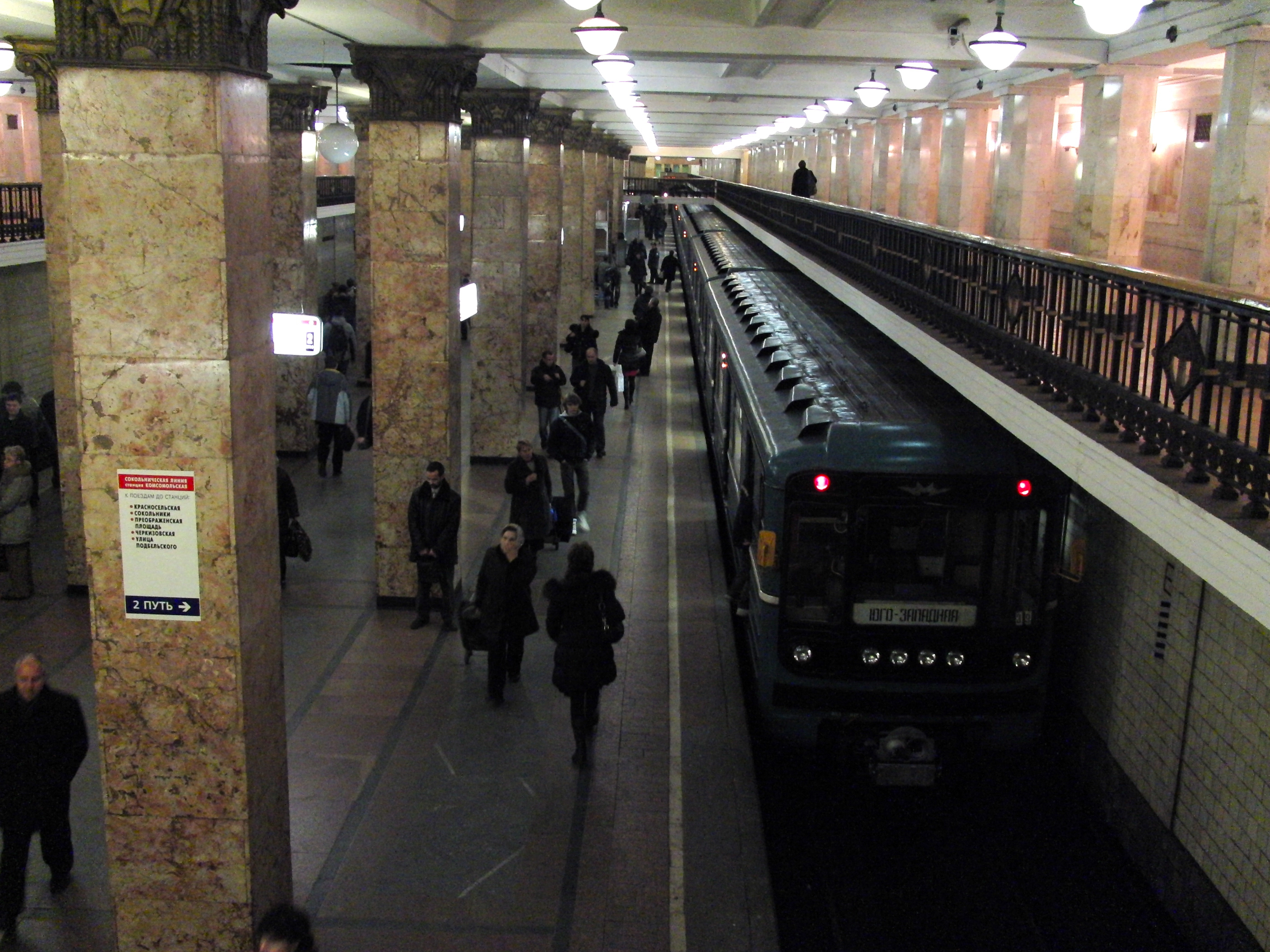
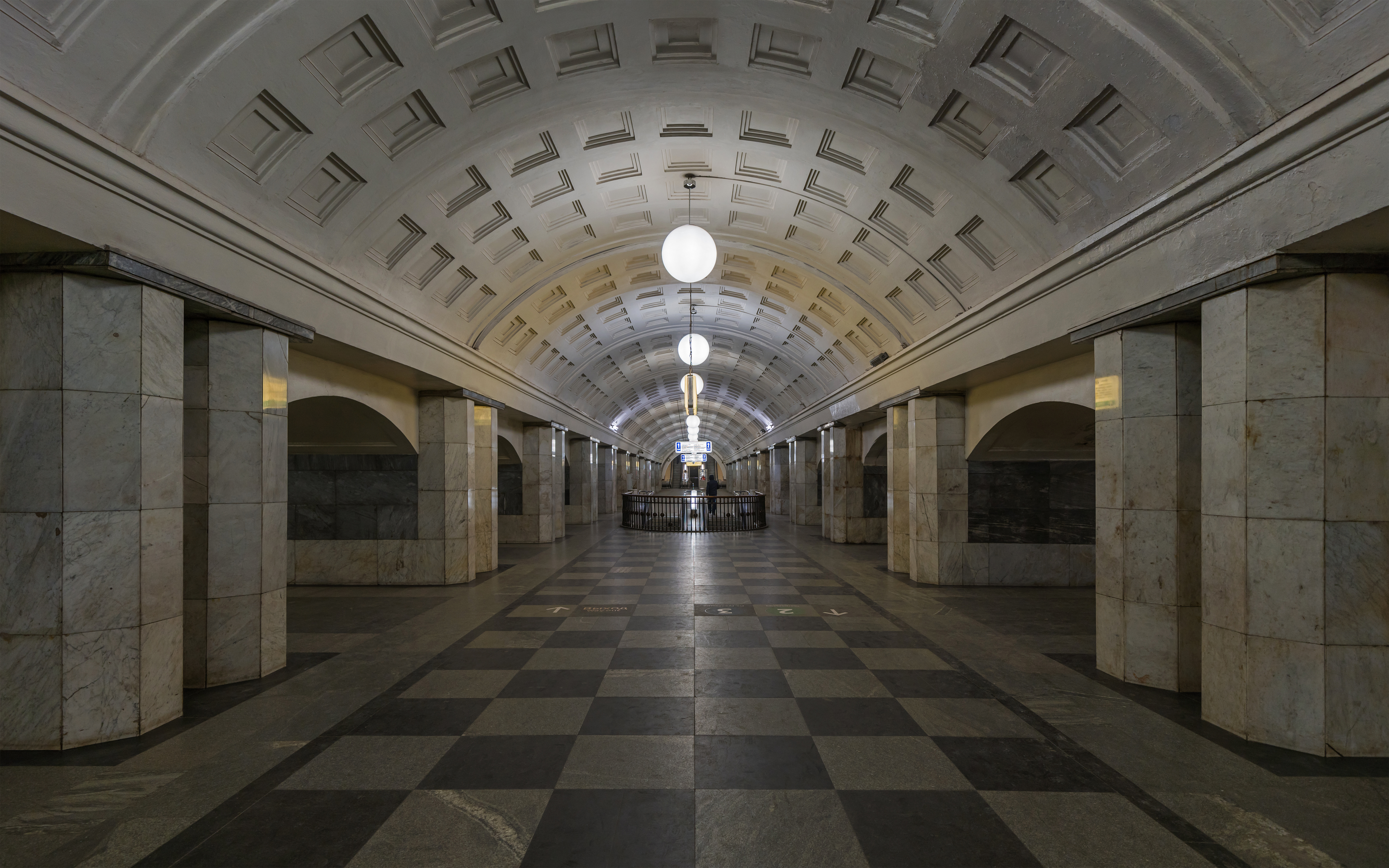
On the other hand, I won't try to exaggerate the similarities to Constructivist architecture. Take 1935's Komsomolskaya. Simple, smooth, and clean, and otherwise a near twin of Sokolniki. But its rectangular pillars have bronze capitals showing ornate harvest motifs. And on deeper first-line stations that had been excavated in the British method, the aesthetic is also simple, but with a greater tendency towards Greco-Roman style already. So there are Tuscanesque cornices on the pillars of Krasnye Vorota, square coffered ceilings at Okhotny Ryad and even Sokolniki, which I cited above as an example of Constructivist hangover, has some coffered ceilings. So the first line also shows the beginnings of a move away from Constructivism and towards a combination of Classicism and ornate Russian baroque elements. But at that point, even though Constructivism as an ideology arguably "ended" a few years earlier, the switch in its expression is hardly complete.
Socialist Realist design as we think of it, though — that is, neoclassical, baroque Socialist Realism — really only takes hold on the stations opened in 1937 and 1938. Kievskaya, designed by Dmitry Chechulin and opened 1937, is no longer just lightly classically influenced Modernism. There's clear Neoclassicism and Greco-Roman motifs there, and it's much more elaborate. The walls and columns are still tiled and clad in cream and reminiscent of first-line stations, but the walls alternate three slightly different shades of cream tiles to create more texture, the columns are 12-sided rather than square, and both they and the floor mosaics incorporate deep crimson and gold stone, which would become characteristic of later Stalinist stations. The column capitals, meanwhile, sculpted in porcelain by Natalia Danko, show a prominent white wheat motif accompanied by five-pointed stars.
Now compare that to the more subdued, dark bronze bas-relief of wheat at Komsomolskaya from above. Chechulin also designed Komsomolskaya, so you can see how one of the dozen or so architects of the first line started to modify his style to be more Socialist Realist. Where it gets really interesting is that Danko’s capitals and Chechulin’s hall were effusively praised by the critic Boris Alekseyev, who was very happy that they didn't "oversimplify" their designs too much. What that tells us is that these architects didn't just have some sinister hive mind where they and Stalin decided exactly what each station would look like; instead, each architect was trying to do what they thought would please the party, and then some combination of Stalin, the rest of the party, and the architectural critics would actually pass judgement on how well they did. Especially towards the end of the 1930s, this becomes less and less a real dialogue and more and more a cover for Stalin to exercise control — but there were always multiple different people with their own ideas and agency trying to navigate this system and produce art that served their ideological aims.
So the architecture of the Metro, as I discussed in the other answers, was an attempt to get Soviet people to think of themselves and their society in a certain way, and you could describe that as subliminal propaganda. But instead of thinking of the Metro as an organized, conspiratorial attempt to secretly foist these ideas onto the people who used it, it makes a lot more sense to think of it as an attempt to express artistic ideals that varied over time. The Metro was always supposed to show the bright future of communism, and to show Soviet citizens their role in creating that society and in making it work. But there was always a dialogue between the state and the architects who tried to figure out the best way to put those ideals into specific forms, and how best to encourage "new Soviet" behavior.
For sources and further reading, a lot of this comes from the sources I cited in my other two answers. It's also paraphrased from part of my bachelor's thesis, so if anyone's concerned about plagiarism and finds a 92-page PDF that starts with a quote from a 1988 movie starring two ex-Pythons — where the hell did you find it? I've never uploaded it publicly. But the point is, I just don't want to dox myself.