Uniforms had camouflage, helmets had it and tanks also had it but I've never really seen it on WW2 weapons. More recent videogames set during WW2 have heavily included weapon camouflages so I'm wondering if it's actually based on anything real or just there to add variety and sell cosmetics.
I can't find anything about this topic Online so I'll see if the people on here have any knowledge about this.
It was used, but was not common for personal weapons. Rifles etc. are not highly visible on the battlefield - they are smaller than soldiers, are very low profile if lying on the ground, and are in colours that are fairly low visibility in many common outdoor environments - wood and/or blackened/browned/blued steel. Such blackening etc. of the steel does serve as camouflage of a sort, by being much less shiny than polished steel (the original purpose was rust protection).
Artillery was camouflaged very often. Direct-fire artillery, such as anti-tank weapons, needed camouflage to survive on the front lines. Indirect-fire artillery was camouflaged mostly against being spotted from the air (aerial reconnaissance was the most successful method of locating enemy artillery during WWI) - detection from the air had a disconcerting tendency to bring counter-battery fire or air attack. Artillery pieces were often painted in low-visibility colour (e.g., olive drab), even if they didn't use a disruptive camouflage pattern.
Such artillery camouflage was largely a continuation of WWI practice.
Smaller crew-served weapons such as machine guns were sometimes similarly painted for lower visibility. For example, the parts visible from the front, such as the shield and cooling jacket, might be painted green, or in winter, white:
Again, this was a continuation of WWI practice.
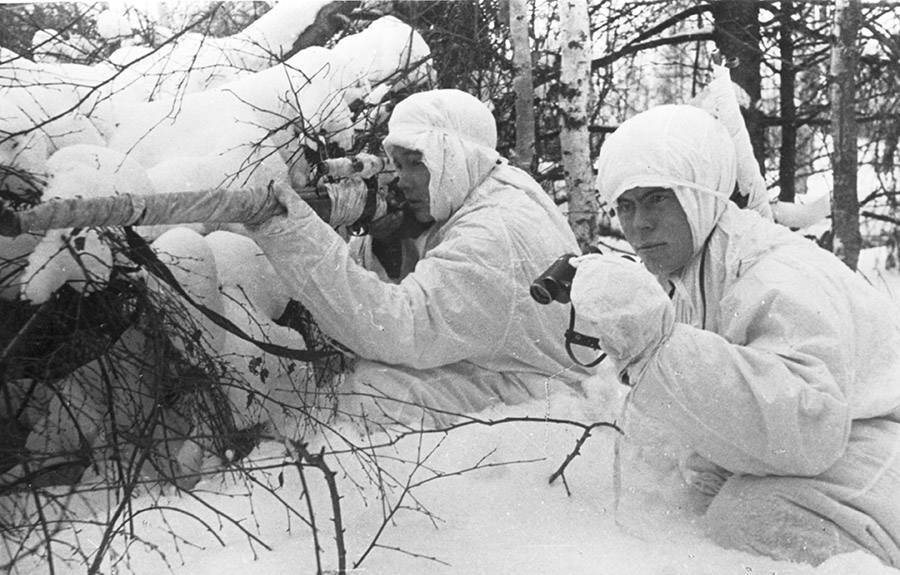
Rifles were not usually camouflaged. Snipers would often camouflage their rifles (and also often not do so). The most common method was to wrap parts of the rifle in cloth, and sometimes some foliage was tied to the barrel. This resulted in more risk of snagging the rifle on branches, etc., and some snipers chose to not wrap to avoid this risk. Also, snipers who did camouflage their rifles in this way didn't leave the wrapping on - being the only soldier in a unit with a camouflaged rifle could easily identify them as a sniper, and make them a high-priority target for enemy snipers. Some examples:
Soviet sniper with a winter-camouflaged rifle: https://allthatsinteresting.com/wordpress/wp-content/uploads/2017/09/russian-snipers-snow.jpg
British sniper: https://i.pinimg.com/564x/b4/5d/f5/b45df570198d51c3ee60a893698bd287.jpg
Canadian paratrooper-snipers: https://i.pinimg.com/564x/6b/06/b2/6b06b2169229af354751a6db0b5d754b.jpg
There were some cases of wider use of camouflaged personal weapons. One example is the Australian Owen SMG, which was issued with factory-painted jungle camouflage:
Since jungle vegetation tends to be the same colour all-year, a permanent paint-scheme like this can work well for jungle fighting. Some of these weapons were repainted in plain olive-drab for later service in Korea, where the jungle pattern was not ideal.
Here is an interesting example, of what appears to be a snow-camouflaged grenade:
White grenades are fairly common, and are usually practice/training grenades (which were also painted red or blue, and possible other colours). White training grenades are anti-camouflaged, painted to make them easier to find after throwing. The example above, however, is carried by a winter-camouflaged soldier.
Finally, there were two classes of well-camouflaged weapons: land mines (camouflaged by burial) and booby-traps.
References
Soviet sniper photo from https://allthatsinteresting.com/russian-snipers