I heard various people saying the same thing: Most khanates in the east have not expanded further into the North because there was little compensation.
But then, why did Russia do it? I mean yeah, most people will say "since they could", but if that is the case, why didn't other nations that had Siberia at their doorstep?
Besides, Russia I believe had conflict with Poland and Lithuania, so why manpower going to an open field with little people to pay you?
Oh, I think I can answer this one! I'm honestly excited to have a chance to talk about this because it's also a subject I've found to be fascinating. The short version is that it only took effort from men who weren't already fighting Ivan the Terrible's (better translated as Ivan the Formidable but I digress) European wars, and for Russian economic interests in fur trade, made profitable by the river layout of European Russia and Siberia combined.
The long version involves a brief crash course in how Tsardom of Russia's precursor state, the Grand Duchy of Moscow (Muscovy, for brevity) started its course going all the way back to Ivan Kalita in the 14th Century during the Tatar Yoke, so hold on tight and let's go!
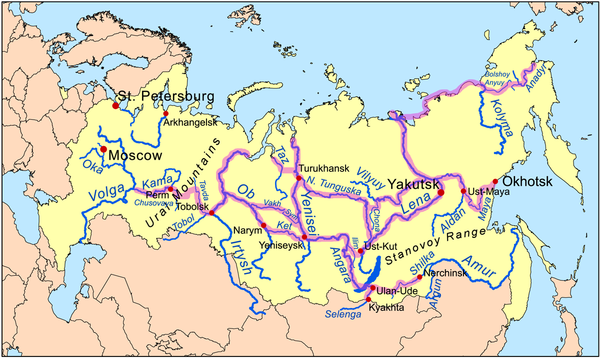
First, a visual aid:
Let that sink in and think about its implications for a bit. Notice how Russia has rivers that go along its direction of expansion? More importantly, pay attention to how the appropriately honored Mother Volga and her tribituaries (quite poetic considering Muscovy's status during the Tatar Yoke), as well as the Don span most of the settled areas of European Russia, giving her life and forming a network for the transportation of both goods and people. Also notice how Moscow is situated at a very strategic position along the Moskva River, a tribituary of a tribituary (Oka) of Volga herself.
It's easy to think of Russia as an empire of conquest considering her immense size and historically very large if a bit problematic at times military, but she's actually an empire built around riverine trade. This attitude can be traced all the way back to Ivan Kalita (Moneybag!), Grand Duke of Muscovy, who, after witnessing the execution of three of his predecessors for either insubordination or being victims of court intrigue at the hands of Öz Beg Khan, decided the best way to keep his head was to keep it down, avoid any military adventurism, and above all, pay his tribute in time and in full. To achieve this, he had to build a strong economy resilient to the usual adversities an agriculture-taxation based economy would have in the geographical conditions of Russia, and so he prioritized the promotion and expansion of trade and a vibrant city life, one that counted on a large and concentrated population. To achieve this, he purchased captured slaves from his Tatar overlords, invited refugees, and resettled people in his lands. Using these riches he was able to gather through his shrewd management of the economy as well as excellent diplomacy with his overlords (he managed to convince them to allow hereditary succession for Muscovy so that his son could succeed him), he engaged in what's curtly described as loan sharking to peacefully take over the nearby lands of Russian rulers small and larger. His successful diplomacy, willful obedience and economic cunning made him the earliest identifiable figure in the Russian ascendancy, and expansion of Russian soft power through these peaceful means would remain the only successful and viable way for the next 150 years.
Enter Ivan the Terrible. By this time, much had changed. The Tatars were in taters (sorry!), losing their grip on power slowly for a while and then rapidly afterwards; by the time of Ivan, any vestige of Tatar dominion was gone for half a century, and the 1552 Siege of Kazan can be said to be the Russian version of Manzikert or Varna (excuse the Turkish-centric examples, but I'm Turkish myself and those were the first examples that came to mind), in that the doors of Siberia were opened to the Muscovites after the fall of the Khanate of Kazan. There weren't many organized (and I use these terms loosely as they were mostly still loosely organized "Khanates" with a tribal steppe-nomadic structure, just larger than the isolated tribes of Siberia) entities left to oppose Eastward expansion, and so the Stroganov noble family privately funded Cossack forces led by one Yermak Timofeyevich, on whom we unfortunately don't have much knowledge. What we do know is that the force that took on the Khanate of Sibir was quite small, numbering in a few thousands at most.
The Cossacks faced little organized resistance and the push was more or less for the establishment of trading posts and minor fortifications alongside important river junctions. Isolated tribes met on the way were usually established as tribituaries or construction helpers, and were otherwise generally left alone as long as they provided their fur tribute, which would be sent back along the eastward-expanding trade routes to be sold in Europe. Various Siberian furs became one of the important exports of Russia through both the Baltic Sea, which had the problem of frozen ports for 3-4 months of the year but was otherwise an excellent trade center, and through the Bosphorus to Mediterrenean ports. So in fact it was perfectly economical and sensible for Russia to do, as it did not cost anything to the state being a profitable privately funded affair, nor did it cost any men as Cossacks were generally frontiersmen whose particular strand of militarism found its way to the Tsar's standing armies in smaller numbers.
It's much more difficult to answer why other states didn't do it, as answering why something didn't happen in history is harder than answering why it did so I would rather not speculate on that. But we can safely conclude that the idea that Siberia was this barren, unproductive wasteland of bogs and wild forests is rather Western European in thinking whose productive farmlands and accordingly well developed and population-dense land, on top of the political fragmentation made conquests a bloody and expensive affair whereas the Russian expansion was simply a consolidation of boutique fur production mom and pop shops into Ivan's Honest Fur Trading Co.
-------------------------------------------------------------------------
Editing in an answer I gave to a question below as I believe it ties to the original narrative directly.
Q: "What, exactly, was Ivan's arrangement with the Stroganov's and the Stroganov's relationship with the Cossacks?"
It's hard to give exact answers when we know so little about our main hero, Yermak. Regarding the Stroganov's relationship with Ivan, they were Oprichniki, a group of nobles empowered during the Oprichnina, a period of political repression meant to weaken Russian nobles and centralize power. It was a divide and conquer strategy where the Oprichniki were afforded some privileges similar to those found on European margraviates where they were charged with finding and executing anyone they considered was acting against the interests of the Tsar, and in turn, the Tsar would reward their loyalty by providing additional labor in the form of serfs and maybe give them some of the land he confiscated from nobles he found to be traitors. Stroganovs were one such oprichniki, a family found to be loyal and effective in rooting out traitors. They expanded their power under this period, which ended less than a decade before the expansion towards Siberia.
The Cossacks were hired by the Stroganovs under payment as well as promise of fur and whatever other riches they might find in Siberia. Remember that the Cossacks have been disparate peoples who, still today, don't have a central "Cossack" identity but one named after their particular settlement, usually around a river or mountain or other natural formation, such as we see with Zaporozhian Cossacks or Kuban Cossacks or Don Cossacks. We know very little about Yermak, and we don't even know which particular Cossack Host he belonged to. So all we can say is that between the Stroganovs and Yermak's cossacks, it was a business relationship where the Stroganovs offered funding and part of the spoils of conquest, while Yermak offered actually getting the job done and helping them establish their fortification and trade network.
Back to the Ivan's support of the Siberian expansion, an educated guess here, but we can probably characterize it best as benign neglect. Ivan had bigger fish to fry in his heartlands, and while the potential of a rich eastward-expanding trade network meant more potential taxes, that benefit was probably balanced out by how he essentially acquiesced to independent conquest by his vassals and thus one day may end up with a stronger internal opponent should their relations sour one day. Still, both the potential upsides and downsides were distant in the future at that point, and it wouldn't be until much later that Siberia had the undivided attention of Russian Tsars, as less than two decades after Ivan's death, Russia would enter the period known as the Time of Troubles, which saw the extinction of the Rurikovichs (Ivan's dynasty stretching back to Rurik of Novgorod, a North Germanic/Scandinavian adventurer who lived in the 9th Century), an interregnum, and the eventual coronation of the first Romanov, the Russian dynasty that everyone's most familiar with that lasted until the abolishing of the monarchy.