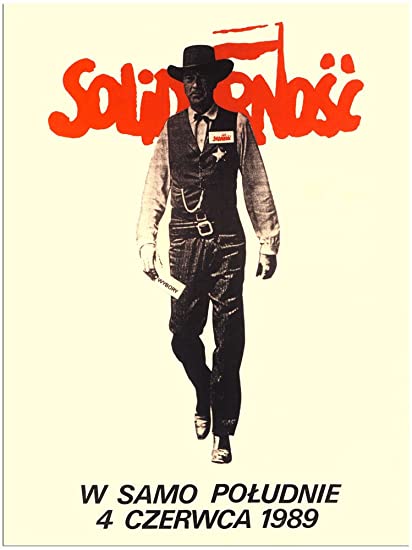
Based on purely the action of the movie -- and the historical reaction of others -- John Wayne's reaction does seem a bit inexplicable.
...
Marshal Will Kane (Gary Cooper) has just married Amy (Grace Kelly) when he is informed the murderer Frank Miller he took down years before received a pardon and is headed to town, arriving on a train at noon, with the full intent to hunt down Will with a gang of three other men as soon as he arrives.
Amy wants to leave with Will by wagon, but Will insists on staying and fighting, claiming they'll just be tracked down:
Amy: Don't try to be a hero! You don't have to be a hero -- not for me!
Will: I'm not trying to be a hero! If you think I like this, you're crazy!
Amy makes an ultimatum she'll be leaving on the train if Will stays.
The action plays out in real time, as Will tries to recruit members of the town to help stop the gang of outlaws. Many turn him down, leaving only one man (Herb Baker) who is too afraid when he realizes he's the only volunteer.
In the final showdown, Will faces the four gunmen alone, but ends up being assisted by Amy who leaves the train as gunshots start and shoots one of the outlaws in the back. In the final scene, Will discards his badge in disgust and leaves with Amy on their wagon.
...
Rugged individuality against terrible odds, facing duty even when it isn't convenient, a heroic gunfight at high noon: it does seem strikingly American. And indeed, presidents like Eisenhower and Reagan thought so (it was Reagan's favorite film); the Soviet Union condemned it. (Pravda called it "a glorification of the individual.")
So why did John Wayne hate it? He had nothing against the lead, Gary Cooper, longtime acting hero of westerns, and even accepted Gary Cooper's best acting Oscar by Cooper's request (he was unable to attend) and joked about needing to have a talk with his agent. But here's John Wayne, in a Playboy interview from 1971:
Everybody says High Noon is a great picture because Tiomkin wrote some great music for it and because Gary Cooper and Grace Kelly were in it. So it's got everything going for it. In that picture, four guys come in to gun down the sheriff. He goes to the church and asks for help and the guys go, "Oh well, oh gee." And the women stand up and say, "You’re rats. You're rats. You're rats." So Cooper goes out alone. It's the most un-American thing I've ever seen in my whole life. The last thing in the picture is ole Coop putting the United States marshal's badge under his foot and stepping on it. I'll never regret having helped run Foreman out of this country.
As noted in the quote: the issue here is with "Foreman", specifically Carl Foreman, who did the screenplay, because John Wayne thought he was a Communist.
(Before I go on, I should note in Clint Eastwood's Dirty Harry, released the same year as the interview, the main character tosses his badge in a river because of criminals being "coddled". John Wayne even tried his hand at two cop movies afterwards due to the success of Dirty Harry. So being upset at the badge still isn't quite logical.)
...
Carl Foreman, screenplay writer, was a hot property in 1951, having already been nominated twice for Oscars (The Champion and The Men, the latter being Marlon Brando's first movie role where he played a paraplegic veteran), and he had just moved (with his wife and daughter) to Brentwood in a house formerly owned by Orson Welles.
He had also been, for a time, an actual member of the American Communist Party. This was a decade in the past -- but it was enough to cause suspicion with the infamous House of Un-American Activities Committee (of the US House of Representatives), specifically during the time period from the late-40s / early 50s which called up suspected members of Hollywood and pressured them into naming other Communists.
Foreman was just finishing the script for High Noon when he received notice from the HUAC: he was to appear before the committee with a day that coincided with shooting for High Noon.
As I was writing the screenplay, it became insane, because life was mirroring art and art was mirroring life. It was all happening at the same time. I became that guy. I became the Gary Cooper character.
Some people on the movie project were supportive. Cooper, for instance, was a charter member of the Motion Picture Alliance for the Preservation of American Ideals but still wanted to vouch for Foreman's "Americanism"; the lawyer for the project nixed the idea. There was some friction between Foreman and the producer Stanley Kramer, and Kramer eventually made the ultimatum that Foreman would hand in both his resignation and his stock holdings to keep the production from being hurt by the HUAC testimony; there would be a later cash settlement when the dust settled.
Foreman initially turned down the plan but eventually was off the project, and when he went to testify, he refused to "name names" and was dubbed "uncooperative" and landed on the infamous Hollywood blacklist.
One of the loudest supporters of the HUAC was John Wayne. Continuing the Playboy interview:
I'll never regret having helped run Foreman out of this country.
PLAYBOY: What gave you the right?
WAYNE: Running him out of the country is just a figure of speech. But I did tell him that I thought he’d hurt Gary Cooper's reputation a great deal. Foreman said, "Well, what if I went to England?" I said, "Well, that's your business." He said, "Well, that's where I'm going." And he did.
So, in all likelihood, his distaste for the movie was a transfer with a distaste for the screenwriter. Foreman did have rough years ahead during his blacklisting, including being uncredited for his work with Michael Wilson (also blacklisted) on Bridge Over the River Kwai. The novelist for the original work, Pierre Boulle, ended up accepting the Oscar for Best Adapted Screenplay. He did not speak English.
In the meantime, John Wayne did a movie (with Howard Hawks) widely considered a sort of anti-High-Noon, Rio Bravo from 1959. As opposed the the hero being turned down for help, everyone offers to help. But isn't that, in a way, a collectivist message? (To be clear, it's not actually full-on Communist, just it merits less disapproval from Pravda.) High Noon certainly is not straight allegory -- or at least showing the weakness of the American people -- as Wayne saw it. Most strikingly, it became a symbol in the 1989 Polish election, where the solidarity movement swept away the communists. The first post-USSR president of Poland, Lech Wałesa, apparently still gets asked by Americans to sign their copy of the poster.
...
Details on the Polish High Noon poster are in this article by Michał Kuź at Lazarski University in Poland.
Frankel, G. (2017). High Noon: The Hollywood Blacklist and the Making of an American Classic. Bloomsbury Publishing USA.
The easy answer to your question is that High Noon was a complex film that broke the mold for Western movies. Gary Cooper’s character had inner demons and visibly showed fear, the townspeople refused to help fight a few villains, and in the end, Marshall Kane disgraced his badge and walked away. From a disruptive cinematic point of view, this was brilliant. From a John Wayne point of view, it went against every fiber of his soul, his livelihood as well as his politics. To understand why John Wayne felt this way, you have to understand a little about John Wayne.
To begin with, John Wayne didn’t see High Noon as a simple Western. He believed it to be a story within a story - a film that was really an anti-Hollywood blacklisting movie wrapped up inside a Western. The script was written by Carl Foreman, who joined the Communist Party in 1938. Foreman and Wayne had previously worked together when Foreman wrote the script for Dakota (1945). It was certain that Wayne was aware of Foreman’s politics in 1945, but by 1952, the House Un-America Activities Committee was in full swing and front page news. Foreman was toxic and Wayne knew it.
It’s easy to both admire and dislike John Wayne the more you study his life. He appeared to have a strong personal moral compass that he followed in public… but it is unclear what was actually at the base of his beliefs as the more you study the man, the more contradictory they seem. On the one hand, he seemed to be guided by a strong love of country, yet he received deferments from serving in World War II. He publicly stated a disdain for the genre disrupting movie High Noon based on a disbelief that American frontiersmen would fear or run from villains and duty, yet, were he to accept the premise of this movie as good, it would make the public doubt the validity of the character that he and John Ford had meticulously crafted. Yet, with it so easy to question the motivations of John Wayne’s belief system, it is also easy to admire his movies as well as a movie star that wasn’t easily swayed by societal changing pressures and momentary headlines. He followed his own compass, for good or bad.
It was those contradictions in his past and perhaps his hopes to compensate for them that many feel inspired his strong outpouring of acceptance of Hollywood blacklisting and the House Un-America Activities Committee. He was their biggest fan, even producing and acting in a movie praising the Committee. The fact that Foreman was hiding a message of anti-blacklisting inside of a movie made for John Wayne would more than ruffle his feathers.
Did I say it was a “made for John Wayne” movie? Well.. it was. John Wayne was supposed to star in High Noon. One can only imagine the anger he had toward Carl Foreman as it could be argued that he was trying to trick John Wayne into coming out against the House Committee by starring in an almost un-refuseable blockbuster written for him. If it was Foreman’s intent to trick Wayne, it backfired in many ways. First Wayne refused the part, then Gregory Peck, Charlton Heston, Montgomery Cliff and even Marlon Brando. To add insult to injury, Foreman was hauled before House Un-America Activities Committee during the production of High Noon where he refused to “give up names” and was blacklisted.
I cannot speak to whether Wayne had anything to do with Forman having to appear in front of the House Un-America Activities Committee, but in 1971, during the now infamous Playboy interview with John Wayne, he bragged that he was glad that he “helped run Foreman out of the country”. On that, I will leave you to draw your own conclusions as to whether he had a guiding hand in Foreman’s blacklisting.
Looking back, it’s easy to see where Waynes motives for his public denouncement of High Noon could be construed as self beneficial to his own career, yet also just as easy to see where he felt like it was the “right thing to do”. Wayne came out publicly for or against several other causes or denounced other movies, even against popular sentiment, because seemingly it was for him “the right thing” to do. Yet none that I have found were as loud nor had as much collateral damage as his dislike of High Noon. A good example of another movie role he turned down was the role of Waco Kid in Blazing Saddles, yet it was interesting to see how he handled that one in comparison to High Noon. Wayne told Mel Brooks that the movie would “disappoint his fans” since it was too blue and in bad taste…. yet he exclaims that he would be would be the first one in line to see it. Quite a difference.
The ironic and again contradictory epilogue to this is that although Wayne was no fan of the picture, he was a friend of Gary Cooper. In 1953, although Wayne never hid the fact that he despised High Noon, he put all that aside to accept the Oscar for Gary Coopers role in High Noon when Cooper could not attend. During the ceremony he feigned disappointment at not being offered the role and ended his speech with a pretend threat to his managers that failed to get it for him. He said ” I can at least run my 1930’s Chevrolet into one of their big black new Cadillacs” which many consider a tongue in cheek way of him admitting although High Noon may have changed Westerns forever, he was going to be sticking to his old ways. And it could be said that by that time his goal was achieved. He remained the icon of the “manly frontiersman” and he had vanquished his enemy to a foreign land. Fade out, go to credits.