I am very fascinated by this topic, I heard that Egyptian magic was famous throughout the ancient world. I looked around but i always find books that teach you how to perform Egyptian magic. I was looking for (if it exists) a scholarly book that analyzes the historical texts and artifacts. Something based on science. Thank you in advance for every answer. I'm sure it'll help.
(1/2) I'm going to begin with a brief overview of Egyptian magic before I jump into reading suggestions, as it's not something I've seen many questions about, and I always enjoy the opportunity to talk about magic in ancient Egypt.
Ancient Egyptian spells
There are quite a few ancient Egyptian magical texts. Egyptian magic is a very complex topic, and we have many different types of magical spells, but suffice it to say that the most common spells were protective spells against snakes, scorpions, and crocodiles. Egyptian magic typically took three forms:
Translation – Taking a current situation and providing a mythological precedent. A snake bite, for example, could be compared to the infant Horus being bitten by a snake and healed.
Homeopathic/analogic – Like affects like. Just as you manipulate a ball of clay in your hands, for example, so the spell will allow you to manipulate your enemies.
Contagious – Contact with an object imbued with power.
Egyptian spells usually identified the speaker with one or more gods (translation magic) and incorporated analogic magic.
Here is an example from a rather comprehensive spell from the Metternich Stela. Most Egyptians were not literate, so they used the spell by pouring water over the stela and drinking the water (contagious magic).
Come quickly to me on this day like the one did for you who handles the steering oar of the divine barque. May you drive away for me all lions on the desert plateau, all crocodiles in the river, all biting snakes in their holes! May you render them for me like pebbles on the desert holes, like potsherds of a jar along the street! May you exorcise for me the pulsating poison that is in all the limbs of this man who is suffering. Take care not to be negligent when you speak about it! See, it will come for you when you are coming for it, with your words directed against it. See, your name is involved therein on this day! I have created the awe for you through your magic – and you have grown through your magic spells – to keep alive those who suffer from an oppressed throat. Praise is given to you by mankind; righteousness is adored in your appearance. All the gods are invoked in your likeness. See, your name is invoked on this day: "I am Horus the Savior who ensures protection for you."
This spell is to be said over a statue of Horus with a snake in his right hand and his left hand...their heads, and a crocodile under his right foot and a scorpion under his left foot...
A magical spell from the Harris Magical Papyrus (P. BM 10042), which requires the user to recite a spell over a clay egg which can then be lobbed like a grenade at any surfacing crocodile or hippo, has another example of translation magic.
"Oh egg of water and earth-spittle - the egg-shells of the Ogdoad gods – great one in heaven, great one in the Underworld, nestling who is prominent on the Island-of-Knives: it is with you that I have escaped from the water. I will emerge with you from your nest! I am Min of Coptos, I am Min, the lord of the land of Coptos!"
This spell is to be said over a clay egg. To be given into the hand of a man at the prow of a boat. If something on the water surfaces, it should be thrown upon the water.
There are also several examples of love spells from ancient Egypt. In one New Kingdom love spell, the speaker threatens to incinerate the home of Osiris if the gods do not grant him the love of his desired woman.
Hail to you, Re-Horakhte, father of the god! Hail to you, seven Hathors who are clothed in wrappings of red linen! Hail to you, gods, lords of heaven and earth! Let the woman [Insert name] come after me like a cow after grass, like a maidservant after her children, like a herdsman after his cattle.
If you fail to make her come after me, I will set fire to Busiris and burn up Osiris!
Egyptians sometimes resorted to black magic when dealing with enemies. An ostracon from Deir el-Medina (O. Armitage), for example, contains two spells against violence. In the first spell, the speaker identifies himself with the gods and then uses a clod of earth in analogic magic; as he manipulates the earth, so he will manipulate his opponent.
Whoever it is who comes against me like a bull whose horns have tasted a fight, [the war god] Montu will come and grab you by the horns! [The chaos god] Seth will come and strike you down!
If you want to grab my legs, I am Montu!
If you want to kill me, I am [the god of resurrection] Osiris!
O Re, O Atum, O oldest of the gods!
I will take earth with my left hand; I will throw it into my right hand.
I will say, "Come to me, Montu, lord of today! Come and deliver me [name] son of [name] into my hand like an insect in the beak of a bird!"
"You shall stand still! Where are you in relation to me? I am Montu, the morning star of the gods! I will cut your bones and eat your flesh! I will take away your forearm, which is placed in my hand."
This spell is spoken over the earth in your hand.
Sympathetic magic in ancient Egypt
Foreigners and enemies in ancient Egypt were attacked magically by means of sympathetic magic. Just as the depictions of the enemies are trampled on or smashed, the Egyptians believed, so were their enemies. It's rather similar to an ancient voodoo doll.
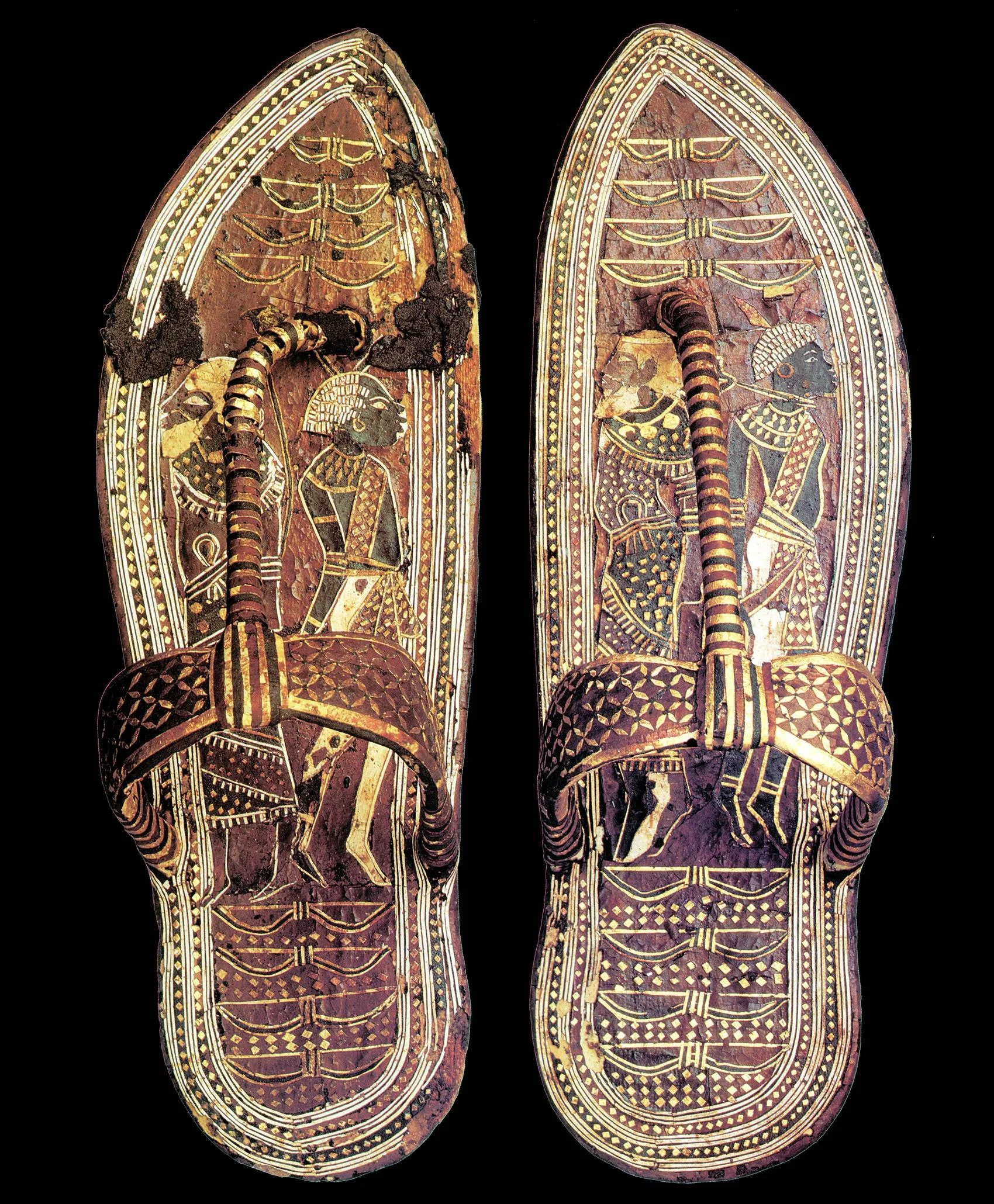
There are many examples of sympathetic magic from King Tut's tomb. By walking on the foreigners on his sandals, for instance, the king was ritually trampling them underfoot. In addition to depicting the bound Asiatic (L) and Nubian (R) prisoners, the sandals depict bows representing the "Nine Bows," the traditional enemies of Egypt. As another example, Tutankhamun placed his feet on a footrest with depictions of foreigners, and he symbolically strangled his enemies by gripping his canes.
The execration texts are in my opinion the most fascinating example of sympathetic magic from ancient Egypt. These were ceramic figurines and pieces of pottery inscribed with the names of hostile people and places which were then smashed.
The Egyptians believed writing could warp reality; in a way, writing was reality, and to write something - or to destroy something written - was to make it so. As a result, scribes were wary of using the intact forms of hieroglyphic signs of dangerous animals like snakes and crocodiles. Snakes were often written with a knife in their middle, and crocodiles were sometimes written with an arrow sticking out of their heads.