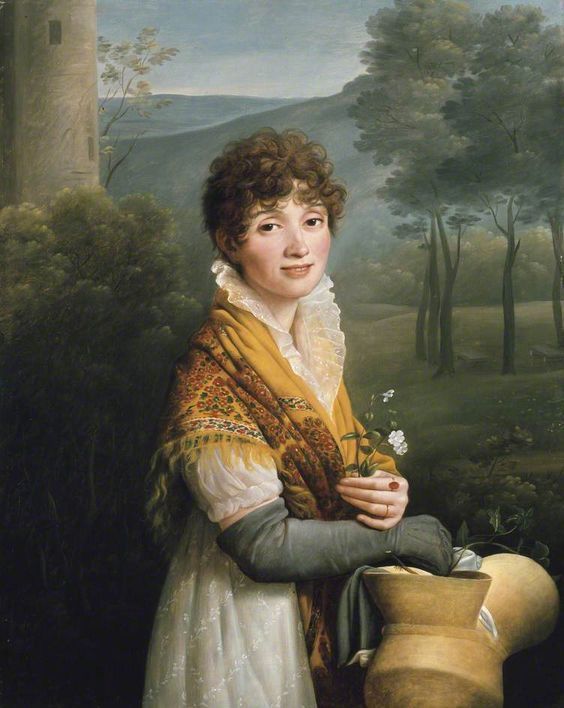
I just got done watching that great 500 years of haircuts video, where Morgan Donner did her best to recreate various historical hair styles. For the Regency period she did the classic Jane Austen updo with those lil side curls, pointing out that for many historical hairdos you basically had to cut layers to achieve them. However she brought up that during the Regency some women opted for what is essentially a pixie cut.
I know from stuff like Bernice Bobs Her Hair by F Scott Fitzgerald that at least at the start of the 1920s, getting short hair could be scandalous. But these Regency women have even shorter hair than flappers and I'm assuming they were society ladies since they got their portraits painted.
So what gives? Some of them have such severe pixie cuts that it would have raised eyebrows in the 1990s, and this is approximately the era where women might be punished by having a forcibly shaved head, right? Do we know what people thought about these hairdos? Was it something to do with how women moved away from giant pannier dresses to more simple muslin gowns? I know at least English court dress was a bit more restrictive in this time - could a woman appear in the palace with this sort of 'do? Or was it just an artistic exaggeration by painters?
This is a good question, but we don't really know what the broad reaction was. This is said fairly frequently in answers here, but we don't have the amount of material on "reactions" historically as we do today - people did not continually record their views on current events and popular culture, and when they did, they typically did not do so in a lasting way.
The only "reaction" I'm aware of that survives - not counting positive press in fashion magazines - is in Jane Austen's letters. In January 1809, she wrote to her sister Cassandra,
We had a very full and agreeable account of Mr. Hammond's ball from Anna last night; the same fluent pen has sent similar information I know into Kent. - She seems to have been as happy as one could wish her - & the complacency of her mamma in doing the honors of the Evening must have made her pleasure almost as great. - The grandeur of the meeting was beyond my hopes. - I should like to have seen Anna's looks & performance, but that sad cropt head must have injured the former.
Anna was Jane's niece, the daughter of her eldest brother, James, and she was 16 at the time of this letter. Her "mamma" would actually be her stepmother, Mary Lloyd Austen.
It could possibly be the case that Austen felt the Titus crop was unflattering to Anna specifically, but it is more likely that her opinion was based on a general issue with this extremely new and shocking hairstyle. Nothing is inherently attractive - we learn to find different things attractive because our culture teaches us. The inspiration for this haircut for both men and women was (male) Roman statuary, so it was not something that had never been seen before, but it was completely unprecedented in living memory. It's related to the Neoclassical fashion change you mention, but it's also related specifically to the French Revolution - the short hair could be worn (again, by men and women) as a reference to the haircuts given to condemned prisoners before they went to the guillotine. This sounds like a kind of just-so story, but women did in fact wear styles and accessories playing off of the Terror, such as the croisure à la victime, a red ribbon wrapped around the bodice as a reference to the blood of the guillotine's victims.
It's important to remember that it was not restricted to "society ladies". For one thing, Jane Austen's niece was the daughter of a country parson! For another, just because someone could have their portrait painted doesn't mean that they were at the top of the social ladder. This portrait depicts Rose-Marie Charlotte Rousseau with cheveux à la Titus, and she was the daughter of an architect. I don't really have the background to discuss how the art world functioned at the beginning of the nineteenth century, but a quick summary would be that there were artists who worked at many price points, and even the best artists had an incentive to paint people who weren't going to pay top dollar for an aggrandizing portrait because they could display more "homely" work in exhibitions.