This is an interesting question and I'm going to say off the bat that I don't think I have a definitive answer, but I have some useful information.
The Supreme Soviet of the RSFSR approved the tricolor as the republic's flag on August 22, 1991: when the coup plot failed. Of course that doesn't explain the flag flown at the protest during the coup attempt.
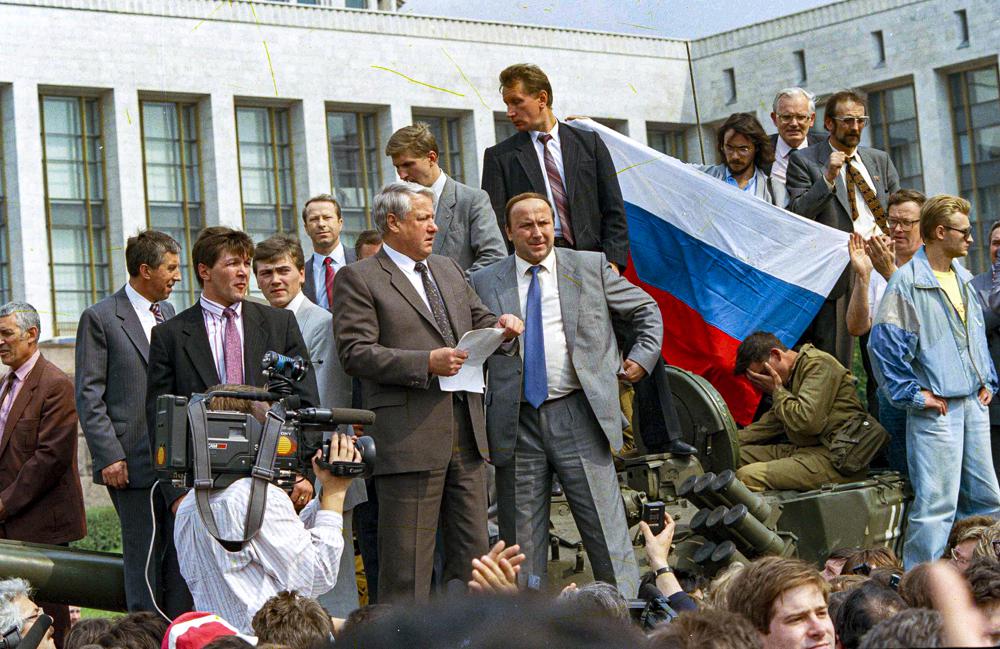
I believe what OP is referring to is actually not a lot of pictures of different tricolor flags, but a lot of pictures of the same tricolor flag, namely the one that was flying at RSFSR President Boris Yeltsin's demonstration at the Council of Ministers building (also known as the Moscow White House) during the coup, as can be seen here. ETA - other commenters have come through with more evidence of other tricolors at protests, so what follows is information about the most widely-photographed flag.
What's interesting about this flag is that it was actually made by artists Konstantin Zvezdochetov and Andrei Filippov for an art installation. Zvezdochetov attended the protests on August 19 and brought the flag along with him (apparently to protect himself from the wind while protesting), and then donated it to the protestors. So it's a little bit of an accident and some artistic coincidence that this flag was at a protest and then prominently used on the barricades, and then captured on video and in photos by the world media.
It's not the first or only time a tricolor flag was used like that as an official protest, however: Gary Kasparov apparently said he would play in New York under a Russian tricolor rather than the Soviet flag in October 1990, but I can't find photographic evidence one way or another as to whether a tricolor was actually used at the chess match in question.
ETA - believe it or not I do have an actual peer-reviewed source for this tidbit, namely Svetlana Boym's Common Spaces: Mythologies of Everyday Life in Russia.