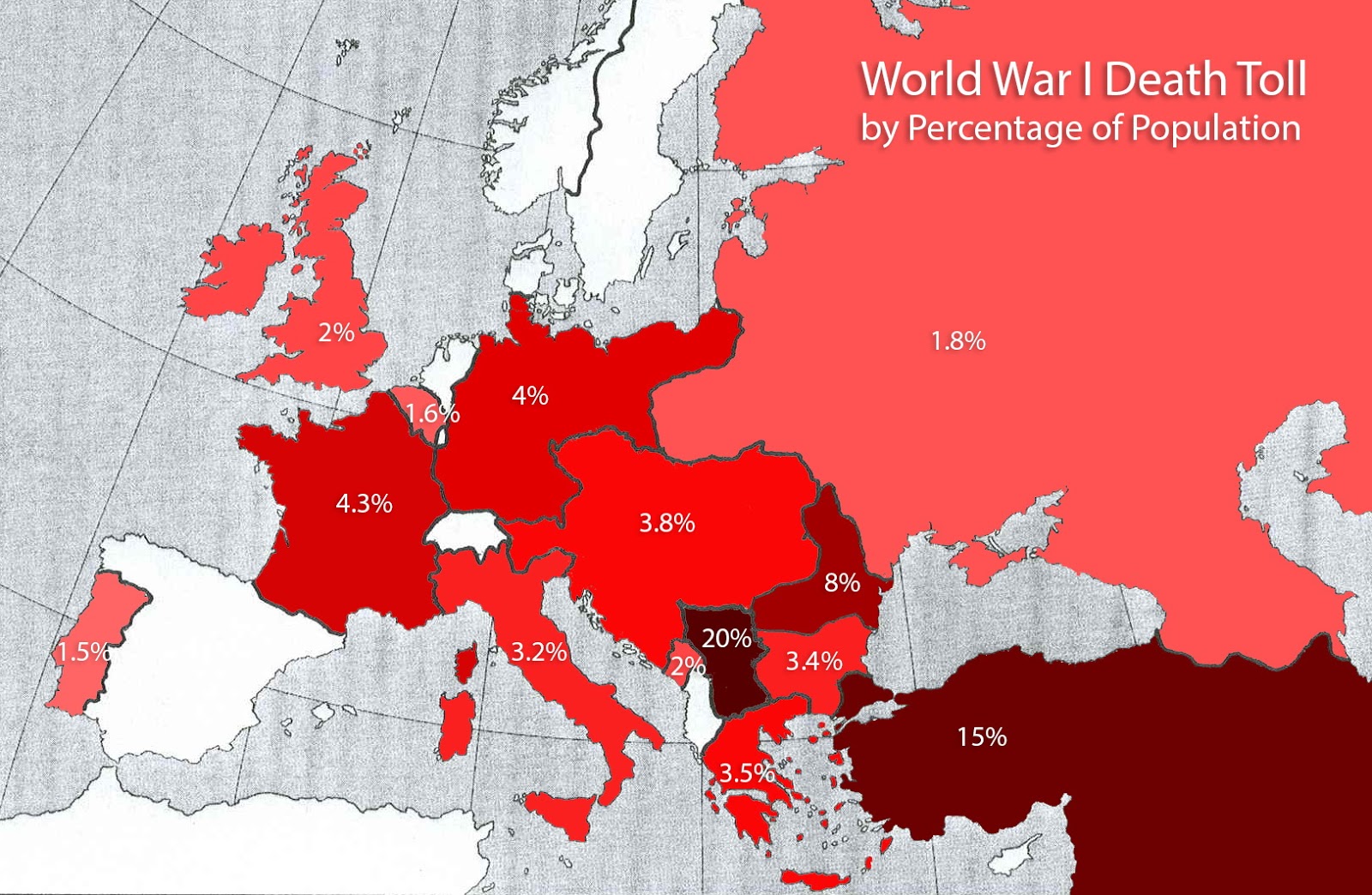
Not sure if this image is correct, but it's the one I'm sourcing my casualty figures from.
I can't speak to Serbia, but the explanation for the Ottoman Empire is very simple if you run through the numbers
To start, the image is not showing only military casualties, rather all deaths. This requires establishing the overall population which is a bit tough. The 1914 Census was based on extrapolation, so not necessarily accurate. The 'official' number was 18,520,016, but estimates go as high as 23 million. The higher seems to actually be more common, but let's just assume the lowest end for our purposes.
To be sure, Ottoman casualties are much less certain than numbers for, say, the United States, but we can at least run through the rough estimates. While not the only estimates out there, I'll use Erickson's estimates, which put the military losses at 305,085 for those killed in combat, died of wounds, or listed as missing, and 466,759 military personnel who died of disease. That gives us 771,844 military dead, which is a high-end estimate (and for our purposes, highest estimate is useful!). This was out of a total mobilized strength of 2,873,000. That is a whopping 27% mortality rate for the military, but still is only 4% of the total population. It is also worth noting that the combat deaths were not far removed from other combatants, but rather it was the deaths from disease and other non-combat related factors which really help to result in such a high mortality rate.
Civilian deaths account for the rest, and can be broken into two groups. The first is Ottoman civilian deaths minus one category which we'll get to momentarily as I believe it should be treated on its own. This number is very imprecise, but generally estimated to be higher than military deaths. I'll arbitrarily round that number then to 800,000, with the caveat that estimates of 1 million or more exist. Pamuk notes estimates for Lebanon and Syria in 1916 alone get as high as 500,000 deaths from starvation. Much of this was a problem which the government created, or at least exacerbated as poor harvest were exacerbated by poor government policy, and shortages unable to be worked around due to the war-time circumstances, with France and Britain blockading Ottoman ports and refusing to make allowances for food shipments. Similarly Metinsoy notes that the refugee columns fleeing Russian advances in eastern Anatolia saw estimates as high as 700,000 whether from hunger, disease, or violence. So as this ought to stress, 800,000 is a very low end estimate - which I'm using mainly just to demonstrate that even the low end estimates get us to a very high percentage - and we could go much higher. Taking all of those civilian deaths at that estimate into account, that now puts us at 8.4% of the total population, but we're missing one more category, namely the victims of genocide.
During WWI, the Ottoman Empire enacted a campaign of genocide against several populations in their borders, most notably the Armenians, but also against other Christian minorities including Assyrians and Greeks. Here, too, numbers are often inexact (and complicated by the fact that some of this took place after the end of the war), but 1 million is a fairly low end estimate for the combined murders, and as before we could easily use a higher number than that (Taking high end estimates and extending to 1923, we're likely over 2 million).
Adding that to our prior total gets us to 13.8%, and again it must be stressed that we're merely picking and choosing our numbers here. I could have decided on 1 million civilian losses plus 1.5m victims of genocide, very reasonably, to bump up to 17.7%, but then I can take the high end population estimate and go with 14.2%. But all of these at least should help place that 15% in context. It isn't a precise number, as it reflects certain decisions on what estimates to accept and what to round to and so on, but it does reflect at the least a decent ballpark picture of the scale of death within the Ottoman Empire in the period. To be sure, it was higher than most other belligerents on its own, but it is particularly high due to the fact they decided to commit genocide against their minority population at that time.
Sources
Erickson, Edward J.. Ordered to Die A History of the Ottoman Army in the First World War. Greenwood, 2000.
Kévorkian, Raymond. The Armenian Genocide: A Complete History. I. B. Tauris, 2011.
Metinsoy, Elif Mahir. Ottoman Women During World War I: Everyday Experiences, Politics, and Conflict. Cambridge University Press, 2017.
Pamuk, Şevket. "The Ottoman Economy in World War I." The Economics of World War I (2005): 112-136.
Shaw, Standford J. "The Ottoman census system and population, 1831–1914." International Journal of Middle East Studies 9, no. 3 (1978): 325-338.
Addendum: As it is likely that the specific number was coming from Wikipedia, as these things often do, I just went to look and see what the numbers used there are on the WWI Casualties page. For total military deaths it gives a range of 325,000 to 771,844, so Erickson is being cited as the high-end estimate here, while the low-end seems to be from a 1924 book, so likely reflects whatever the Turkish/Ottoman governments had been reporting at the time (Erickson has thoughts on those numbers).They break civilian deaths down by military related which includes genocide, and offer 1,500,000 as an estimate, and then deaths by disease and nutrition which are related to wartime conditions which is given as an estimate of 1,000,000. For total population, they seem to be using 21.3m, but no explanation of why that, in particular. This then results in a range fairly similar to our own above, which comes out at between 13.3% to 15.4% mortality rate.
I think it would be more instructive to compare Turkey and Serbia as shown here to much more pink country on your map, Belgium, with 1.6% loss shown. This figure is indeed remarkably low relative to Belgium's neighbors on the Western Front, particularly for how profoundly brutal and traumatic the war and Imperial occupation of the country was.
Part of this comes from how remarkably uninvolved Belgian armed forces proportionally were in the fighting relative to neighbors. In part this is from low levels of mobilization in the first weeks of the war before the occupation worked to prevent more mobilization, but it is also from refusals by Albert I to participate in a number of costly offensives that he ...inaccurately... described as ineffective. Thus, a relatively small number of Belgians in uniform spent a relatively large amount of time not fighting while they sat through more of the war than their neighbors. The proportion of excess deaths in the UK, France, and Germany explained by military casualties varied but was significant. So the relatively lower number of Belgians fighting, leading to a lower relative number of Belgians dying in uniform, has a substantial impact on overall relative excess deaths.
At the same time, as profoundly brutal as the occupation was, at least the kinds of Imperial atrocities that lead to countable deaths tended to be associated with movements and instability in the front. For example, the Rape of Louvain appears to have been sparked by nervous German sentries shooting at each other having been spooked by the noise of a distant and unthreatening Belgian cavalry advance miles to the north. Thus, while the front moved across almost the entirety of Belgium quite rapidly, leading to a dense early cluster of lethal atrocities in the beginning of the war, it then stayed relatively static in Belgium for the remainder. This lead to an occupation that wasn't quiet by any stretch, but was at least organized relative to the intermittent chaos that plagued an occasionally less static front across much of France.
Each of these factors that help explain why Belgium's neighbors had substantially higher population impacts were supercharged in both Serbia and the Ottoman Empire. With notable exceptions, the front was either much more dynamic and fluid than in the West, or worse didn't really coherently exist at all. Indeed, much of the fighting and killing in both countries was related more to civil conflicts and genocides than the broader global war. Rates of mobilization were also much higher, which was both unhealthy for the young men involved and the people they were pointed towards, but also removed them from their farms and the workforce. This created the kinds of active famines that would have come for the west with one more season of fighting.
Note: There is also an important sense in which the example of Belgium relative to its neighbors will be actively misleading. A portion of the low relative figures for Belgium will also likely come from a relative undercount of deaths of refugees. At least 8% of the Belgian population settled in some form overseas somewhere, and their excess deaths from the profound disruption of that and the 1918 influenza pandemic are going to be difficult to confidently estimate.
Since Serbia hasn't really be touched on I'll chime in with what I know about Serbian casualties in WW1. It is important to note that Serbia was a small nation with large mobilization. This provides a partially unique situation for casualties to make up a large percentage of the prewar population. As opposed to large nation, small mobilization (Belgium) and Large nation, large mobilization (Austria Hungary) combatants. Start with the estimation that Serbia's prewar population was 4.5 million, the statistic used by most sources.
A little less than 5 months after the war the Kingdom of Serbs, Croats and Slovenes presented the official national estimates of Serbia’s population losses during World War I. With this estimation from the official source, I can actually tell you *exactly* how so many Serbians died in WW1. Here are the military losses broken down by the Kingdom of SCS:
Military Deaths:
KIA, MIA during the initial, repelled, Austro-Hungarian attack: 172,508
KIA, MIA during the retreat from Serbian Land : 77,455
KIA, MIA during Battles after retreat from Serbia : 36,477
Killed and Died in Captivity : 81,214
Deaths of wounded/sick who could not escape with the Serbian retreat: 34,781
Total: 402,435
Civilian Deaths:
Killed in initial 2 invasions: 15,000
Killed in retreat from Serbia and subsequent return to Serbia: 140,000
Killed by occupying force: 70,000
Killed during forced labor: 80,000
Death by disease: 360,000
Death by famine: 180,000
Total: 845,000
Now, with an estimation of 4.5 million population, this report suggests 27.7% of the population of Serbia died in WW1. One takeaway you may have from this data is disease, famine, and disease again. If you combine all death relating to disease, you come out to 46% of all deaths occurred to disease given the Kingdom of SCS's own report. Now, please keep in mind that the kingdom's estimate only accounts for military personal death by disease *if* they were left behind during the retreat through Albania. However, many Serbian military personal would have died to disease before the retreat and in subsequent recapture as well. in fact, historians Stephen Pope & Elizabeth-Anne Wheal suggest that 65% of **all** Serbian military casualties are from disease and famine. This clearly makes disease and famine the majority culprit for Serbia's large death toll. This devastation of Serbia's population was so noted that the Bulgarian Prime Minister at the time is quoted to have said "Serbia had ceased to exist".
Now, the New York Times said half of Serbia perished in 1918. Serbia's own report states 27.7% of Serbia perished, this map says 20% of Serbia perished, whats the catch? Well, nobody really knows exactly how many people died in Serbia during World War 1, but it is somewhere around 20%.
Essentially, the Serbian government estimated a population for Serbia in 1919 if the war did not happen, and subtracted the actual 1919 population to show the total amount of deaths during WW1, that is the figure I have discussed. However, the population estimate for 1919 Serbia (5.2 million) is dubious at best. Here's an excerpt from a great statistics paper by Biljana Radivojević and Goran Penev; " the question remains of the basis on which it is presumed that Serbia would have had 5.2 million persons by 1919 in normal, peaceful circumstances. If the estimate is true, it follows that in the period of August 1914 - March 1919 the ‘normal’ population growth would be 700,000 persons, and the average annual growth rate would be a very high 31.5 per 1,000. As an example, the average annual rate of population growth of former Northern Serbia in the period 1895-1910 was only 15.5 per 1,000, and in the period of 1905-1910 it was 16.1 per 1,000."
If you are interested in the statistics of how a 27.7% estimate gets knocked down to a more modern, moderate estimate of 20%, please give the paper a skim. However, that was not your question, your question was why. Which boiled down neatly into the response of, low population, high mobilization, disease, famine, and more disease. In fact, the Serbian Typhus pandemic is considered the worst in world history as claimed by the New York Times.
Sources:
Report of the Delegation of the Kingdom of Serbs, Croats and Slovenes at Paris Peace Conference 1919-1920
DEMOGRAPHIC LOSSES OF SERBIA IN THE FIRST WORLD WAR AND THEIR LONG-TERM CONSEQUENCES, Radivojević, Goran Penev
https://timesmachine.nytimes.com/timesmachine/1915/10/29/105045220.pdf
https://timesmachine.nytimes.com/timesmachine/1918/11/05/98273895.pdf
The Dictionary of the First World War, Stephen Pope & Elizabeth-Anne Wheal, 1995