In Alex Vitale’s The End of Policing, he makes the following claim about early 20th century America:
“There was also a widespread fear in the South that blacks on cocaine had superhuman strength and couldn’t be stopped with .32-caliber bullets, then the standard police issue, prompting the widespread adoption of .38-caliber bullets.”
He doesn’t provide a citation. Does anyone know if this is historically accurate and can provide a source? Thank you!
Back very briefly - hopefully I'll finally start having some more time off to finish up a couple questions and get back into the rotation sometime soon.
But as far as the reference, shame on Vitale for lifting it wholesale from the late, great David Musto with neither context nor footnotes, inflating it past what Musto writes, and most importantly for not chasing the footnotes the later provides to see if he could come up with a more robust set of supporting documentation.
Musto was a pioneer in writing on the history of controlled substances who had slightly less success when he ventured over into policy making. His major work is The American Disease: Origins of Narcotic Control, where the passage referred to comes from a chapter on cocaine and why it went from being an ingredient to a controlled substance.
The actual quote and context from page 7 of Musto is this:
"If cocaine was a spur to violence against whites in the South, as was generally believed by whites, then reaction against its users made sense. The fear of the cocainized black coincided with the peak of lynchings, legal segregation, and voting laws all designed to remove political and social power from him. Fear of cocaine might have contributed to the dread that the black would rise above "his place," as well as reflecting the extent to which cocaine may have released defiance and retribution. So far, evidence does not suggest that cocaine caused a crime wave but rather that anticipation of black rebellion inspired white alarm. Anecdotes often told of superhuman strength, cunning, and efficiency resulting from cocaine. One of the most terrifying beliefs about cocaine was that it actually improved pistol marksmanship. Another myth, that cocaine made blacks almost unaffected by mere .32 caliber bullets, is said to have caused southern police departments to switch to .38 caliber revolvers. These fantasies characterized white fear, not the reality of cocaine's effects, and gave one more reason for the repression of blacks.
Musto footnotes this section with two 1913-1914 articles, "N.Y. Times, 8 Feb. 1914; Med. Record 85 : 247-49 (1914)". A bit of digging reveals them to basically be the same "The Drug-Habit Menace in the South" article, written by one Edward Huntington Williams, M.D. - of New Jersey - that can be read here and here (the latter requires you to scroll up to page 247.)
I won't comment much on the article besides saying that it is both 1) a relic of its times both racially and medically (reading pre-1945 medical journals is always...interesting) 2) relies on yet another, even shakier bit of 'scholarship' - an 1897 "Cartwright Prize Essay" for 1897 by one Dr. Crile on cocaine's physiological effects 3) does note that the .38 was the standard issue Army and Navy sidearm, and as Musto himself argues in his next footnote 4) can even be read as more of one of a series of anti-Prohibition rather than anti-Black tracts by Williams that offered a doomsday scenario for what Williams called the "problem (of) the control of the Negro" would turn into if alcohol were eliminated and they sought out a different source of intoxication.
Now, all that said, was there likely fear of cocaine's effects on African Americans in the turn of the century South and interest in increased caliber weaponry by its law enforcement? Yep, and there's some history there too of how new drugs often do so; one example is that in the early 1990s this fear had migrated to PCP, which became the new bogeyman for superhuman strength. This 1991 LA Times article gives a pretty exhaustive contemporary view, for instance (and as a bonus includes the Musto quote.)
But was it fear of cocaine alone that caused the upgrade, and was it "widespread"? That's a lot more questionable, it called for more research before Vitale should have been using it in that fashion, and it's something that makes Vitale's claim here - at best - extremely sloppy, and at worst it hints at leaving out the context deliberately since he couldn't find a better supporting piece.
I've traced back references as far back as I could go and the main source seems to be a 1914 New York Times article by Edward Huntington Williams, M.D.
Before I go on, I should mention it is true that despite fairly widespread use of cocaine in medicine at the time and even its presence in Coca-Cola, there were worries about cocaine as an addiction and connecting it to African-Americans in particular: a June 1900 issue of JAMA opined about "a new form of vice -- that of 'cocaine sniffing' or the 'coke habit'". From a 21 June 1903 statement in the New York Tribute by Col. Watson of Georgia:
...many of the horrible crimes committed in the Southern States by the colored people can be traced directly to the cocaine habit.
It was sometimes just attached to criminality more generally, as in a 1907 report from the National Prison Association of the United States:
The habitual use of no other drug has a more injurious effect upon the nervous system than that of cocaine, nor does any other drug, so sued, with the exception of morphine, seem to be a more prolific cause of crime...
A 1914 claim made the police chief in Atlanta blamed "70%" of crimes on drug use (this number -- and the other assertions -- have no foothold in accuracy but were accepted wisdom at the time).
Going back to the Dr. Williams article, here is where the claim seems to have sprung up from:
He tells a story of Police Chief Lyerly of Asheville, N.C. There is an incident where he comes to arrest an African-American in a "cocaine frenzy" who attacks with a knife; the chief tries to shoot him in the heart, "intending to kill him right quick." However, the shot -- and second -- were reportedly unsuccessful in subduing the attacker, and he the chief switched to using his club.
The following day the Chief exchanged his revolver for one of heavier caliber. Yet the one with which he shot the negro was a heavy army mode, using a cartridge that Lieut. Townsend Whelen, who is an authority on such matters, recently declared was large enough to "kill any game in America."
The article then goes on to explain how other officers have switched to higher caliber guns for similar reasons.
While the "heavy army model" is not a specific description, it could not by any stretch of the imagination be applied to the .32 model.
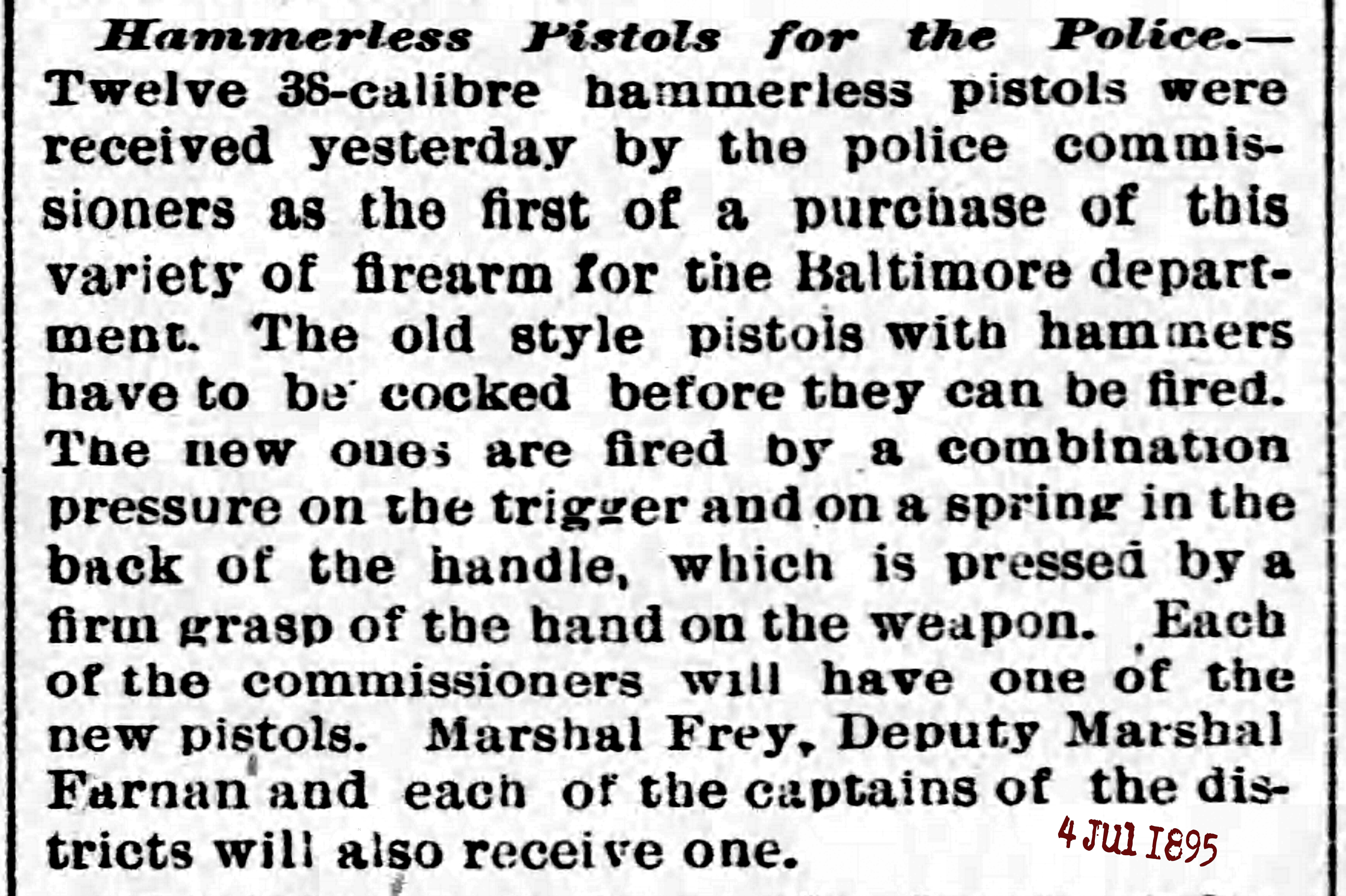
So how did it get associated with those specific calibers? A .32 was relatively common with police around this time, and this is roughly around when departments starting getting .38s -- Baltimore got their first in 1895, and the NYPD switched to .38 when the Colt Police Positive came out in 1907. So it is possible this tale got mixed with the gun switch, but even if the first part of the story is taken at face value -- given the circumstances, the reliability is questionable -- it is clear those aren't the two calibers being referred to, and the second part at face value simply indicates switching weapons with one that is already available, not departments making special orders specifically because of concerns over cocaine.
So, there was still plenty of racism to be found in police actions at this time, especially in the South, but in this particular case: the story of officers swapping their type of weapon got merged with the true event at the time of police buying new weapons (especially with the Colt Official Police revolver coming out), forming the myth.
...
Musto, D. F. (1999). The American Disease: Origins of Narcotic Control. Oxford University Press.