We see lots of accounts from the Greeks. Do we have the Persian side of the story?
Unfortunately, the simple answer is a big, fat "Nope." The Achaemenid Persians were apparently not big fans of writing down war stories. There are a few exceptions, namely the Behistun Inscription of Darius I, but not about the wars in Greece. To some degree, this is not very surprising, given that the conflicts with the Greeks were not overwhelming successes for the Persians. The few Persian descriptions of war that do exist, are celebrating victory over rebels, not chronicling defeats. That said, I should at least acknowledge that we know the Achaemenid kings did maintain annual chronicles, but only a small fragment from Artaxerxes III has been found.
What we do have, is a few indirect allusions and references to war with the Greeks. These primarily come from a collection of fragmentary administrative records known as the Persepolis Fortification Archive (PFA) and the Persepolis Treasury Archive (PT), as the names suggest they come from two separate store rooms at the Achaemenid palace complex of Persepolis. The surviving documents are largely written in Elamite Cuneiform on clay tablets, and represent records from about 509 - 457 BCE. Unfortunately for anyone interested in Greek affairs, they mostly record day to day transactions at Persepolis, far removed from war in the Aegean. However, there a few notable instances of evidence from the west making its way into the Persian core.
For conveniences sake, I''ll just use the Greek version of personal names when we know them. If you're interested in how we can mix and match the Elamite translation of a Persian name and Greek translation of a Persian name, without actually having the Persian name in writing, that would probably be a separate question.
One is a seemingly innocuous receipt from the time of the Ionian Revolt (BAR is a unit of volume just shy of 10 litres):
32 BAR of grain, supplied by Ashbashuputish, Shedda the [regiment commander] at Perspolis for whom Abbateya sets the apportionments, received, and gave it as [rations] to post partum Greek women at Persepolis - irrigation workers - whose apportionements are set by Abbateya and Mishabadda... 12th month, 22nd year. (PFA 1224)
As I said, relatively innocuous on its face. It's just a typical receipt for rations in the typical style of the Persepolis administrations, but on further inspection the workers in question and the timing are relevant. The only "22nd year" in the PFA is under Darius and the 12th month in the Persian calendar would be February-March. So we're looking at early 498 BCE, right in the early days of the Ionian Revolt. While there is an ongoing Greek revolt, we also happen to have recently pregnant women put to work on irrigation, the back breaking labor of digging canals.
Post-partum rations appear regularly in the archive, but his kind of labor does not. We know from several instances in Herodotus' Histories that the Achaemenids used deportation to deal with rebellious Greeks on several occasions, and both Herodotus and accounts of Alexander the Great's conquests say that some of those Greeks ended up in southern Iran. They also seem to have been under the authority of a military commander - Shedda - rather than the regular administrators.
It's very likely that these women were prisoner's of war put to work on hard labor - I hesitate to call them slaves only because this forced labor seems to have been a temporary punishment rather than permanent bondage. And in a morbid note to quote from Encyclopedia Iranica "...it must be doubted whether the children they had borne were the offspring of husbands."
Darius' Palace at Susa also contains hints at these events:
The cedar timber, this was brought from a mountain named Lebanon. The Assyrian people brought it to Babylon; from Babylon the Carians and the Greeks brought it to Susa. (Inscription DSf)
This example is more tenuous. It's entirely possible that these are Carians and Greeks who had emigrated to Babylon of their own accord. On the other hand, Caria (the inland region of southwestern Anatolia) and the Ionians were in active revolt at the same time that Darius was building this palace, and Herodotus specifically states that some of the deportees were sent to Susa. We even have evidence of loot from the Ionian Revolt in Susa too. A huge inscribed bronze weight from the oracle of Apollo at Didyma - sacked by the Persians in 494 and 478 -was stored in the Susa treasury.
Another example from the PFA contains a more direct connection to Darius' wars with the Greeks, an actual reference to Datis the Mede who commanded the Persian army at Marathon (1 marrish is apparently equal to 1 BAR):
Datis received 7 marrish of beer as rations. He carried a sealed document of the king. He went froth from Sardis expressly, [and] went to the king at Persepolis. 11th Month, 27th year. (PFA Q-1809)
While the surviving Greek sources only really remember Datis from his role in the Marathon campaign, he was commanding an army and couldn't have come out of nowhere. This tablet describes how Datis was at Sardis in late 494/early 493 right at the end of the Ionian Revolt and rushed to Persepolis, apparently using the famed Persian system of courier stations, to deliver some report to Darius. Given that we know he was a military commander and he was coming from an active front, it's likely that his was some kind of report.
In a similar passing reference to an individual at Persepolis, the Treasury Archive also makes passing reference to one of the Persian commanders: (karsha and shekel are units of weight, ~83 and 11 grams respectively):
By the hand of the administrator the workmen [who are] entitled to receive wages, [and for whom] Megabates the admiral is responsible, have received 14 karsha and 6 shekels, silver, for wages. The king commanded it. (PT 8)
So here we have a reference to Megabates. There's no year associated with it, but the earliest date in the Treasury Archive date to 492 BCE. The name Megabates appears a few times in in the context of naval commanders. In Herodotus the name is used for the Persian admiral at Naxos in 499 and the father of the admiral Megabazus in 480. Diodorus Siculus and Strabo both identify an active Persian admiral under this name in 480. In Aeschylus' historical fiction play The Persians, he identifies a Megabates as an admiral who died at Salamis. "Megabates the admiral" was apparently a longstanding presence in the wars with the Greeks, but also had a household or staff back in Persia.
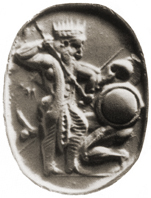
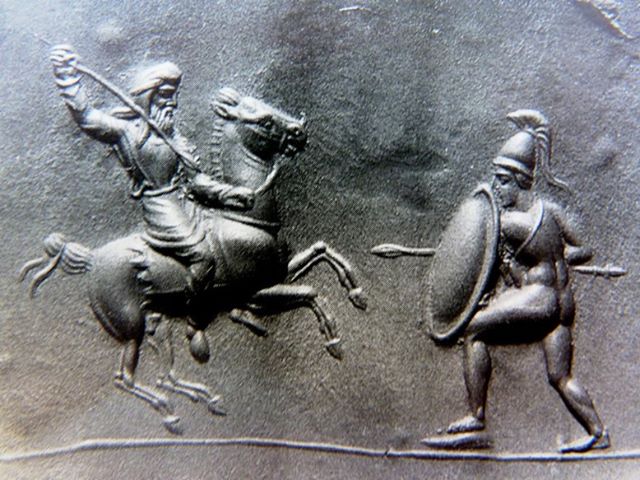
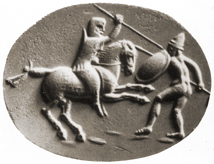
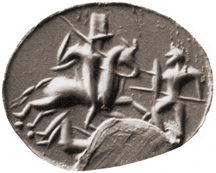
The other great source of Persian "records" of their wars with Greeks comes from artwork. I wouldn't say it was a favorite motif, but it certainly wasn't uncommon. Several Persian seals have been found depicting a victorious Persian king/noble killing Greek-style hoplites. Examples include stabbing a kneeling hoplite, stabbing a fallen hopolite, and stabbing a different kneeling hoplite. Similar seals were even produced by Persian/Iranian artisans in Anatolia for Greek buyers, usually showing the Greeks in "heroic nudity" against formidable Persian cavalry: version A, version B, version C.
One of the more famous examples of a Persian battle scene even depicts conflict with the Greeks, though probably not from the "Greek Wars" you're thinking of. The Altıkulaç Sarcophagus was found in northeastern Turkey and depicts a scene of a Persian rider bearing down on a fallen Greek peltast. It dates from the early 4th Century BCE and could correspond to any of three Greek incursions into Anatolia during that time frame.

.jpg)