In Peanuts, the short lived character 555 95472, along with his sisters 3 and 4, was a victim of their dad's frustration at how everyone was being numbered, and their dad decided that if everything was going to be numbered anyway then they may as well take on their zip code as their last name and numbers for first names. (It's funnier in the strip.) Did people really have strong feelings about the institution of zip codes? Was this part of a larger trend of things being numbered (area codes, ID numbers, Idunno...)? Or is it just another contextless Peanuts joke like the kite in the tree?
Out of the various appearances of the characters 3 and 4 (sisters to 5) the most significant for the story is perhaps from the second day they were in the comic strip, October 18, 1963, which simply shows Snoopy atop his house thinking as the sisters walk by. From the first two of the four panels:
Here come those little two girls with the funny names ...
"3" and "4"
We'll get back to the last two panels at the ending.
...
While the ZIP Code in full was introduced in 1963, the concept of numbering to assist with delivery was around in the United States much earlier. In 1895, using a circular letter, the Postmaster in Chicago encouraged those sending mail to add the carrier's number or postal station number to their letters for faster service; thousands of people complied. However, this never caught on past the city.
More comprehensively, WWII introduced the idea of adding numbers to mail, as service serial numbers were added to addresses for soldiers, and on May 1, 1943, 124 of the largest post offices in the country were given zone numbers, and the districts within those zones had their own one or two digit numbers. A campaign was run encouraging those sending letters to put the numbers, and it was reported
Excellent cooperation was had from large mailers and the public, and the plan already has shown pleasing results.
However, this system went no farther, being restricted to large cities, so not nationwide. It still counted as a proto-ZIP-code system.
The increases in both wealth and population post-WWII led to a jump in mail volume (doubling between 1943 and 1962) and a new nationwide system was urgently needed. The Philadelphia Postal Inspector Robert Moon had long advocated for a system, and he managed to get the attention of Postmaster General Edward Day.
Day consulted with AT&T (who had their own problems getting people to use area codes) and found encouragement in West Germany, which had an 80% adoption rate after its first year. Importantly, the adoption was accompanied by a advertising campaign, so Day decided to do the same.
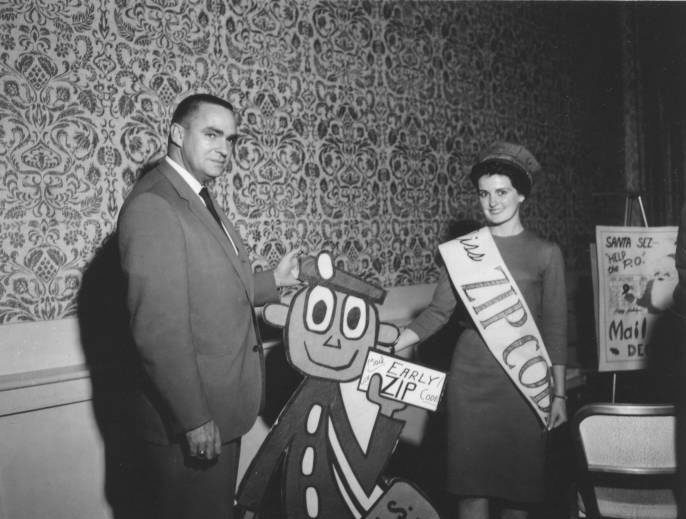
Hence: the birth of Mr. Zip. He had first appeared several years earlier (designed by Harold Wilcox) in a bank-by-mail campaign of Chase Manhattan, and was bequeathed to the Post Office at no cost.
Mr. Zip was introduced before the ZIP Code even started, at a postmasters convention in October 1962, and his cartoon image was used in a large variety of post office mailings and public service announcements, like one which featured the actor and musician Johnny Puleo, a dwarf who played harmonica, did pantomime, and played Max in the 1956 movie Trapeze alongside Burt Lancaster and Gina Lollobrigida.
Here is the one-minute ad in full.
As Johnny Puleo strongly suggests, use ZIP Code on all your mail.
Remember, only you can put ZIP in your postal system.
Mr. Zip showed up in jewelry, toys, and magazines. Ethel Merman sang about the ZIP code to the tune of "Zippity-Doo-Dah". People dressed in Mr. Zip costumes. 1963 also saw the crowning in various parts of the country of Miss Zip Code.
The Post Office was right to pull out all the stops, because people were originally worried: an initial poll had 75% of people concerned. The campaign eventually worked, as by 1966 2/3 of the US population polled thought it was a "good idea" whereas in 1969 this came up to 90%.
But still, even in 1969, there was the 10% of holdouts. What were they (and the people before) thinking?
Both postal workers and the general public had issues. Some workers found Mr. Zip goofy ("held up to public ridicule") and the ZIP code itself as a threat to jobs ("Remember the good old days when Postal Employees were respected people and friends to those they served?")
The second point is important, in that increasing volume meant quite naturally decreasing personalization. The image of a postman in the 1950s was connected to small-town America, and the rise of machines did add an element of depersonalization.
Amongst the public, some people just didn't want another number to memorize, with one upset correspondent writing
The Pony Express would be more efficient and much desired to take letters to towns close by.
The feeling of depersonalization is why the post office put so much effort into explaining how the system worked, that it indicated places and it no way removed the individual. This included a nearly 15 minute (!) promotion of the ZIP Code system by the "Swingin' Six", which you can watch here if you have time, and want to be boggled by the raw power of the 1960s.
The first digit tells me what part of the nation your letter will find its destination.
Since the country’s divided into ten big sections,
each with a number to establish direction, before your letter has even departed, we’ve already got it started.
The next two digits go hand in hand, to a major post office over land.
Since each big section has town after town…
we need these numbers to really narrow things down.
We’ve got the section, we’ve got the city, just two more numbers and we’re sitting pretty.
These last two digits are really specific. They’re your local post office number.
Terrific!
In the most extreme cases, citizens claimed the ZIP code was un-American or a Communist conspiracy. This is where the Snoopy comic comes back in. The concern was that the ZIP code would be carried on, not just to places, but to people, to an extent that people would be cogs in the system, manufactured, no longer with "rugged American individualism". Thus, Snoopy muses:
Numbered children ... Fantastic ...
The next thing you know, kids won't be born ... you'll just have to send in for them!
However, objections eventually faded away, and Mr. Zip was finally retired in 1986.
...
You can hear Ethel Merman at this page from the Smithsonian's National Postal History Museum. They also have more pages about Mr. Zip including a lunchbox and board game, and I pulled quotes from the "Response of the American Public" page.
Gill, A. (2016). Zone Improvement Plan: The Story of Mr. Zip. Postal History, (165), 7.
Scheele, C. (1970). A Short History of the Mail Service. Smithsonian Institution Press.
USPS Office of Inspector General. (2013). The Untold Story of the ZIP Code. Report Number: RARC-WP-13-0062013.